


Published work / SITUS
COACTUS
The gravity of invisible forces and the cells of refuge in the painting of Maurizio Valch
- Medium
- Pintura
- Size
- 31.5 × 47.2 in / 80 × 120 cm
- Series
-
SITUS
 Painting series
SITUS
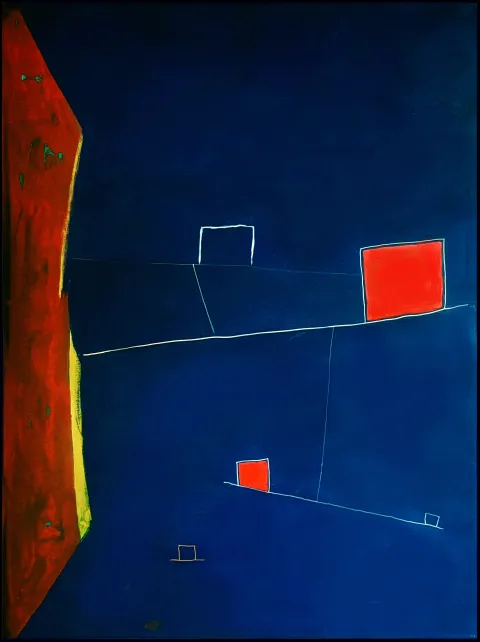
SITUS brings together abstract paintings in which the position of a form, the distance separating it from another, and the activity of empty space construct a territory of relations. Maurizio Valch works with lines, edges, shifts in level, and fields of colour as conditions of presence rather than signs within a closed narrative. View series
- Orientation
- Vertical
- Context studies
- 9
Conceptual Note
To contemplate "COACTUS" is to stand before a cartography that does not seek to describe the earth, but rather to register the invisible forces that sustain it. In this canvas by Maurizio Valch, space is not offered as a passive void, but as an accumulation of pressures, a stratification of weights and tensions where each block of color seems to be fighting a silent battle against its own collapse.
First Movement: The Upper Celestial/Terrestrial Stratum
At the crowning of the painting, a thick, turbid mantle of dark brown and ocre compresses everything. This is not a transparent sky; it is a heavy, almost geological atmosphere, leaning over the horizon like a roof threatening to collapse.
To understand this boundary, it is essential to summon Ailton Krenak, an indigenous Brazilian thinker who teaches us to postpone the end of the world through the art of storytelling and of maintaining a living, ritualized relationship with the earth. From his perspective, the sky is not a celestial abstraction, but a living heritage requiring our care so as not to fall upon our heads. The large upper brown block of "COACTUS" embodies that danger: a gravity-laden firmament pressing down on the blue slope below.
Right on that dividing scar, defying the oppression of the ocher, sits a decisive red quadrant. Is it a sunset captured in a geometric box? Is it a block of fire heating the edge of the world? Krenak would see in this red rectangle one of those "domes of resistance," a device of warmth and memory that prevents the upper darkness from completely swallowing the blue. It is a brilliant warning reminding us that where the sky grows heavy, the earth's response must be a pulse of ignited light.
When I stood before the blank canvas, before these forms existed, I was obsessed with the fragility of balance. I remember the trembling pulse of my hand as I traced the extremely fine lines that now cross and divide the great blue mass. I felt that if those lines deviated by a single millimeter, the enormous weight of the upper brown block would fall, crushing the small compartments of color. I wanted those almost invisible incisions to hold a real physical tension, like tension cables preventing the painting from crumbling under the pressure of its own atmosphere.
Second Movement: The Blue Slope and the Refuge Cells
Beneath the border of the ocher sky, an immense slope of deep blue unfolds to dominate the composition. It is not a flat blue; it has the density of night or wet clay. In this sloping territory, space is organized through thin lines that segment the surface, creating small niches where yellow, black, and light blue blocks are embedded.
This is where the perspective of Hassan Fathy—a pioneering Egyptian architect who championed the use of adobe and mud to return to communities the power to build their own thermal and human shelters—acquires its full meaning. Fathy understood architecture as an organic extension of the soil, a play of shadows and ventilation to humanize the desert. Observing the blocks of "COACTUS," one cannot help but wonder if these forms are not, in reality, minimal dwellings sculpted into the slope of the world, windows of a vertical village seeking shelter from the cosmic elements.
However, these cells do not dialogue with space in the same way. This forces us to ask: What kind of silence is breathed inside that central black cell in comparison to the yellow block on the far left? While the yellow on the periphery seems to radiate the last light of a hot day, the black cell absorbs every gaze, becoming a well of absolute muteness, a space of retreat where the body hides from the world.
If these thin lines were not borders, but seams trying to keep the painting from tearing, what is pulling on each side? On one side, the inertia of weight and gravity dragging everything downward; on the other, the stubborn will of these small blocks of color to remain suspended on the slope, resisting sliding into the abyss.
Now that I see the finished work, detached from my brushes and framed in its black border, I experience a strange estrangement. I notice that those who observe it tend to look for maps, shelters, or habitable architectural structures, attempting to domesticate its mystery. But for me, there is something in it that completely escapes me: a silent vibration in the transition from blue to the lower red that I did not consciously plan, an internal disagreement between the rigidity of the geometries and the fluidity of the pigment that belies any promise of a safe haven.
Third Movement: The Base of Gravity
Upon reaching the base of the painting, the deep blue yields to a band of dark, earthy reddish tones that ground the work. It is the final floor, the bed where the painting's tensions die. On this base, cornered in the lower right, dwells a tiny blue cube, textured with subtle vertical brushstrokes that give it an almost tactile quality of mineral or dense fabric.
This tiny cube holds a monumental poetic tension with the rest of the work. It poses a final question: What does an inhabitant of the small blue cube below see that the large upper red rectangle can never understand? From its humble position, the small blue cube experiences the accumulated weight of the entire painting, the pressure of the upper slopes, and the density of the earth beneath its feet. It understands the fatigue of the ground and the value of staying upright at the lowest point. The large upper red rectangle, suspended on the border of the sky, only knows altitude and dry heat; it is unaware of the silent effort of gravity that the blue cube must metabolize every second so that the painting does not lose its axis.
"COACTUS" is not a static work. It is a thermal system where the cold blue of the slope rubs against the dry heat of the red and yellow blocks. As we look away from the painting, we are left with the physical sensation in our bodies of having contemplated a sacred and vulnerable territory that, through its seams and its small cores of color, continues to actively fight against breaking.