Context study / COACTUS
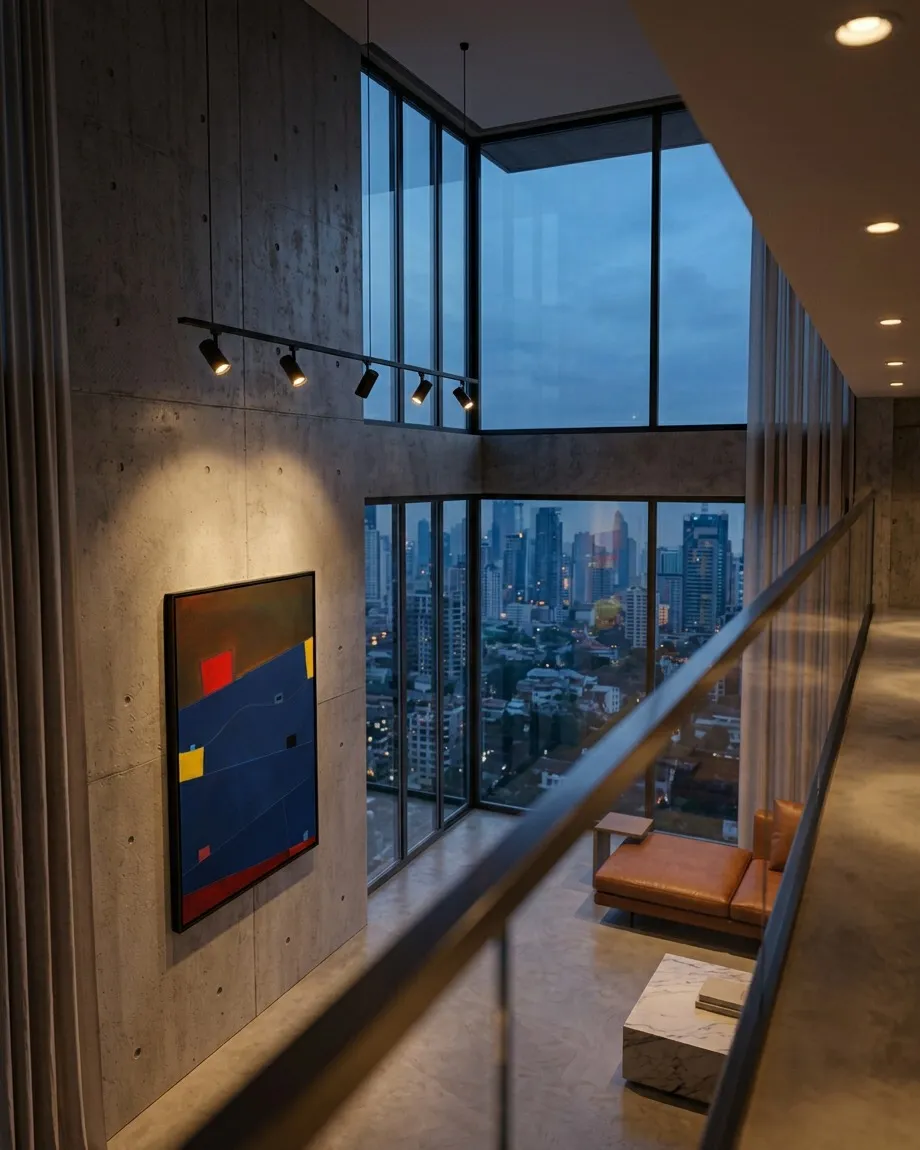
COACTUS Abstract Painting by Maurizio Valch in Industrial Loft
The gaze plunges into COACTUS (2023) from the upper ledge, where a dense twilight exerts an implacable gravity over the pictorial plane. In this first stratum, the dark crown is no mere emptiness; it is a charged atmosphere, a field of invisible pressures pushing downward. Suspended at this threshold, a large block of reddish and orange tones seems to float and, at the same time, sink. How does the weight of that great dark upper mass feel in the body compared to the apparent weightlessness of the central blue? The contrast generates an almost tactile vibration on the retina. One wonders: is the large red block a warning, a source of heat, or an intruder that has just fallen into the blue? Its presence alters the climate of the entire canvas, acting as a center of thermal mass that threatens to disrupt the equilibrium of the surrounding void.
When I placed that large red block at the top, I felt an almost physical vertigo, a hesitation that forced me to take several steps back. It wasn't simply a decision of color; it was a weight imposing itself on the canvas with its own gravity, claiming a space whose internal logic I didn't fully understand, as if the painting demanded a tension that I only had to witness and allow.
As the gaze descends, the pressure eases and we enter the territory of boundaries. Here, the blue unfolds in terraces defined by thin lines that wave subtly, suggesting a geography of containment. In this intermediate strip, the work dialogues with the sensibility of Charles Darwin, an explorer of invisible transitions who understood nature as a constant negotiation for survival in hostile environments. From his perspective, the small blocks of color—a yellow flash on the left, a black core and a lighter incision on the right—are not decorative accidents, but organisms highly adapted to their niche. They have mutated to occupy the exact margins where the pressure of the blue plates is tolerable.
To this observation is added the sharpness of Elinor Ostrom, a thinker with the astonishing lucidity to understand how human beings cooperate and draw boundaries to protect what belongs to everyone without destroying one another. For her, these dividing lines act as the boundaries of a common good. The canvas is not a space of conquest, but a shared ecosystem where the colors have negotiated a balance of peaceful coexistence. But this order is fragile. If this canvas were a map of a shared resource, who is consuming whom? What would happen to the temperature of the paint if the small yellow block on the left decided to slide toward the center? The slightest shift would unleash a collapse in the chain of tensions sustaining the composition.
Finally, the visual journey reaches the sediment, the base where all the accumulated weight finds its support. The blue, after traversing the upper terraces, rests on a lower red strip that acts as a burning sole, a stratum of friction and teluric resistance. However, in the lower right corner, a small dark block clings to the edge of the canvas, like a last vestige refusing to be assimilated by the tide pressing upon it.
When looking at the finished work, my eyes always end up searching for that small block in the lower right corner. That fragment taught me that the painting has its own silent will; it is a loose end, a pocket of resistance that contradicts the apparent stillness of the rest of the canvas and remains, even for me who saw it born, an indecipherable mystery.
Is this sediment the announcement of a new cycle of pressures or the true foundation holding the painting in suspense? The permanence of this visual system remains suspended in the air, inviting the body to experience the coldness of the blue and the latent pulse of the red, reminding us that on the surface of COACTUS nothing is static, and that balance is only a temporary truce in a conversation that never finished being deciphered.
- Original artwork
- COACTUS
- Actual dimensions
- 31.5 × 47.2 in / 80 × 120 cm
- Presentation
- Digital contextual visualization
Context references
large abstract paintings for living room · decorating with contemporary art · designer lofts with paintings · blue and red abstract painting
About this visualization
This visualization places the artwork within an architectural context to help collectors and viewers imagine its presence in a real space. It is an interpretive reference, not an exact reproduction: the original work remains the sole authority for scale, color, surface and material presence.