Context study / COACTUS
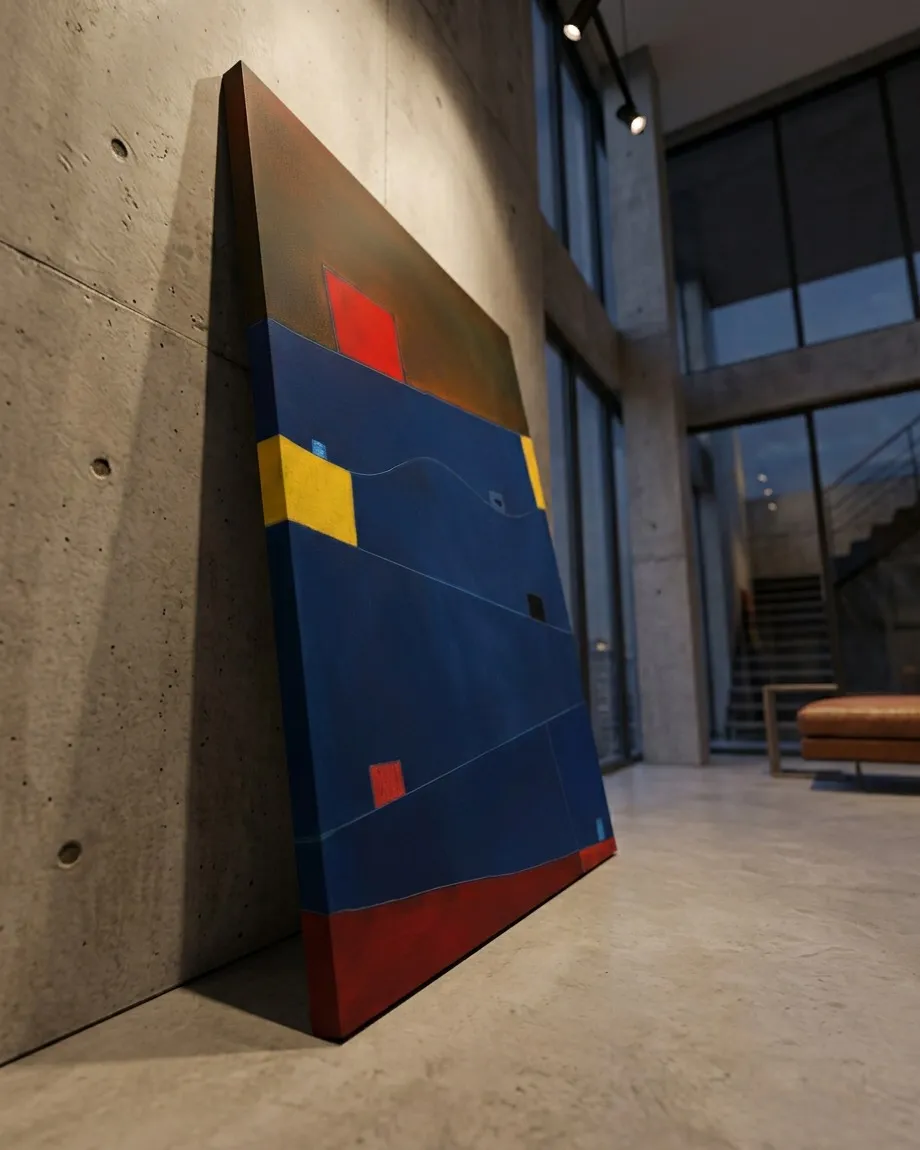
COACTUS canvas leaning in brutalist space | Art by Maurizio Valch
The base of the canvas rests on a dark red ground, a strip of chromatic earth supporting the weight of everything that rises. Upon this base, enormous masses of an abyssal blue unfold, arranged like tectonic plates that overlap and tilt slightly, defying pure orthogonality. The divisions between these masses are not iron borders, but lines of an improbable fineness, almost invisible incisions holding tremendous static pressure. They force us to ask: does the color blue have weight when it meets a line as thin as a thread? To understand this lower plane, it helps to evoke the gaze of Yasujirō Ozu, the Japanese filmmaker who, through his tatami shot at the eye level of someone sitting on the floor, taught us to contemplate the sacred quietude of the everyday and the imperceptible transition of time. By adopting that low, paused scale in front of the work, the abstract monumentality of the canvas is transformed into an intimate and twilight room; the inclined lines cease to be mere geometric vectors to become the subtle decline down which the gravity of the hours slides.
In the midst of that blue immensity, the quietude is interrupted by small geometric incidents: a yellow block pushing the left boundary, a tiny suspended black square, and a red fragment floating near the ground. This is where the intuition of Jorge Oteiza intervenes, the Basque sculptor whose obsession with the emptying of space and the energy of vacant forms reveals how a limit can be activated by pure absence. For Oteiza, these small squares are not ornaments on the canvas; they are active forces that empty the blue, voids that suck in the density of the paint so that the plane can breathe.
When I leaned my brush to trace that small yellow rectangle on the left and the tiny textured blue fragment at the bottom right, I felt the weight of a decision that was not entirely mine. There is a moment in the studio where the pulse trembles not from lack of precision, but from the suspicion that these small chromatic anomalies are the only stitch points preventing the large blue block from collapsing on itself, or rather, the only slit through which that blue tries to breathe and escape its own density.
Toward the top, the dense, nocturnal blue yields its sovereignty to a stratum of brown and earthy tones, a dense atmosphere that seems to float like smoke or suspended dust over the geometric landscape. On this uncertain boundary, a large red plane, off-center and slightly inclined, crowns the composition like a square sun or a cooling block of fire. If we could hear the difference in temperature between the large upper red block and the small blue square below, what would be the musical interval separating them? It is a dissonant and tense chord, a dull vibration resonating between the upper edge of the atmosphere and the lower abyss.
As I approached the upper limit, where the dense blue collides with the earthy, brown atmosphere, I suspended that large red plane like a warning or a half-open eyelid. I must confess that in the vibration of that border, in the way the oil and the matter merge into a dirty twilight, something escaped my hands; it became an autonomous threshold whose true temperature and depth I myself, even today, cannot fully decipher.
What ultimately prevails on the surface of the work is that which eludes the gaze. At the intersection of Oteiza's spatial emptying and Ozu's intimate, silent scale, the painting reveals itself as an in-between space. Is this painting a map of memory or a wall preventing us from seeing what lies behind? There is no definitive answer in its stratified planes. The viewer is left before the canvas, stripped of analytical certainties, holding only the physical sensation of a suspended gravity, the echo of an ancient silence, and that zone of absolute mystery that the painted matter reserves for itself.
- Original artwork
- COACTUS
- Actual dimensions
- 31.5 × 47.2 in / 80 × 120 cm
- Presentation
- Digital contextual visualization
Context references
decorating with floor leaning paintings · art for exposed concrete wall · minimalist brutalist interior design · large size paintings for lofts
About this visualization
This visualization places the artwork within an architectural context to help collectors and viewers imagine its presence in a real space. It is an interpretive reference, not an exact reproduction: the original work remains the sole authority for scale, color, surface and material presence.