Context study / COACTUS
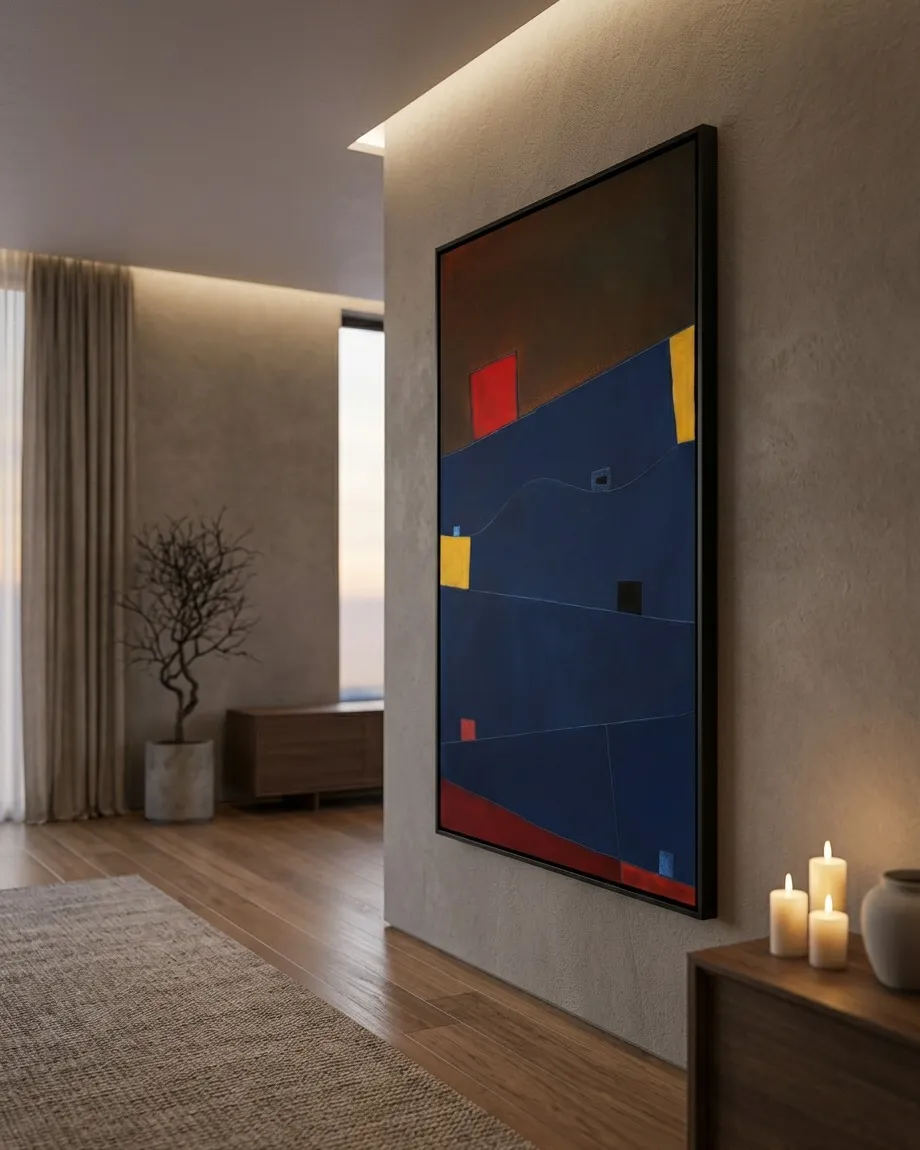
Abstract painting COACTUS in minimalist living room - Maurizio Valch
Stratum I: The Crown of Twilight and the Suspended Block
The upper zone of the painting presents itself as a dense, ocre mass, an atmosphere of twilight hovering over the canvas with the weight of a night resisting dissipation. Right on the boundary of this darkness, an opaque red quadrangular block holds itself up improbably. Why does this large upper block seem not to fall, despite its apparent volume and the steep slope of the line running beneath it?
Manuel Álvarez Bravo, who knew that reality is not invented but waited for in the quietest corners of the day, observes this first threshold and interrogates the framing. For him, this red block is not a static geometric form, but a suspended instant, an everyday object stripped of its context, caught in the diaphragm of a strange light. From the wild perspective of a child, this upper zone loses its formal abstraction: the red block might well be the lit chimney of a submerged house, or the last redoubt of a roof emerging on a hill made completely abstract under shadow. There is no rush in this band; there is a latent stillness, the suspicion that if we blink, the block might slide or disappear entirely into the margins of the painting.
Stratum II: The Great Cobalt Basin and the First Crack
Descending, the painting opens to an immense blue mass dominating the composition. It is a cold plain, a gravity plane that seems to absorb any light vibration. At the far left of this stratum, a yellow rectangle interrupts the blue monotony like a thermal anomaly.
"At first, this blue was to be only a transition, a docile background to order the gaze. But the cobalt opposed its own density, a physical gravity that began to demand absolute territory. In drawing those very fine, almost imperceptible white lines, I did not seek to divide the plane, but to contain a tide that threatened to overflow the stretcher. I felt how the paint made its own tactile decisions, escaping my initial control, asking me to let it settle into its own weight, as if the canvas were not a support, but a slowly moving tectonic rift."
Lise Meitner, ever attentive to the mysterious vibration of the invisible and the energy released when the balance of matter breaks, analyzes this second stratum with microphysical precision. For her, that thin white line is not a simple visual boundary, but a quantum potential barrier. The yellow block at the edge is not resting; it is a confined particle accumulating energy. Meitner and Álvarez Bravo agree on the tension of the framing, but where the photographer sees the poetry of a shadow cast by chance, the physicist detects an imminent state of collision. The temperature of the yellow, compared to the absolute zero of the surrounding deep blue, suggests a constant friction, a contained heat struggling to expand along the dividing crack.
Stratum III: The Abyss of Calm and the Black Point
Further down, the blue becomes even denser, almost opaque, losing the sky-blue nuances of the previous stratum. In this territory of maximum compression, a black square and a small light blue witness act as anchor points.
If this painting were an energy container under constant compression, this third stratum would be the critical point. Where exactly would the balance break? Meitner points to the black square: not as an absence of color, but as a collapse of matter, a sinkhole of force where the lines of the painting begin to curve subtly. Álvarez Bravo, on the contrary, turns his gaze toward the small light blue block floating on the right. For the photographer, that point is the accident that humanizes the scene, the visual coincidence that breaks the rigidity of the physical map. A child would see here a tiny window lit on the slope of a dark mountain, a minimal lighthouse measuring the immensity of the surrounding void. There is no dramatic symbolism; there is a physical and sensory measurement of distance.
Stratum IV: The Base and Compression
We reach the base of the painting, where a final, narrow, curved red band seems to support the weight of the entire piece. Here, a tiny red block on the left and a blue fragment on the right mark the boundaries of the territory.
"There is a strange vibration in what remains silent, a suspicion accumulating in those small blocks floating near the lower boundary. I wonder if they are trapped, coerced (coactus) by the pressure of the outer space pushing against the frame. In the end, painting is an act of voluntary confinement; placing that last red point at the bottom left was like leaving a held breath, a minimal heartbeat refusing to die out amidst the immense stillness of black and blue."
What at the beginning of the journey might have been sensed as a night landscape or a mountainous horizon reveals itself now, in this last stratum, as a cartography of invisible forces and accumulated tensions. The painting does not describe a place; it registers the resistance of matter against the physical limit of the canvas. The gaze remains caught at the base, oscillating between the inertia of the deep blue and the persistence of those small cores of color refusing to be absorbed, leaving us before a silent vibration that continues to operate long after we have looked away.
- Original artwork
- COACTUS
- Actual dimensions
- 31.5 × 47.2 in / 80 × 120 cm
- Presentation
- Digital contextual visualization
Context references
large painting for living room · decorating with abstract art · modern living room decor ideas · blue and ocher painting · minimalist interior design
About this visualization
This visualization places the artwork within an architectural context to help collectors and viewers imagine its presence in a real space. It is an interpretive reference, not an exact reproduction: the original work remains the sole authority for scale, color, surface and material presence.