Context study / COACTUS
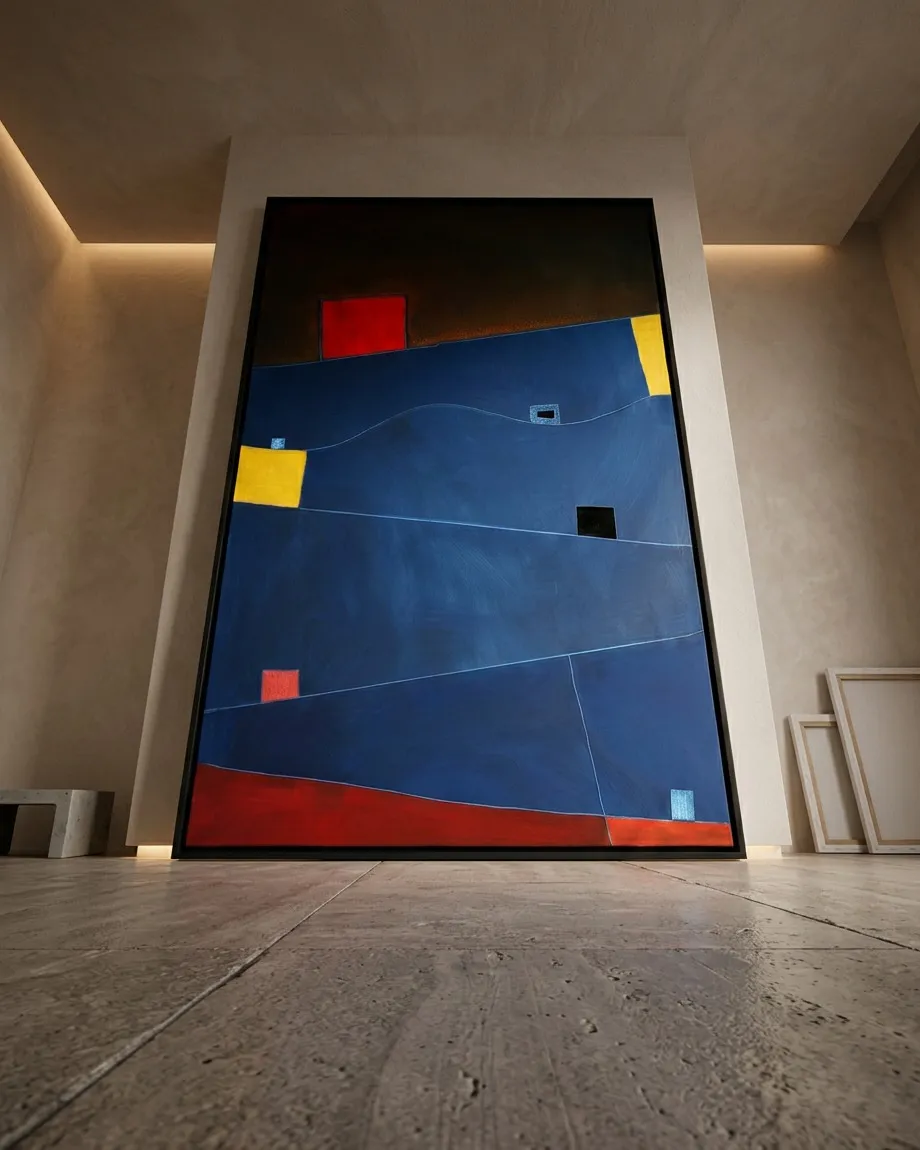
Large-format COACTUS painting leaning in minimalist interior
COACTUS: The Tectonic Scale of the Gaze
1. First Stratum: The dark vault and the editing cut
In the upper strip of the canvas, where the matter thickens into a twilight of brown and black tones, gravity seems to operate under a different law. Luis Buñuel, a man who throughout his life pursued with a sharp gaze the mechanisms of repressed desire and the intrusions of the irrational into the everyday, would observe this area with the suspicion of a film editor. For him, that red block emerging at the upper edge is not a mere geometric form; it is an orphan frame, a violent insert that breaks the continuity of the dark lethargy.
There is something deeply subversive about that upper border. The red block does not float lightly: it presses down, like a secret threatening to collapse the entire scaffolding of the plane. It is the tension of cinematic suspense, the exact moment before the spectator realizes that what they believed to be a ceiling is, in reality, a trapdoor about to give way.
2. Second Stratum: The indigo slope and the gravity of the body
As the gaze descends, the plane fractures into an immense slope of deep blue, crossed by lines that cut the canvas with precise angles. Here, scale ceases to be visual and becomes purely proprioceptive. Anna Halprin, who revolutionized dance by transforming movement into a direct dialogue between the weight of the body and the memory of the earth, would not look at this stratum with her eyes, but with the soles of her feet and the curve of her spine.
For Halprin, these slanted lines dividing the indigo are not abstract divisions, but vectors of physical force. Moving across this canvas demands a constant adjustment of posture: the body must lean to avoid sliding down the blue slope. The large central plane proposes a choreography of resistance. The yellow block on the far left functions as a point of support, a firm heel that stops the slide, while the dark void opening further to the right forces a suspension of weight, a silent leap over the crack dividing the space.
3. First Voice of the Artist (Maurizio Valch)
> "As I pressed the graphite and began to clear a path for the first lines on the canvas, I wasn't looking to define a landscape or construct an orderly perspective. I felt a real physical resistance, as if the canvas itself had hidden geological layers that my hand was simply unearthing. Tracing those diagonal divisions was an exercise in negotiating with space; on more than one occasion, the direction of the stroke veered because the blue began to demand its own slope, its own free fall. It wasn't I who decided that gravity should operate sideways in this painting; it was the plane itself, gaining density, that demanded its own boundaries to avoid collapsing."
4. Third Stratum: Counterweights and silence
In this middle plane, the blocks of color do not function as decoration, but as accumulators of visual mass. Here, the conversation between the filmmaker and the choreographer becomes a technical whisper about the rhythm of the void.
For Buñuel, the central black block and the yellow square on the left are ellipses. The black is a blind spot in the painting's narrative, a place where the plane folds in on itself and conceals information; the yellow, on the contrary, is an overexposure, a direct cut that returns our gaze with a dry, muted vibration.
Halprin, however, perceives these blocks as dynamic pauses. They are not inert elements: the yellow is a contracted muscle sustaining the tension of the great blue hill, while the black square functions as a deep exhalation, an absolute point of repose where the weight of the body sinks and rests before continuing the descent toward the lower layers of the work.
5. Second Paragraph in First Person (Maurizio Valch)
> "For a long time, I was disturbed by the presence of the tiny light-blue square resting almost at the bottom right edge, right where the blue mass collides with the final red strip. It seemed to me a mistake, an unnecessary residue that broke the cleanliness of the descent. I tried to ignore it, but every time I took a step back to look at the entire work, I understood that without that small point of support, the entire structure of COACTUS would fall apart. It is a contradictory presence, an anchor that does not respond to any clear geometric logic and yet holds the weight of the three tons of blue above it. It is the detail that still escapes me, the loose end that shows me that the painting has a center of gravity I did not design."
6. Final Stratum: The red base and the zone of uncertainty
At the bottom edge of the work, the blue slope dies suddenly against a strip of bright red that crosses the canvas from side to side. It is not a firm ground; the line separating the indigo from this red base is not straight, but tilts and deforms, suggesting a zone of constant friction, a magma pushing from the edge of the frame.
Is the great blue body sliding slowly and inevitably toward this fiery abyss, or is the red pressing upward to reclaim the space of the painting? Observing closely the thin lines of light outlining the slopes, one wonders if the journey has really ended at that base or if, looking back at the top edge, that original red block is nothing but the first trickle of this lower tide that has managed to pierce the darkness.
- Original artwork
- COACTUS
- Actual dimensions
- 31.5 × 47.2 in / 80 × 120 cm
- Presentation
- Digital contextual visualization
Context references
large paintings leaning on the floor · xl minimalist contemporary art · modern decoration with large paintings · abstract paintings by maurizio valch
About this visualization
This visualization places the artwork within an architectural context to help collectors and viewers imagine its presence in a real space. It is an interpretive reference, not an exact reproduction: the original work remains the sole authority for scale, color, surface and material presence.