Context study / COACTUS
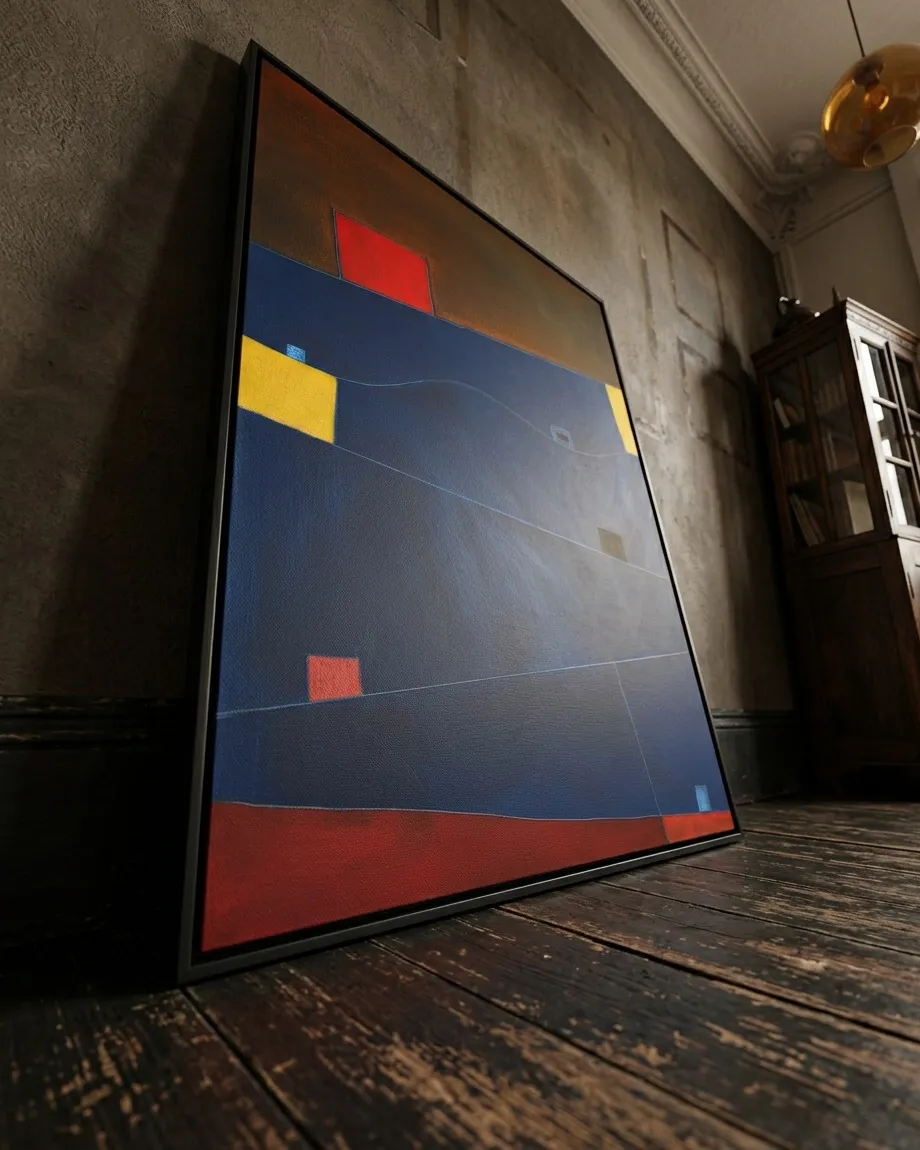
COACTUS by Maurizio Valch - Abstract painting in rustic setting
The work "COACTUS" (10102) by Maurizio Valch does not reveal itself at a single glance; it behaves rather like an old piece of furniture made of creaking wood, full of false bottoms, steep slopes, and drawers slightly open in the twilight. To dismantle its apparent geometric severity, we invite two extraordinary observers to converse:
Roberto Fontanarrosa, the humorist and writer whose tender gaze always sought the everyday mischief and human nod behind any solemnity, and Miguel de Cervantes, the great chronicler of the blurred boundaries between reality and dream, accustomed to dusty roads where shadows transform into knights.
Together, we prepare to descend through the strata of this canvas.
Station 1: The Dark Hilltop (The upper ledge)
At the summit of the painting dominates a somber and earthy atmosphere, a sky of thick oil that seems heavy with an old storm. Against this twilight, a red quadrant stands out, off-center and mysterious.
Contemplating it, Fontanarrosa's gaze smiles with irony: what if that red square were not an abstract element, but a stubborn sun that roundly refuses to be round out of pure rebellion? An obstinate sun, a suspended brick defying the laws of lyrical astronomy. Cervantes, for his part, narrows his eyes and sees in that upper plain a high wasteland, a Castilian plateau where the limit between earth and sky turns into dust.
If we dared to push that large red block, would it slide down the blue slope of the center, dragging with it the fine lines of the canvas like threads of a loom unraveling? Gravity here is a dangerous suggestion.
> "When I faced the canvas, the blue was not a color, but a physical pressure demanding to be divided. I remember my hand's hesitation as I drew those very fine lines segmenting the surface; they were not rational boundaries, but the intuitions of a blind surveyor plotting virgin land without knowing what strange harvests or secrets would remain enclosed beneath each stratum. I felt that if I accumulated too much matter in the upper field, the entire painting would collapse under its own silence."
Station 2: The Blue Slopes (The segmented middle plane)
Descending, we enter a vast territory of deep, nocturnal blue. It is not a smooth void; it is furrowed by thin lines, subtle incisions resembling seams or paths drawn in pencil over the immensity.
Cervantes traces these lines with his finger in the air, recognizing in them the crossing paths of the plain, trails where travelers lose their way and mistake the plain for the sea. For him, the small dark opening, that black slot interrupting the blue slope, is the slit of an inn window or the lock of a chest where an imaginary will is guarded. What giant or what mill lurks behind that window without light?
Fontanarrosa, instead, prefers to focus on the tabs of color dotting the slope: that yellow rectangle on the left and the tiny light blue block. For the writer from Santa Fe, they are toys forgotten by a child on the side of an abstract mountain, or perhaps small improvised mailboxes to leave secret messages for the elves of the painting. What is kept in that black drawer in the middle? Perhaps a letter never sent, or simply the accumulated cold of the night.
Station 3: The Sediment (The red base)
Finally, we reach the base: a horizontal band of bright red holding the entire weight of the blue, acting as a clay floor or a cold fire sediment.
An almost imperceptible detail in the bottom right corner draws attention: a tiny bright blue block, sheltered at the edge, at the very brink of the frame's abyss. Cervantes looks at it with tenderness; it reminds him of Sancho Panza clinging to a branch in the middle of the night, fearing falling into an inexistent well, suspended between the safety of the earth and the fear of the void. It is a fragment of sky that has fallen from the middle plane and remained trapped there, shivering in the corner, on the verge of slipping out of the painting.
> "It amazes me to see how they search for giants or forgotten toys where I only saw tensions of weight and plane. Yet there is some truth in their suspicion: those dark slots interrupting the blue are not mere visual pauses, but openings I left slightly open on purpose, a subtle geometric discrepancy so that air might circulate and the spectator suspect that behind the painting, on that inaccessible reverse, sleeps something not even I dared to name."
"COACTUS" remains thus before us: not as a geometric answer, but as a structure of wood and mystery, a map of slopes to slide down and small half-open drawers inviting us to keep our own questions in them.
- Original artwork
- COACTUS
- Actual dimensions
- 31.5 × 47.2 in / 80 × 120 cm
- Presentation
- Digital contextual visualization
Context references
abstract art for loft · modern rustic decor · painting leaning on the floor · large abstract canvas · wabi sabi interiors
About this visualization
This visualization places the artwork within an architectural context to help collectors and viewers imagine its presence in a real space. It is an interpretive reference, not an exact reproduction: the original work remains the sole authority for scale, color, surface and material presence.