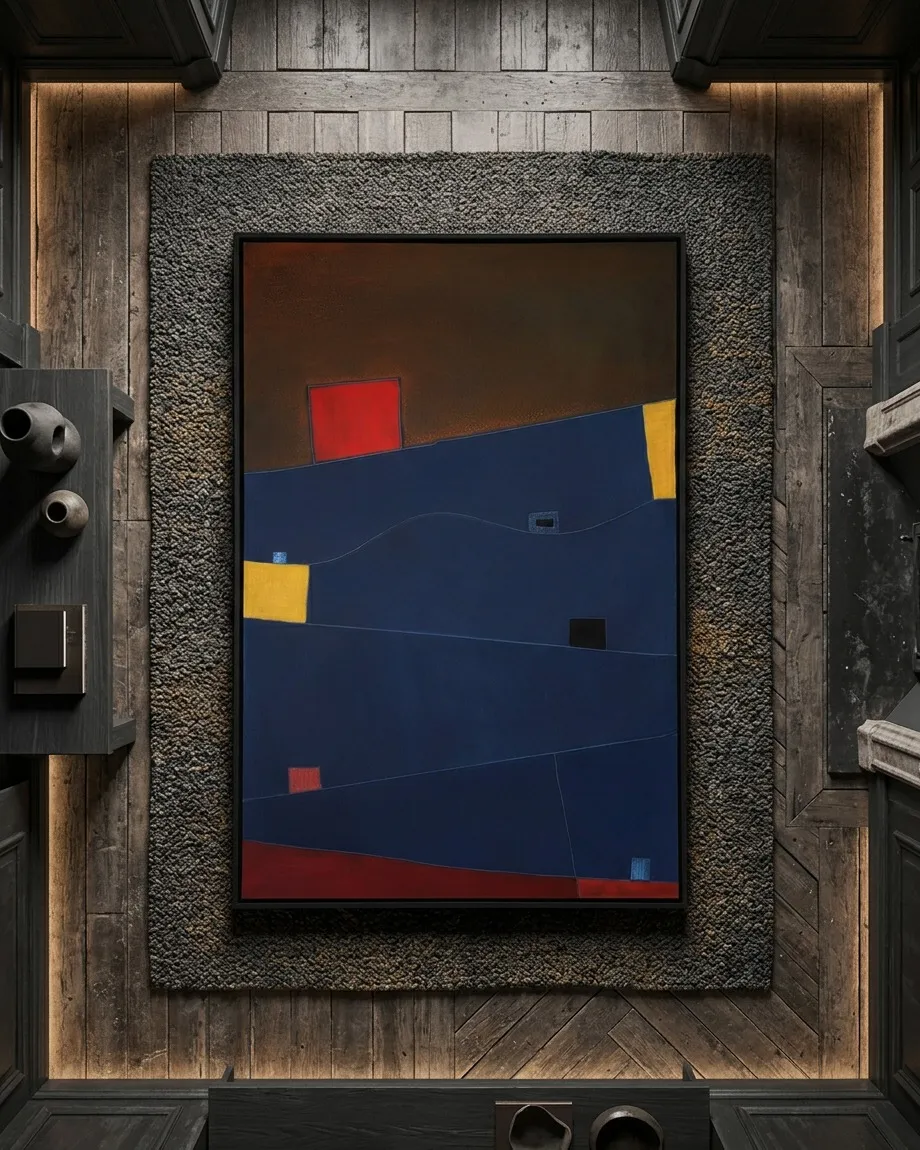
Context study / COACTUS
COACTUS Modern Painting on Textured Wall - Maurizio Valch
1. The Constellation of Intelligences
To unravel the forces operating in "COACTUS", we must invoke an impossible conversation between two minds who understood, each in their own way, that space and time are not empty containers, but malleable materials:
* Charles Lyell, the geologist who taught us to read the Earth as a dynamic record of slow forces, accumulative faults, and deep time, deciphers in this canvas a topography of latent pressures and tectonic layers in constant friction.
* Thelonious Monk, the pianist and composer who sculpted silence with angular dissonances and unexpected accents, perceives the painting as a suspended score where each plane of color is a chord striking on the offbeat.
The dispute: Lyell leans over the canvas, sliding his fingers near the fine dividing lines, seeking the dip angle of a fault or the lithostatic pressure of the upper mass. Monk, however, interrupts him by gently tapping his foot on the floor: "There's no gravity here, Charles. That red block above isn't falling because of its weight; it's a tonic chord sustained just before the bar begins. Don't look for sediment where there are syncopations".
2. Syncopated Stratigraphy
```
+------------------------------------------+ <- Stratum 1: The Earth Sky
| ■ [Red] | (Lithostatic Pressure / Suspended Chord)
+------------------------------------------+ <- Stratum 2: The Great Blue Fault
| ■ [Yellow] | (Displacement / Deep Resonance)
| ■ [Black] | <- Stratum 3: Rhythmic Anomalies
+------------------------------------------+ (Syncopations / Physical Silences)
| ■ [Red] ■ [Blue] | <- Stratum 4: The Molten Basement
+------------------------------------------+ (Magmatic Support / Bass Pedal)
```
First Stratum: The Earth Sky and the Suspended Block
At the top of "COACTUS", a dense twilight of earthy and coppery tones exerts a silent oppression. It is not an atmospheric sky; it is a plane of overload, an accumulation of dark time. Just below this boundary, almost brushing it, floats a red square with imperfect edges.
How does our breathing react to the pressure of that great dark upper mass? An involuntary contraction occurs in the chest, a slight lowering of the collarbones, as if the air became denser under the weight of that earth horizon.
Is that red square trying to rise to dissolve into the darkness, or is it slipping into the blue void, tired of supporting its own mass?
> When I slid that red plane just beneath the boundary of the upper twilight, I felt a vibration of vertigo in my wrist. There was a physical hesitation in the brush, a real fear that the color would plummet or dissolve entirely into the dark background. I didn't want it to float lightly, but to resist; I wanted the viewer to feel the material effort of a form holding itself at the exact edge of its own disappearance.
For Lyell, this stratum represents a stratigraphic unconformity: the red block is a clast trapped in the plane of contact between two different geological eras. Monk, nodding his head, smiles: "It's a suspended chord, Charles. The red is a high-pitched sound that refuses to resolve into the dark silence above it. It stays there, suspended in the air, making you wait for the next beat".
Second Stratum: The Great Blue Fault
Beneath the earth sky stretches an immense blue body, an abyss of pigment that occupies most of the space. It is not a passive void; it is furrowed by fine, oblique lines that rise and fall with a subtly broken geometry.
Lyell follows these lines with his gaze: "Here is structural displacement. These lines are not decorative; they are shear planes. The blue block is sliding laterally, breaking the continuity of the terrain. It is the slowness of geological time turned into a fracture".
Monk intervenes, mimicking with his hands the spacing of the lines on an invisible keyboard: "It's a distorted scale. Those lines are the threads of a staff that has been bent to force the notes to sound slower. Blue is not a color; it's the vibration of a low double bass note reverberating in an empty room. If you pass your hand over it, you can almost feel the hum of the wood".
The transition from this deep blue to the adjacent areas alters our own body temperature: we pass from the static coldness of a marine trench to the latent warmth of the glowing edges.
Third Stratum: Rhythmic Anomalies
Scattered across the blue immensity, several smaller-scale blocks—a yellow one on the left, a black one on the right, a small flash of light blue below—interrupt the continuity of space.
Are these small blocks of color cold in the middle of that great blue territory? They seem to seek shelter in the dividing lines, as if they need to lean on those cracks to avoid being swallowed by the immensity of the background.
They do not function as symbols, but as physical anomalies. The yellow block on the left is a visual impact, a dry noise. For Monk, it's a flat-five, one of his favorite dissonances: "A yellow strike right where you expected the blue to continue its course. It wakes you up. And that black square on the right... that's not paint, it's absolute silence. It took me a lifetime to learn how to play a silence with that much strength".
Lyell sees xenoliths in them: fragments of a foreign rock that have survived without melting inside the blue magma during the tectonic intrusion. They are the undigested remnants of another era, deposits of mineral memory that resist assimilation.
Fourth Stratum: The Molten Basement
At the base of the canvas, a strip of dark red and burnt earth supports the entire weight of the composition. It is the basement, the lower crust that receives the accumulated pressure of all the upper strata.
Here, Lyell's and Monk's readings finally converge. What the geologist describes as the thermal engine of the system—the latent magmatic flow pushing from inside the Earth to keep the upper blocks raised—the musician interprets as an organ pedal note, a deep, continuous tone that sustains the entire improvisation. The geological crack that Lyell initially observed as a rupture plane has transformed, at this base, into a deep musical interval resounding in the viewer's body.
> When I finished the work, I stepped back and found myself facing a silence that no longer belonged to me. There is something in the direction of those dividing lines and in the insistence of that blue void that I myself do not fully understand. I have stopped looking for answers on the surface; I accept this canvas as an independent territory, a geography that has closed its wounds and now beats under its own laws of gravity and distance.
- Original artwork
- COACTUS
- Actual dimensions
- 31.5 × 47.2 in / 80 × 120 cm
- Presentation
- Digital contextual visualization
Context references
large vertical blue painting · brutalist decor · elegant hallway painting · sober abstract art · blue geometric composition
About this visualization
This visualization places the artwork within an architectural context to help collectors and viewers imagine its presence in a real space. It is an interpretive reference, not an exact reproduction: the original work remains the sole authority for scale, color, surface and material presence.