Context study / COACTUS
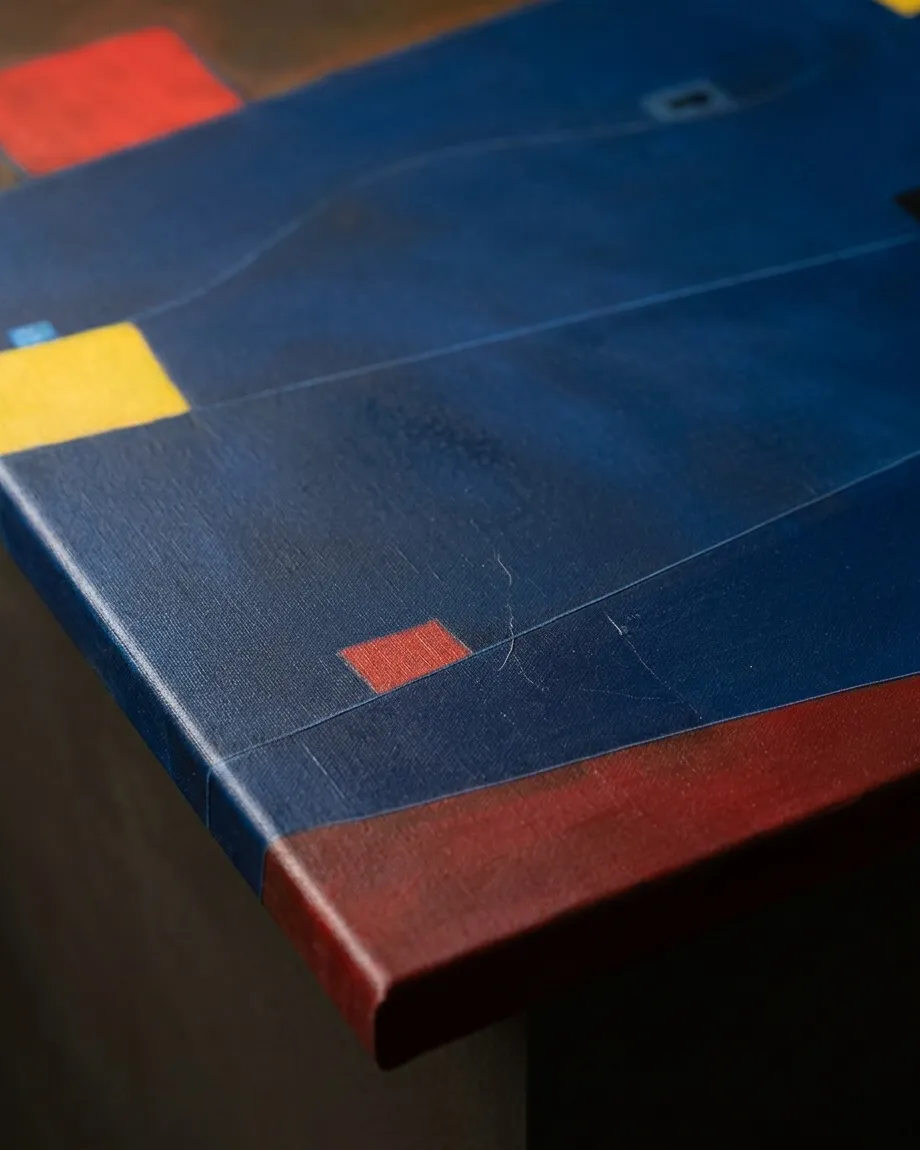
Texture detail of COACTUS - Abstract painting by Maurizio Valch
First Level: The Earth Sky and the Suspended Block
The gaze does not enter "COACTUS" head-on; it drops into it. At the top of the canvas, a horizon of dark, telluric brown stretches out like an inverted earth sky, a dense atmosphere that seems to press the plane downward. Right on that boundary, almost touching the first line of demarcation, floats a large rectangular block of red. It is not a festive red; it is a dull, heavy red, holding itself over the blue void like a body suspended by an invisible force. What kind of gravity rules in this space where blocks of color seem to float yet weigh tons? Why does this red not get soiled by brushing against the crowning brown, maintaining an almost defiant purity in its isolation?
To venture into this first frontier, we summon Dōgen, the Zen master who taught us that time is not something that passes by, but that time itself is our own existence flowing and stopping at once in each fragment of the universe. From his perspective of Uji (being-time), this red block is not statically waiting to be looked at; it is being concentrated time, an instant of active stillness where background and form dissolve. Dōgen interrogates the upper zone not as a sterile stratification, but as a state of meditation where the heaviness of the earth and the vibration of the red color breathe at the same rhythm, reminding us that silence is not the absence of sound, but the fullness of presence.
> At times I doubt the vibration of these dense blues, that almost physical quality they acquire when light hits the canvas sideways and reveals the grain of the fabric. I find myself holding my breath as I trace the subtle seam of the light lines dividing the color fields, knowing that a millimeter of deviation would break the entire tension. Placing that block of color at the edge of the canvas responds to a physical need for weight: it is an anchor needed to keep the painting from tipping sideways, to sustain the balance of an architecture that exists only in my mind and that the gravity of matter demands be consolidated on the plane.
Second Level: The Yellow Margins and Oscillation
As the body descends through the painting, the temperature changes abruptly. The warm brown fades, and we submerge into an immense layer of deep blue, an abyssal cold that slows the heartbeat and demands a more paused breathing. On the lateral edges of this geometric ocean, pushing from the borders as if wishing to sustain or narrow the space, yellow blocks burst in. Why do they seek the periphery of the canvas, as if trying to escape the great blue mass or avoid being devoured by it? A very fine light line crosses this territory, a slight wave vibrating with the fragility of a fishing line or a scar of light.
Here comes Walter Benjamin to meet us, inviting us to think of the image as a threshold where past and present collide, revealing that in the smallest, most insignificant details of a structure lies the key to its secret history. Benjamin does not see here an exercise in decorative abstraction, but a map of hidden passages. For him, that subtle line dividing the blue is a suture of urgency: what two worlds is it joining or keeping apart in its fragility? If a child walked at night along that line, as if it were a path suspended over an abyss of dark water, they would wonder if the yellow on the sides is the light from a window lit in the distance or the warning of a limit we must not cross.
Third Level: The Small Sentinels of Color
Further down, on the vast blue surface, the space begins to populate with small accents, minimal musical notes acting as optical anchors. A small black square suspended on the right, a tiny red block down on the left, and minuscule blue accents barely perceived unless with an attentive, devoted gaze. The body of the spectator experiences a microscopic tension here: the gaze jumps from point to point seeking a pattern, a numerical order, or a constellation to give meaning to the void.
> I admit there are moments when the canvas knows something I do not yet understand. In painting that small black square in the middle of the blue, I felt I was not applying pigment, but opening a hole, a threshold whose true depth and direction I do not know. I do not know if that black point absorbs light from the entire work or if, on the contrary, it is the secret origin from which the tension of the yellow blocks emanates. In the end, one steps back from the stretcher accepting that the painting must keep its own secret, an unfinished space that not even the creator has the right to desecrate.
Dōgen would look at that small black point and see the emptiness containing all things; Benjamin would see the melancholic fragment testifying to a lost totality. Both agree that these small sentinels of color are not mere ornaments: they are the guardians of the work's scale.
Fourth Level: The Iron Base and the Red Abyss
Finally, we reach the base of the painting, the last step of this gravity field. Here, the dense blue is cut sharply by a lower band of a dark, earthy, thick red that acts as an iron base for the entire composition. It is a definitive boundary.
If the tiny blue square in the bottom right corner were the key to turning on the entire composition, what mystery would it reveal upon activation? This lower level closes the journey not with a cheerful resolution, but with a dense vibration that remains in the body like the echo of a bell struck underwater. "COACTUS" folds back on itself, leaving us at the threshold of a silent architecture where each color weighs, each line divides, and the void sustains the world.
- Original artwork
- COACTUS
- Actual dimensions
- 31.5 × 47.2 in / 80 × 120 cm
- Presentation
- Digital contextual visualization
Context references
abstract painting detail · acrylic canvas texture · cobalt blue and red · contemporary abstract art · incisions in painting
About this visualization
This visualization places the artwork within an architectural context to help collectors and viewers imagine its presence in a real space. It is an interpretive reference, not an exact reproduction: the original work remains the sole authority for scale, color, surface and material presence.