Series · 2024–Present
MARE SOMNIORUM
Mediterranean memory between light, distance, and suspended forms

About this series
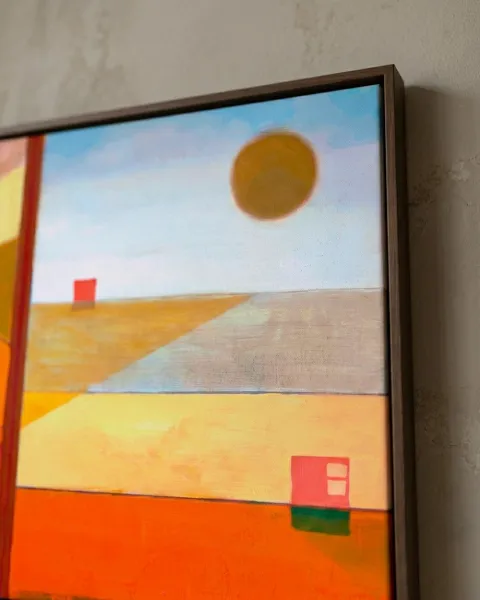
MARE SOMNIORUM transforms Maurizio Valch’s Mediterranean experience into an open pictorial territory, where horizon, silence, and isolated structures retain the intensity of a place without describing it literally. His paintings sustain a distance between what has been lived and what has been imagined, between movement and stillness.
MARE SOMNIORUM begins with a Mediterranean experience that Maurizio Valch does not seek to fix as a view or an illustrated memory. Intense light, the dryness of the land, the sea understood as both boundary and expanse, and the persistence of the horizon shift into a space that retains a memory of place without being bound to recognisable geography. The Mediterranean appears less as a coastline than as a condition of perception: an expanse where clarity does not eliminate distance, and where openness may still remain strange.
Colour fields, horizontal planes, voids, paths, and compact forms organise territories that seem traversable, although they offer no conclusive orientation. A path may enter the surface and disappear; a block may take on the weight of a structure, a vestige, or an unnamed presence. Valch does not use these elements as a vocabulary to be decoded. He allows them to act through their position, their isolation, and the relation they establish with the expanse around them.
This suspension finds a particular resonance in a sensibility marked by transit. In the artist’s experience, moving does not necessarily mean arriving: what also matters is the in-between condition, the time spent walking without an immediate conclusion, provisional belonging, and the gaze that changes upon leaving a place. The series retains something of this attention. Its compositions do not narrate journeys, but they contain the uncertainty of a direction that has not yet become a destination. Far from promising arrival, the horizon keeps distance open.
A temporality broader than individual memory also persists. The Mediterranean, crossed by routes, settlements, and layers of civilisations, enters these paintings without becoming historical reconstruction. Isolated structures and silent intervals may convey a duration both prior and subsequent to the viewer. In this sense, light does not reveal a complete scene: it makes it possible to measure what remains inaccessible, the separation between forms, and the time accumulated in a territory.
An affinity with a territorial construction akin to Richard Diebenkorn’s may help reveal how abstraction retains a memory of landscape. In Valch, however, the planes tend to condense into a quieter, more remote, and dreamlike atmosphere. MARE SOMNIORUM does not turn dream into narrative or landscape into a psychological symbol. It keeps both dimensions in relation: a world recognisable through its horizons and distances, yet sufficiently displaced for each viewer to remain before it without ever fully possessing it.
Tags
contemporary abstract painting; territorial abstraction; abstract landscape; minimalist abstract art; brutalist abstract painting; contemporary geometric art; colour fields; horizons; spatial divisions; monolithic forms; abstract blocks; paths and routes; suspended forms; Mediterranean-inspired art
Series works
Works in this series