



Published work / SITUS
SINGULA
Distance and position as a territory of relations
- Medium
- Pintura
- Size
- 47.2 × 31.5 in / 120 × 80 cm
- Series
-
SITUS
 Painting series
SITUS
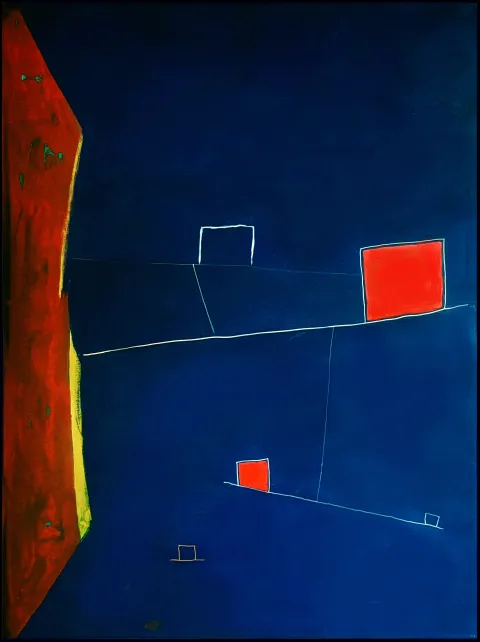
SITUS brings together abstract paintings in which the position of a form, the distance separating it from another, and the activity of empty space construct a territory of relations. Maurizio Valch works with lines, edges, shifts in level, and fields of colour as conditions of presence rather than signs within a closed narrative. View series
- Orientation
- Horizontal
- Context studies
- 8
Conceptual Note
SINGULA stands at the center of the SITUS series, a body of work where Maurizio Valch investigates territory not as an external geography to contemplate, but as a system of relations of position, distance, and belonging. After moving through the dreamlike spaces of his early series, the artist anchors his search here within a structure of levels where forms must negotiate their own place. The artwork presents itself as a map of relative positions, an austere stage where each element seems to rehearse what it means to occupy a space, to hold its ground on a slope, or to remain suspended at the margin of a color field that shuns literal description.
The tension structuring this piece lies in the distance and alternation between solid presence and delimited emptiness. By confronting dense, heavy crimson blocks with rectangular structures that are barely hollow outlines, the work raises a question about the nature of what we choose to keep and what we leave open. There is no center ordering the gaze; the eye is forced to drift along the slopes of these territorial subdivisions, experiencing physical separation as a form of internal relation. The painting asks whether identity and space are defined by what they accumulate or, on the contrary, by the interval of silence sustained between them.
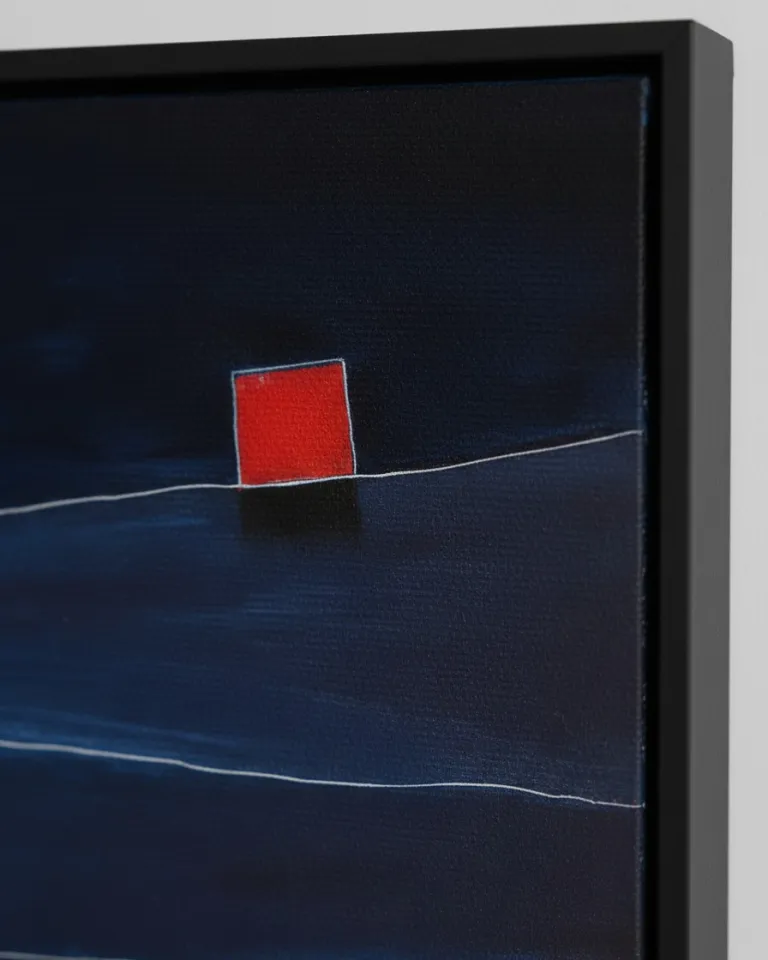
In this economy of the interval, the composition reveals an affinity with the sobriety of Estonian composer Arvo Pärt, particularly in his attention to the pause and the resonance of what remains quiet. However, while in Pärt's work silence structures time, in Valch's painting stillness is embodied in physical matter. The incision cutting through the blue plane is not a clean, idealized line, but a physical trace running through the layers of pigment. This subtractive gesture distinguishes his abstraction from a mere geometric or rational exercise, giving the plane a tactile, inhabitable quality that brings the painting close to the condition of relief.
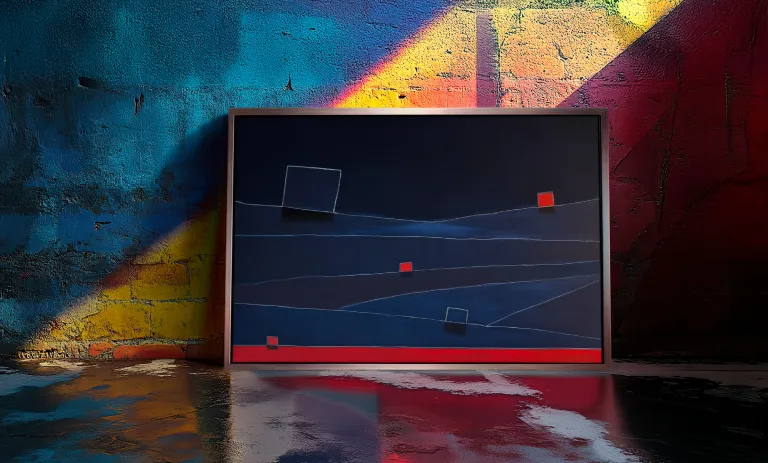
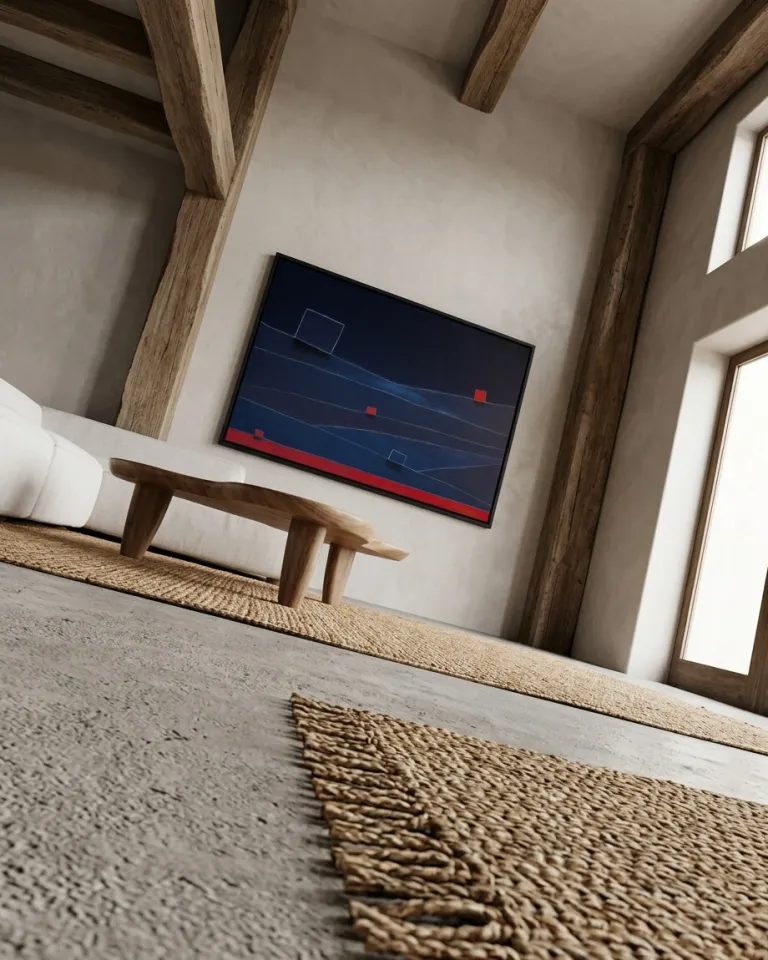
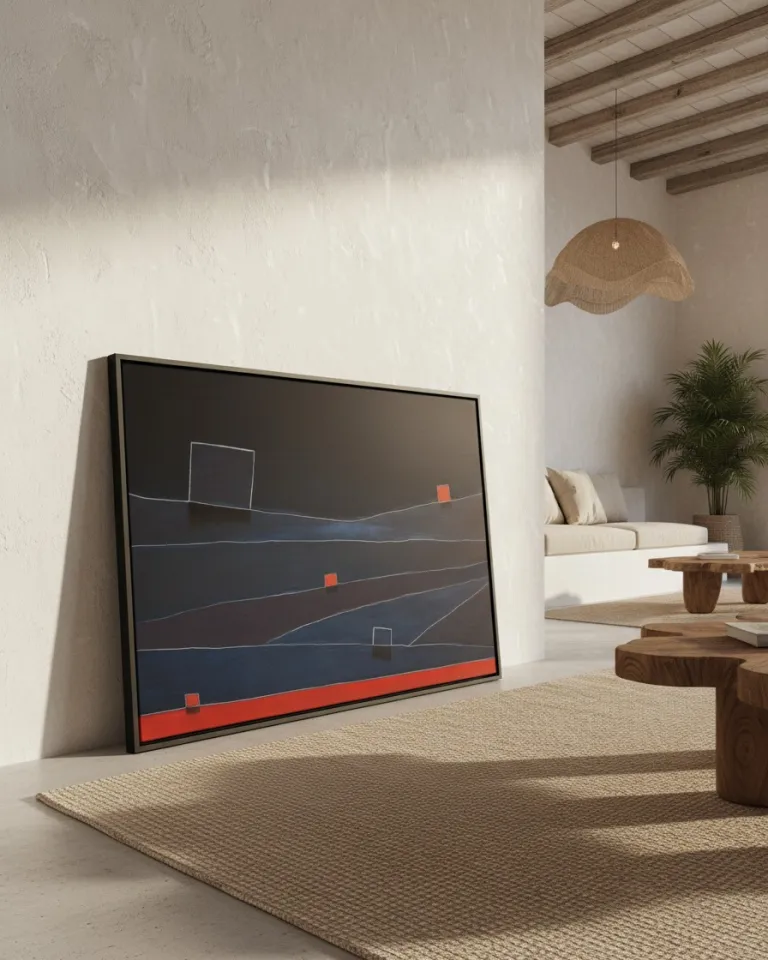
Visually, the work is supported by a deep indigo blue field interrupted at its base by a vibrant horizontal crimson band, a solid ground that acts as the painting's anchor. Upon this dark backdrop, white incisions trace gentle slopes, ridges of incised lines from which forms hang and upon which they rest. Two empty rectangular outlines and three solid red blocks are distributed along this relief of levels, balancing visual weight through subtle lower shadows that suggest volume. Each element, by virtue of its scale and isolation, functions like a solitary note on a staff of earthly forces, where color does not illustrate, but exerts pressure and temperature.
When I work on pieces like this, I seek to strip the territory of all noise to remain only with the pure distance between things. I often ask myself how much matter a form needs to begin to exist, and whether it is the empty outline or the filled block that best defines our way of inhabiting a place. In carving these incisions into the deep blue, I do not seek to draw paths or impose a rigid order; I simply need to open fissures, mark levels, and observe how each singular element resists sliding, holding its ground on its own edge as if it were the last possible refuge.