Context study / SINGULA
SINGULA by Maurizio Valch on Easel at Night | Abstract Art
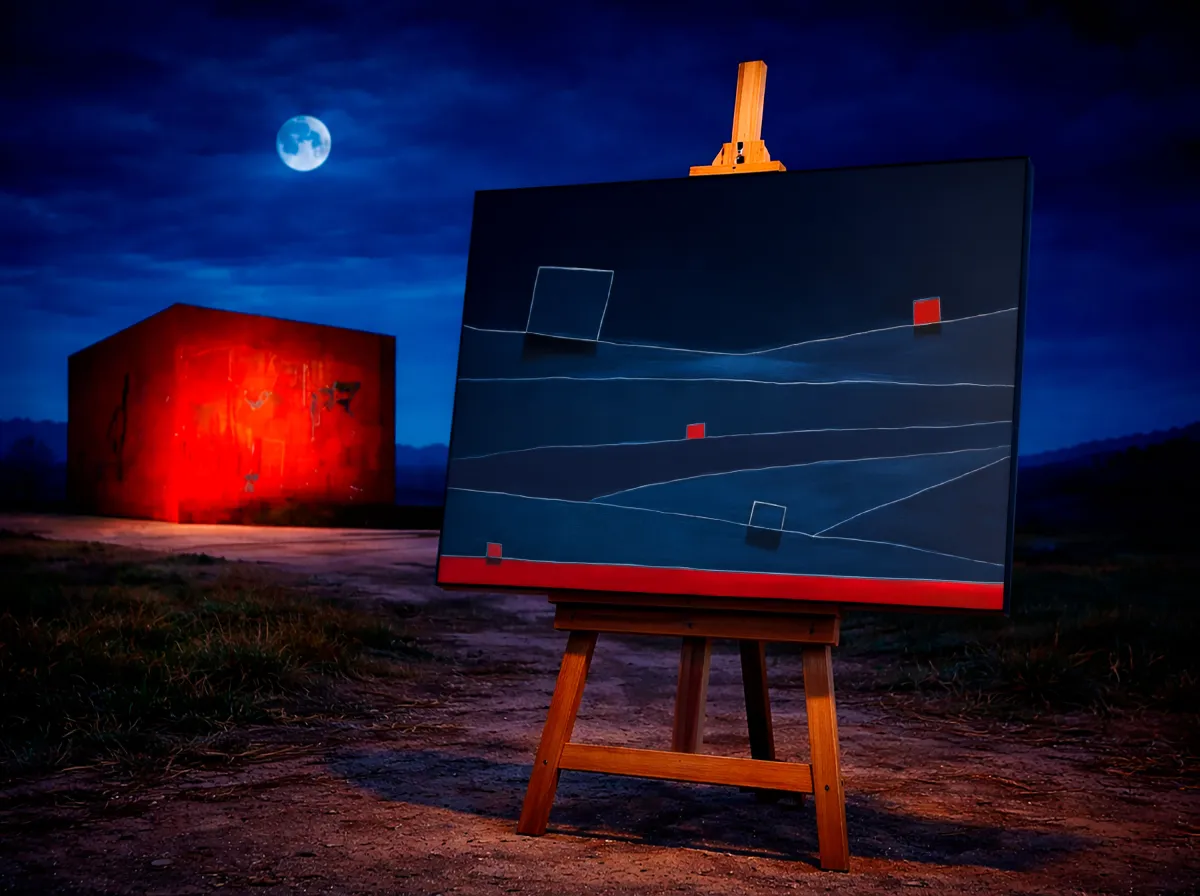
Placing an easel in the open air, under the cold dome of a night that is beginning to close in, completely alters the pact of permanence we usually demand of painting. In this scene, the canvas of SINGULA measures itself directly against a real landscape where, in the background, a cubic volume glows red beneath a suspended moon. That external structure, massive and burning, seems like a three-dimensional projection of the small blocks inhabiting the blue plane of the canvas, as if physical space were reconstructing on a large scale what is only barely suggested inside. This duplication reveals that remembering is never a passive archiving exercise, but an event that modifies the environment: what we call the past is not preserved intact, but is projected outward, transforming and acquiring a new body with each gaze that attempts to summon it.
When I sink the metal tip into the wet material to trace these white lines, I know I am not recording a path that existed beforehand. The incision does not rescue a prior map; it invents it by wounding the surface. In scraping the indigo blue, each furrow becomes a physical decision that alters the original state of the canvas, just as each attempt to remember a past territory inevitably deforms its geography. I distrust memory that claims to be exact; for me, remembering is much closer to this subtractive gesture, to this accumulation of layers that I must later cut and erode to see what survives under the pressure of the paint.
This tension between presence and emptiness is organized in the composition through a highly sober dialogue: three solid red blocks and two rectangular outlines that remain open, mere boundaries enclosing nothing. The crimson color at the base acts as a solid ground, a physical anchor, but the slopes traced by the incised lines suggest that everything in this territory is in a state of contained sliding. The human mind tends to fill in the gaps of the past with convincing explanations, to solidify the void by transforming it into dogmas or rigid identities, very similar to those painted monoliths. However, by placing the empty frames alongside the filled ones, the painting forces us to keep our gaze on the absence, suggesting that what is no longer there, or what never quite came to be, holds the same gravitational pull as that which appears compact.
I often wonder if this need to parcel out the canvas, to create levels and search for a precise place for each singular element, is merely a replica of my own effort to find order in the transitory rooms and paths I have left behind. But painting always ends up disobeying my intentions. At the end of the day, when I observe the friction between deep blue and crimson, I understand that the order I seek is neither a safe destination nor a definitive refuge against uncertainty. These blocks and lines are not monuments to what I was or what I lived; they are stations of a transit that remains open, marks of a movement where the only real ground is the transformation of the matter itself.
The affinity this space shares with the music of Arvo Pärt does not lie in a desire for spiritual asceticism, but in the raw honesty of the interval. In SINGULA, each form is held in strict isolation, separated from the others by expanses of an impenetrable blue that demands silence before permitting any interpretation. Ultimately, contemplating this painting on its wooden support, exposed to the variations of natural night light, returns us to the fundamental paradox of memory: to remember is not to recover what is lost, but to accept the task of inventing it anew on a ground that changes constantly beneath our feet.
- Original artwork
- SINGULA
- Actual dimensions
- 47.2 × 31.5 in / 120 × 80 cm
- Presentation
- Digital contextual visualization
Context references
blue and red abstract painting · abstract painting at night · maurizio valch artist · minimalist wall art · large original canvas
About this visualization
This visualization places the artwork within an architectural context to help collectors and viewers imagine its presence in a real space. It is an interpretive reference, not an exact reproduction: the original work remains the sole authority for scale, color, surface and material presence.