Context study / SINGULA
Indigo Blue Abstract Painting SINGULA - Maurizio Valch
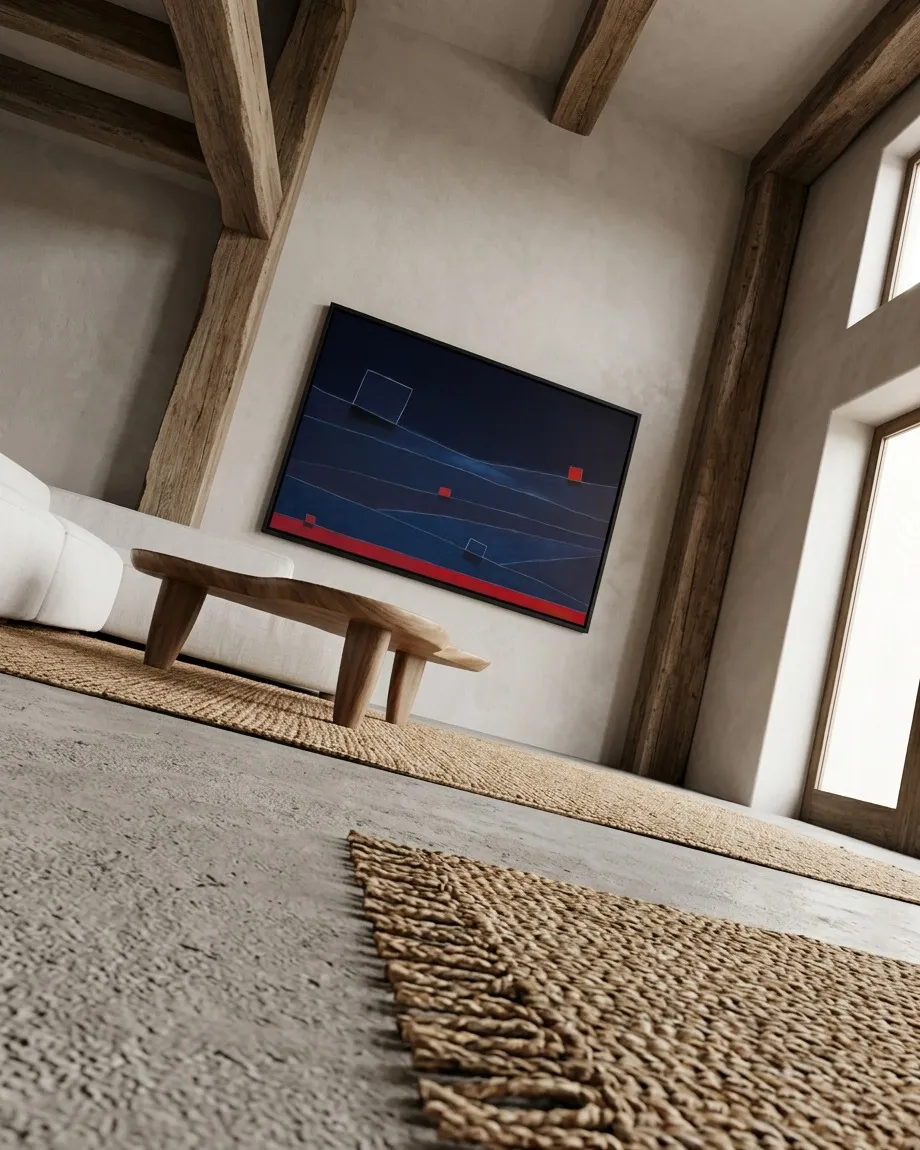
Observed from the low, oblique angle imposed by this space of solid beams and textured floors, the gaze does not enter the painting frontally; it is guided along a physical slope that duplicates the inclination of the work's own lines. The first thing that assaults perception is the low vibration of the lower crimson stripe, a solid ground acting as a visual anchor before the eye is pushed to ascend the incisions that furrow the indigo blue. This organization is not ornamental: it is a topography of detours where the eye learns to lose its haste. By forcing a sinuous path between the levels of the canvas, the composition determines an order of appearance in which the immensity of the dark field is not delivered all at once, but is meted out through the forms that inhabit it.
When tracing those fine incised lines on the wet medium, I do not seek to define a drawing, but to open passages for the viewer's attention. I know that an excessively straight line or a perfectly balanced plane lulls the eye, allowing it to cross the painting without stopping at any edge. That is why I cut the surface, seeking the tool to meet resistance, letting the pulse tremble and the slope incline toward the void. Each incision functions as a tactile relief, a path that interrupts the free fall of the gaze and forces it to weigh the space, deciding on which step to rest before continuing toward the twilight of the background.
In this transit across the surface of SINGULA, what truly holds the attention is the alternation between solid presence and absolute vacancy. The three red blocks concentrate visual weight as if they were gravity points or hardened certitudes, while the empty rectangular contours operate inversely: they do not add matter, but frame the underlying darkness. This tension evokes the subtlety of a map that hides more than it reveals, where empty forms function as portals open to suspicion. Like the famous box Saint-Exupéry drew to hide the sheep from the literal gaze, these hollow rectangles protect the mystery of the painting, demanding an active participation from the viewer to complete the absent volume.
I often wonder if thought does not operate in the same way, constructing dense theories about who we are to hide a much simpler void. When I place a red block next to an empty frame, I am not trying to illustrate a psychological conflict, but to see how both dimensions coexist on the canvas without canceling each other out. The solid block offers immediate refuge to the gaze seeking handholds, but it is in the contour that the painting truly breathes and opens to the unexpected. Working with these contrasts is my way of dismantling the urgency of interpretation, forcing the mind to remain a moment on the edge of the pictorial fact, before it begins to invent explanations.
In the end, the composition reveals itself as a system of retentions and delays where space is not an inert void, but a presence pulsing with the distance between the elements. The affinity with the structural rigor of Richard Diebenkorn becomes evident in this capacity to partition the plane without suffocating its atmospheric character, allowing the oblique horizon to act as an interior distance. Contemplated in the dim light of this high-ceilinged architecture, the work does not offer itself as a decorative response, but as a silent threshold that waits. The gaze, after traversing the blocks and the incised lines, inevitably returns to the intermediate space, discovering that the essential part of the painting does not lie in the forms displayed, but in the vibration of that silence held between them.
- Original artwork
- SINGULA
- Actual dimensions
- 47.2 × 31.5 in / 120 × 80 cm
- Presentation
- Digital contextual visualization
Context references
navy blue and red abstract painting · high ceiling living room decor wooden beams · original contemporary wall art · abstract painting with textures and incisions · horizontal format original paintings
About this visualization
This visualization places the artwork within an architectural context to help collectors and viewers imagine its presence in a real space. It is an interpretive reference, not an exact reproduction: the original work remains the sole authority for scale, color, surface and material presence.