Context study / SINGULA
SINGULA Abstract Painting on Rustic Floor | Maurizio Valch
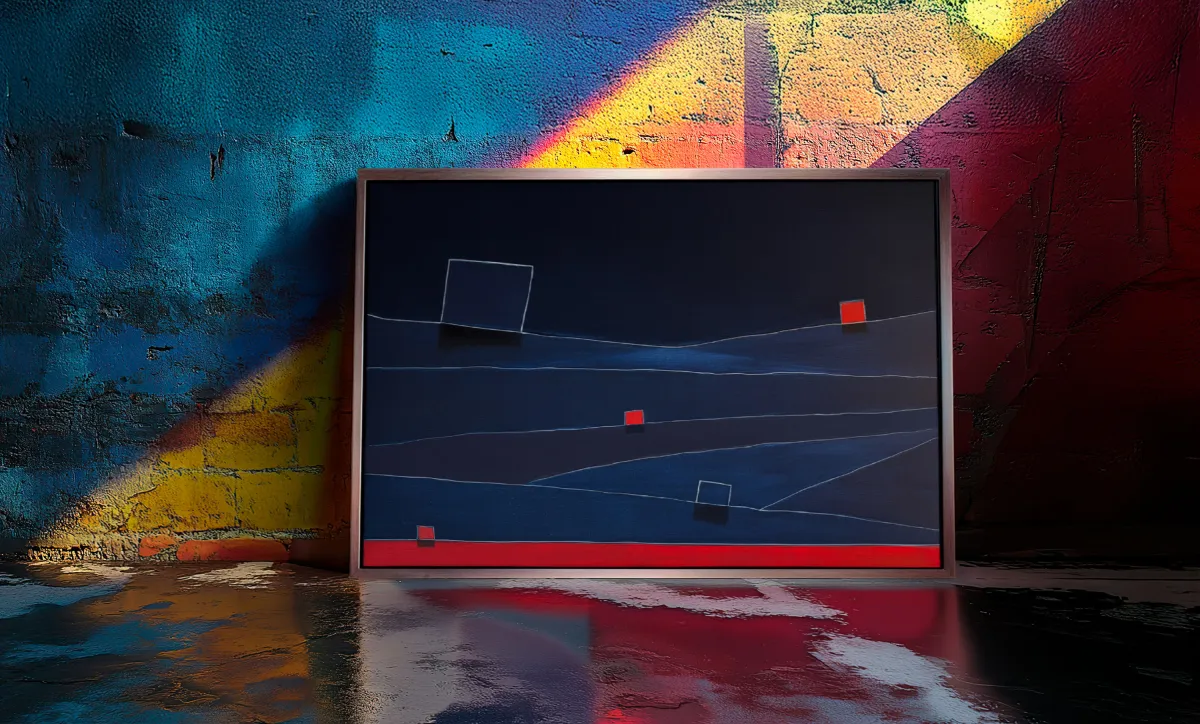
Extracted from the continuity of its series, a painting behaves like a fragment claiming absolute autonomy, a meaning the viewer attempts to fix within the limits of a single frame. However, observing SINGULA in this presentation, resting directly on the floor and set against a wall of weathered textures under oblique, theatrical light, that illusion of isolation weakens. It is not just that the work dialogues with the physical roughness of its real surroundings, but that its own internal structure—those fields of indigo blue cut by incisions and marked by monolithic and empty forms—begins to reveal its true nature: it is not a static territory, but a passing station. By being situated alongside the other pieces of the SITUS series, the painting sheds its apparent rigidity and begins to function as a link within a shared search, where meaning does not reside in a single element, but in the transition and distance established between all of them.
When I enclose a form on the canvas, I sometimes fall into the trap of believing I have exhausted its question. In SINGULA, I arranged those three red blocks and two empty frames as if they were the only possible coordinates on the deep blue plane, an order intended to sustain itself. But stepping back and contemplating the work off the easel, I understand that no singular element possesses a definitive voice; the crimson block that here seems a refuge or an unshakeable belief tilts, loses its weight, or empties out completely in the adjacent work. To paint is not to accumulate certainties in watertight compartments, but to open a path where each painting is forced to yield part of its meaning so that the next can breathe.
This mutual dependence between works in the same series recalls the concept of boundaries analyzed by Ken Wilber in No Boundary. For Wilber, a dividing line is not necessarily a wall of exclusion, but a tactile membrane of contact, a zone of friction where parts are defined precisely through their relationship. In the physical space where SINGULA is exhibited, the painting does not isolate itself from the rough architecture that surrounds it; it extends it. The fine white incised lines scratching the surface of the work cease to be mere compositional strokes and become cracks connecting the painted space with the imperfections of the real wall. The series functions in the same way: each painting is a tactile shore where Maurizio Valch's material inquiry fractures and resumes, demonstrating that a single canvas is incapable of containing the totality of experience.
I am often asked if the incised lines crossing my paintings are paths leading somewhere, or if the empty blocks represent losses. Today, seeing this piece resting on the floor, exposed to the shadows of decline and reflected light, I realize that the incision does not seek to direct the viewer's gaze, but to wound the surface to reveal what lies beneath. I do not intend to offer a resolved map or a theory about who I am. Those forms hanging from the lines are only attempts to hold balance on an unstable slope; if the viewer observes this painting in isolation, they will look for a closed symbol, but if they accept the transit of the series, they will understand that the emptiness of a frame is as real and necessary as the density of the red block.
The gaze that lingers on SINGULA ultimately discovers that the painting does not pretend to be a window to an absolute, but a surface recording the passage of time and matter. Just as in the compositions of Arvo Pärt, where the silence following a note is what gives gravity to the sound, in Valch's work meaning is constructed in the interval, in the suspicion that each painting is merely the continuation of a missing heartbeat. By renouncing the tyranny of the single, self-sufficient painting, the work invites the viewer to abandon their need for definitive explanations. The true journey is not completed by deciphering the secret of a block or the path of a line, but by accepting the uncertainty of a territory that transforms and completes itself only when we dare to look beyond its edges.
- Original artwork
- SINGULA
- Actual dimensions
- 47.2 × 31.5 in / 120 × 80 cm
- Presentation
- Digital contextual visualization
Context references
minimalist painting leaning on floor · contemporary brutalist painting · large abstract artwork · interior decor with art · maurizio valch situs
About this visualization
This visualization places the artwork within an architectural context to help collectors and viewers imagine its presence in a real space. It is an interpretive reference, not an exact reproduction: the original work remains the sole authority for scale, color, surface and material presence.