


Published work / SITUS
GRADUS
The tension of balance and matter in suspension
- Medium
- Pintura
- Size
- 47.2 × 63 in / 120 × 160 cm
- Series
-
SITUS
 Painting series
SITUS
SITUS brings together abstract paintings in which the position of a form, the distance separating it from another, and the activity of empty space construct a territory of relations. Maurizio Valch works with lines, edges, shifts in level, and fields of colour as conditions of presence rather than signs within a closed narrative. View series
- Orientation
- Vertical
- Context studies
- 11
Conceptual Note
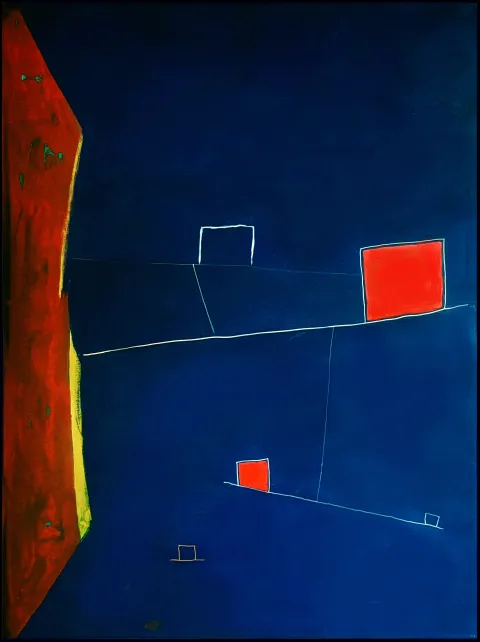
A gigantic wedge of ochre and crimson matter bursts violently into the left third of the canvas, abruptly interrupting the monopoly of the indigo blue that dominates the rest of the space. This vertical mass, dense and almost geological in its execution due to the material use of acrylic and oil, acts as an imposing chromatic cliff. Its presence exerts an immediate defensive function: it is a wall, a tactile shield that seems to arrest the advance of an absolute, nocturnal void. The painting is thus divided into two asymmetrical worlds, establishing a physical boundary where the left strip embodies a promise of severe, almost hermetic protection against the unprotected immensity of the blue. The viewer perceives this boundary not as a smooth transition, but as a sharp border between the sheltered and the exposed, a threshold where the heaviness of the earth measures itself head-on against the weightlessness of the abyss.
In the stillness of my studio, when I face the vast surface of blue before it fully settles, I take the stylus to make the incisions. I do not seek to add superimposed lines, but rather to wound the pictorial layer, making precise cuts that reveal the lower strata of the canvas and leave a white trail, a clean scar in the density of the pigment. By suspending those solid red blocks over the fragility of these oblique incisions, I perform an exercise in radical trust. Sustaining the chromatic matter upon such a fine stroke does not require firm ground or a predictable support; it demands full trust in the tension of the void and the geometric accuracy of the cut. It is the faith that an incised line, no matter how thin, possesses the structural resistance necessary to bear the weight of a suspended body, transforming instability into a deliberate and tense balance.
As the eye traverses the blue sector of the canvas, it discovers a disconcerting alternation between densities and absences. On one hand, small empty quadrilaterals are visible, barely outlined like delicate wire structures floating or resting at the base; on the other, the solid, opaque red blocks balance with contained gravity upon the incised slopes. This formal dialectic raises a questioning of the nature of belonging in abstract space. The painting questions us on whether belonging to a place is equivalent to occupying it physically and assertively by imposing our weight—like the red block asserting itself on the line—or if, on the contrary, true belonging consists in inhabiting a transparent contour, a stripped-back architecture open to the passage of the background. These minimal geometries map a cartography of dwelling and detachment, suggesting that rootedness is not a static condition, but a permanent oscillation between solid presence and empty trace in this territory of night.
I know well that this great crimson and ochre mass I have raised on the left offers an initial impression of security, but as a painter, I distrust absolute refuges. The obsessive search for protection hides a trap: if we refuse to leave the fortress, that solid parapet inevitably becomes a cell that cuts us off from the rest of the world. The painting needs the gradus, the step that drives us out into the open weather of the blue. Therefore, I decided to apply those zones of vibrant yellow light that border and wear away the right margin of the great landmass. This luminous flash is not an ornament; it is an active threshold, a fissure of heat that undermines the rigidity of the wall and invites us to leap outward, abandoning the security of the bunker to test a much more free, mobile, and necessarily vulnerable form of belonging on the open plane of the canvas.
In this way, GRADUS articulates its tensions not to propose a linear ascent toward a definitive goal, but to map a state of constant suspension. The step alluded to in the title reveals itself as a sequence of minimal supports and calculated shifts in level that reconfigure our relationship with space. At the end of this visual itinerary, the work dismantles the conventional certainties of its three conceptual pillars: protection is no longer identified with the isolation of an impenetrable wall, belonging is stripped of the need for heavy, suffocating rootedness, and trust manifests as the bodily capacity to position oneself on the decline of a wounded line, sustaining oneself on the slope without succumbing to the fear of the fall. In this canvas by Valch, inhabiting the void is not a condemnation to helplessness, but the conquest of a geometric freedom that learns to sustain itself on the delicate seam of its own stroke.