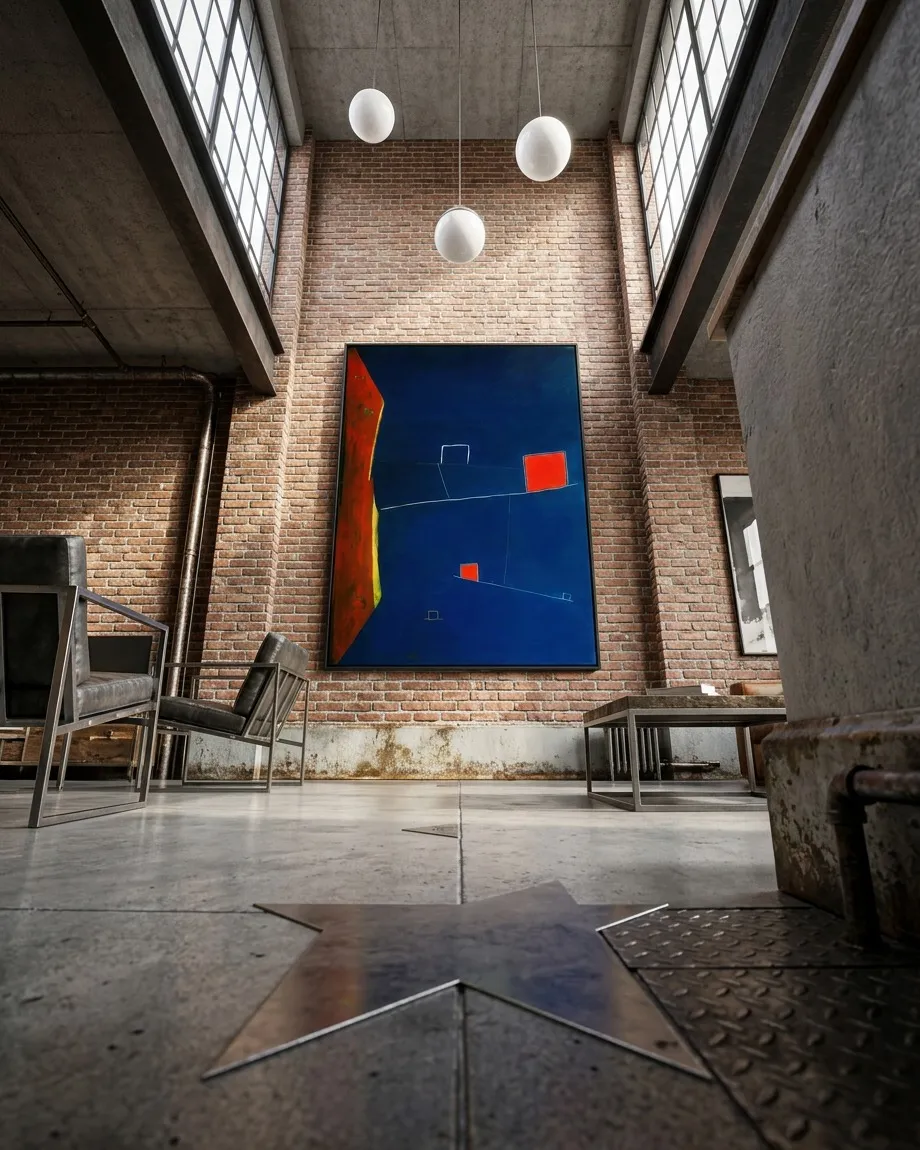
Context study / GRADUS
Contemporary painting GRADUS in a high industrial living room
The confrontation with the surface of GRADUS places the observer before an abyss of indigo blue that functions not as a neutral background, but as a dense and corporeal presence. This chromatic field unfolds as an accumulated temporal continuity, an active void that sustains and at the same time isolates the elements inhabiting it. Upon this nocturnal immensity, the thin lines incised into the canvas do not offer themselves as secure guides for a triumphant ascent or logical progression; on the contrary, they reveal themselves as highly fragile, almost spectral paths. In them, the fatigue of an unfinished journey has been inscribed in a purely physical way, not as an illustrative representation, but as a subtractive trace, a wound in the pictorial matter betraying the weight of effort and the renunciation of the summit.
I sink the tool into the still-tender matter, feeling the resistance of the oil and acrylic against the taut weave of the linen. In building that large vertical block on the left of the canvas, loaded with earth tones, crimson, and yellow flashes, I wanted to raise the memory of an eroded wall, a physical limit that, nevertheless, ends up cracking under the pressure of that infinite space. It is through these fissures that the dense darkness of the blue penetrates, bringing with it the sensation of absolute exposure to the elements. In painting this picture, I understood that the fatigue of body and spirit is not drawn or illustrated through pleasing forms; it is excavated directly into the support, stripping away layers to leave the vulnerability of the underlying matter exposed.
In the apparent stillness of the composition, the glowing red quadrangular blocks and the subtle suspended white contours—those steps or gradus that give the work its title—pose an unusual spatial paradox. These forms seem to possess a leaden gravity while simultaneously floating devoid of a firm ground or a horizon line to anchor them to the physical world. The painting deliberately dismantles the contemporary urgency to reach a goal or crown a summit, suggesting that inhabiting the continuity of the pictorial space demands the acceptance of deviation, pause, and fall as constitutive parts of the structure itself. The space offers no destination, but a suspension where the weight of the object becomes one with the void.
Now that the canvas has left the easel and rests exhibited on the wall, I observe the fragility with which those small red squares hold their own light, vibrating discreetly like embers resisting the elements in the midst of a silent twilight. I know well that this work is not intended to heal or offer a definitive truce to the fatigue inherent in our existence, for painting lacks such curative pretensions. My intention has been, simply, to build an honest and material refuge where that weight can be deposited, a tangible limit where the tensions of color and incision sustain, at least for an instant, the fatigue of the world.
The silence emanating from GRADUS overflows the physical limits of the frame to impregnate the surrounding architecture, transforming the perception of inhabited space into an experience of contemplation. Faced with this tactile shore proposed by the work of Maurizio Valch, the spectator is stripped of immediate certainties and confronted with the nakedness of their own limits. In the end, this silent encounter reveals to us a metaphysical truth suspended on the canvas: that only by assuming one's own vulnerability, entirely exposed to the elements of being, is it possible to experience a true and deep continuity with that which surrounds us.
- Original artwork
- GRADUS
- Actual dimensions
- 47.2 × 63 in / 120 × 160 cm
- Presentation
- Digital contextual visualization
Context references
exposed brick wall decor · large paintings for high ceilings · industrial living room design with art · contemporary abstract painting · buy original large format art · lofts decorated with art
About this visualization
This visualization places the artwork within an architectural context to help collectors and viewers imagine its presence in a real space. It is an interpretive reference, not an exact reproduction: the original work remains the sole authority for scale, color, surface and material presence.