Context study / GRADUS
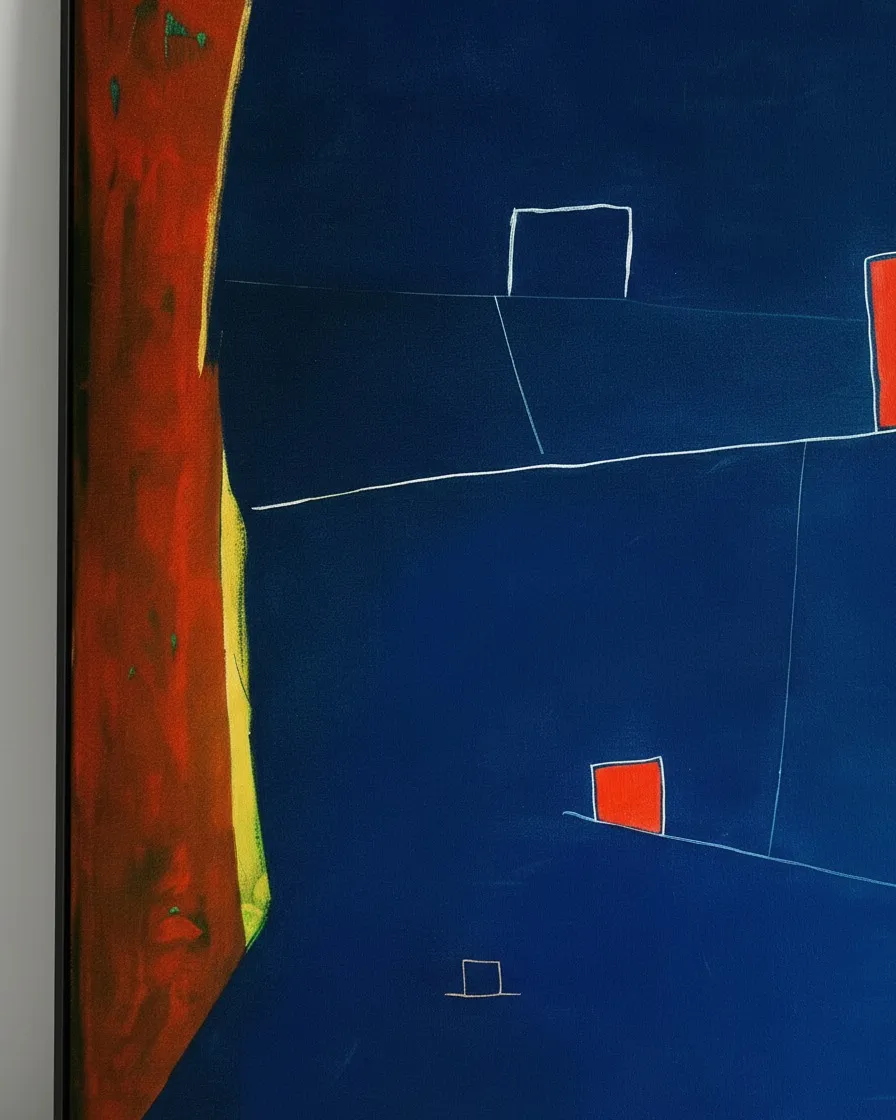
GRADUS - Detail of abstract painting by Maurizio Valch
The gaze is immediately intercepted by a silent yet massive collision of chromatic forces unfolding across the surface of GRADUS. On the far left, a vertical crimson band, dense and charged with an organic vibration, stands not as a simple outer frame, but as a tectonic boundary against the overwhelming immensity of the indigo blue that dominates the rest of the canvas. Here, depth is stripped of the conventions of classical perspective; it does not seek to seduce the eye toward an illusory vanishing point in the distance, but asserts itself as a tactile and gravitational presence pressing frontally upon the spectator. This blue ocean does not represent a passive void or a mere absence of matter, but a dense, almost architectural mass that both supports and exerts pressure on the fine lines and incisions crossing it. The boundary imposed by the red mass thus acts as an act of extreme structural generosity: it is this vertical seam that gives a legible scale to the blue abyss, providing an indispensable physical anchor so that its ungraspable gravity acquires a palpable consistency before our own body.
In the dim light of the studio, the painting reveals itself to me not as a surface to be filled, but as a body that resists and must be questioned through physical wear. To shape GRADUS, my process began by accumulating layers of dense pigment and then initiating a radically subtractive gesture: scraping the surface, wounding the still-fresh oil with the firmness of the tool to bring forth those fine white incised lines that now structure the work. The small crimson block resting on the chalk line is not an added decorative element, but a suspended mass that I placed seeking a communion that lies far from any peaceful or mystical reconciliation; it is a tense, almost violent coexistence between the raw weight of the saturated zones, the active void of the blue, and the extreme fragility of the carved line. It is in this friction, where the support is deliberately worn and torn to allow the underlying light to breathe, where I understand that my craft consists in negotiating with the opposing forces of matter until finding their point of maximum resistance.
Tracing the topography of the canvas, the eye stumbles upon a series of linear elements and small quadrangles that seem to emulate the idea of misaligned steps or niches. However, in GRADUS these elements do not configure a functional staircase nor promise an orderly ascent to a summit; on the contrary, they float disoriented, disrupting any pretension of logical progression or sequential reading. This destabilization of geometric scale forces a reconfiguration of the perception of inhabited space. The composition is thus transformed into a scene of highly silent geometric communion, in which the longitudinal incisions do not act as borders destined to fragment or parcel out the pictorial territory, but as delicate threads of physical contact. These lines function as "tactile shores" that subtly link the vibrant red block floating on the right with the small niches and strokes of the lower quadrant, establishing a network of invisible but decisive tensions that unifies the entirety of the canvas.
Stepping back from the easel and allowing the work to face the real light of the space that welcomes it, I accept that the true generosity of painting does not lie in the accumulation of matter, but in its total surrender to accident, to the gaze of others, and to the passage of time. I have let the canvas reveal its textures and reliefs without hiding the trace of the tool, allowing light to fall upon the irregularities of the surface and alter the perception of color at every hour of the day. I must confess that the authentic depth I pursue with my hands does not hide behind the enigmatic vibration of this indigo blue, but manifests honestly in the very incisions crossing the canvas: they are physical cuts, deliberate furrows that expose the previous layers of color and the support itself upon which they rest. Painting, for me, is not building an illusion of volume, but undertaking an exercise of subtraction and divestment, an act of material honesty where every incision is a necessary wound to discover what truly sustains the gaze.
Finally, the experience of contemplating GRADUS is consolidated in the perception of a dynamic equilibrium that firmly renounces symmetry and mathematical exactness. The lines that fall slightly tilted and the blocks that stand without any apparent anchor manifest a somatic resistance against the grid-like rigidity that usually constricts abstract space. It is in this apparent instability where the governing concepts of the work fully converge: the active depth of the blue that continues to expand before us, the communion of chromatic and spatial tensions that dialogue without neutralizing each other, and the generosity of a pictorial space that offers itself open, without imposing hermetic meanings or univocal narratives. In the end, Maurizio Valch’s work places us before a suspended stillness, a threshold where inhabiting the limit does not mean facing an insurmountable barrier, but learning to sustain oneself in the subtle crevice that separates shadow from light.
- Original artwork
- GRADUS
- Actual dimensions
- 47.2 × 63 in / 120 × 160 cm
- Presentation
- Digital contextual visualization
Context references
abstract painting detail · textured oil painting · blue and red minimalist artwork · Maurizio Valch GRADUS · incised lines in painting
About this visualization
This visualization places the artwork within an architectural context to help collectors and viewers imagine its presence in a real space. It is an interpretive reference, not an exact reproduction: the original work remains the sole authority for scale, color, surface and material presence.