Context study / GRADUS
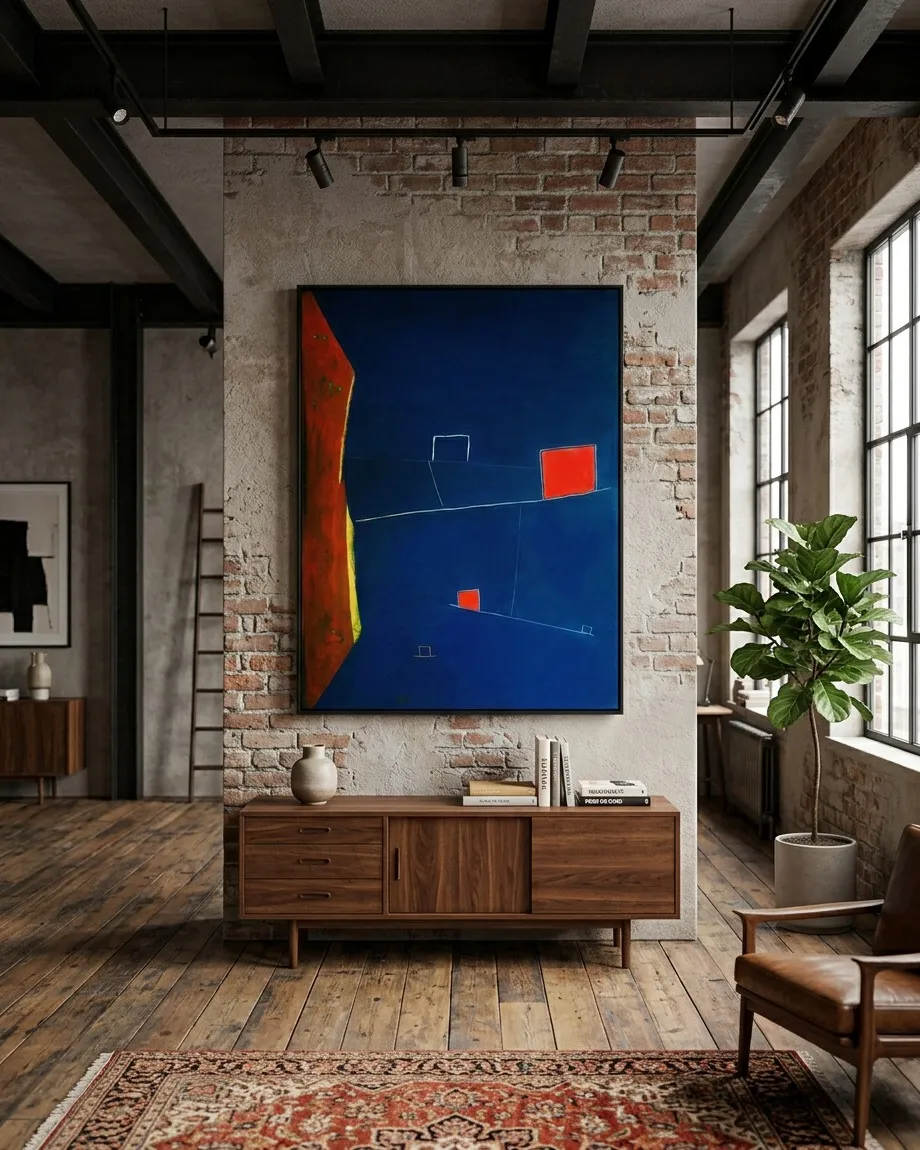
Blue Abstract Painting GRADUS in Rustic Industrial Living Room
The gaze immediately collides with a spatial fracture that divides the canvas into two asymmetric and magnetic realities. On the left, an imposing vertical mass of crimson and orange tones rises like a geological crust, eroded and of an almost tactile roughness, seeming to bear the weight of the entire plane; on the other side, an indigo blue abyss opens up, dense and nocturnal, threatening to engulf any trace of form. Faced with this immensity of 160x120 centimeters, the viewer experiences a sudden helplessness, a physical vulnerability activated by being exposed to such a vast and deserted nothingness. Yet, this void is not a free fall; it is contained and bounded by the resounding permanence of that lateral structure, a chromatic wall acting as a visual and physical refuge, a tectonic boundary that transforms the desolation of the plane into a threshold where the body stops, small yet firmly anchored in its contemplation.
When I face the canvas, the gesture I seek is not that of a docile brushstroke, but that of a physical cleft, the cut that pierces the surface to leave an indelible mark. Those thin white lines crossing the blue void of GRADUS are not superimposed strokes; they are incisions, self-inflicted wounds in the matter where I scrape away the accumulated oil and acrylic to find the hidden support, the truth of the original plane. This process of subtraction is a violent yet necessary dialogue between the resistance of the paint and my own surrender, an attempt to transform my own helplessness before the immensity of the blank canvas into a structure of permanence. By wounding the canvas, I do not intend to represent the pain of existence, but rather to transmute it into a tactile path that assumes its own wear, leaving marks that survive the ephemeral gesture and become the permanent record of a body that insists on leaving evidence of its passage.
Faced with the immensity of the blue void, the viewer's attention is drawn to a series of minimal and suspended elements that defy the gravity of the plane: small blocks of a fiery red that seem to balance upon the incised lines and schematic white steps floating without a clear destination. It is at this point that wonder bursts in with a subtle and silent eloquence, devoid of artifice or stridency. It is astonishing to see how a tiny block of warm color, fragile and helpless before the immense blue night surrounding it, is capable of exerting such a force of attraction that it completely balances the composition. The diagonal lines that descend and suggest a slope are no longer perceived as an inevitable fall, but as a controlled slide, an instant of poetic suspension where the weight of matter and the lightness of drawing agree on a perfect truce.
For me, the deep blue and crimson red I use in this work do not attempt to describe a twilight landscape or a physical horizon, but rather map the exact temperature of my own inner silence. Through color, I seek to suspend the destructive flow of chronological time to settle into a state of permanence, a non-time where external urgencies dissolve and only the vibration of exposed matter remains. Observing the finished canvas now, suspended upon this exposed brick wall under a light that changes throughout the hours, produces in me a profound strangeness and, at the same time, a liberation; it is the moment when I assume my own vulnerability as a creator and turn it into a silent wonder. The painting releases itself from my hands to transform into a box protecting its own secret, a refuge where mystery no longer needs to be explained, but simply inhabited by whoever decides to pause before it.
In the end, the physical presence of GRADUS in real space demystifies any attempt at a purely abstract reading to return us to the pure immediacy of matter and space. The steps outlined on the canvas do not configure a staircase toward celestial redemption nor do they resolve a logical narrative; on the contrary, they force the gaze to return constantly to the rough surface, to the edge of the canvas, and to the warmth of the surrounding environment. The transition before this work is a circular experience that begins in the helplessness of the blue abyss, stabilizes thanks to the permanence of its incised boundaries, and is consummated in the wonder of a precarious yet absolute balance that holds the world in an instant. At that border of silence where the painting breathes, we understand that there is no need to ascend anywhere when the surface of the canvas already contains everything.
- Original artwork
- GRADUS
- Actual dimensions
- 47.2 × 63 in / 120 × 160 cm
- Presentation
- Digital contextual visualization
Context references
decorating ideas with large paintings · blue painting on brick wall · living room with industrial design and abstract art · contemporary rustic living room decor · how to hang large abstract art
About this visualization
This visualization places the artwork within an architectural context to help collectors and viewers imagine its presence in a real space. It is an interpretive reference, not an exact reproduction: the original work remains the sole authority for scale, color, surface and material presence.