THE GOLD NOT WORTH A HUNDRED EUROS
An essay exploring the paradox of value in contemporary art through Maurizio Valch's painting from the STRATA series, sold at auction for exactly one hundred euros.
Published work / STRATA
Matter and memory in a burgundy field of color
 Painting series
STRATA
STRATA brings together abstract paintings in which the surface becomes a territory of pressure, cutting and duration. Amid dense chromatic fields, compact blocks and incisions, Maurizio Valch situates memory as a material trace rather than a decipherable narrative. View series
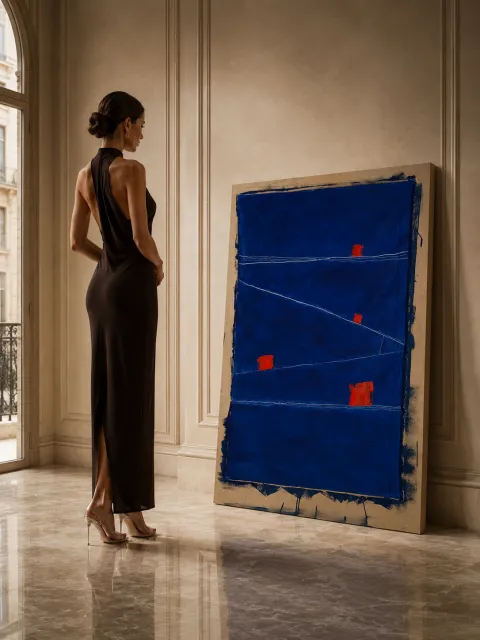
Below, the first line curves like a contour line that has given up on precise measurement. It does not support the space: it barely grazes it, yet forces the eye down toward it, to incline. Along its path, a pale, small, slightly tilted form appears, so minimal it could be mistaken for an interruption in the red. But it isn't. It stays. If these four lines were the only remains of a music that has lost its sound and a night that has lost its prayer, this first presence could be the place where someone stopped walking without quite sitting down. Why does the small thing below seem to keep warmth on a single edge? The question is somewhat childlike, carries a hint of domestic alarm: as if the vast dark field were too large a room and that form had forgotten to turn on a light. The red, almost wine and almost nocturnal earth, does not offer depth as a promise; it offers reserve. Each line is a contour that refuses to be stable, and each block seems to have survived a retreat: it does not announce conquest, only persistence.
On the second line, slightly higher up, the inclination changes. The eye ascends, slips to one side, encounters another small, pale form, and no longer knows if it is looking at a distant house, a fragment of wall, or a body arrested behind an edge. Juan de la Cruz was a poet and mystic who made darkness and the absence of certainty a path of search. Here, his sensibility does not turn red into drama, nor heights into salvation. Instead, it recognizes a geography of dispossession: increasingly silent boundaries, shelters that promise no protection, signs left behind when almost everything else has withdrawn. The question shifts: it is no longer about who inhabits these small forms, but how much emptiness a small thing can hold without ceasing to be a thing. The line seems to say: there is still ground. The block replies: perhaps, but not much.
I look at the surface, and the distance between one line and another does not behave as a fixed distance. At times I seem to ascend; at others, everything descends, leaving me behind. I see the pale forms and cannot decide whether they assert themselves or are on the verge of disappearing. As I draw closer, the red becomes less compact than it seemed; as I move away, the lines begin to order something I cannot name. I cannot guarantee there is withdrawal, prayer, or dance here. I only perceive that a minimal presence alters an entire field, and that this alteration forces me to look again.
The third line, almost horizontal, introduces a stranger pause. There, the paint seems to hold its breath. The small block toward the right could be a tiny room facing a doorwayless landscape; it could also be a slight blow of light that has learned to stay still. Its clarity does not defeat the red: it makes it denser around it. Architecture returns as rhythm. An edge, a pause, a place where the eye touches something and bounces back. Then Joséphine Baker breaks in. She was a performing artist who made the body and rhythm an energy capable of transforming an entire space. Before this line, the blocks stop behaving merely as ruins or hermitages: they begin to act as scenic apparitions, sudden beats of presence in a choreography devoid of human figures. The lines, once read as strata or horizons, become irregular tempos. One advances, another lingers, another seems to lose its pulse only to find it higher up. There is an almost comic moment: the block on the right seems to have arrived late to an appointment no one scheduled. Yet that slight awkwardness opens up air. It does not trivialize the darkness; it makes it breathable.
Baker’s sensibility, however, meets an obstinate resistance. There is no applause, no speed, no recognizable body to confirm the dance. The rhythm happens almost motionless. What seemed a tempo returns to silence, though a silence that has already learned to shrug a shoulder. The gravity Juan found in the lines does not disappear: it shifts its weight. A presence can have a pulse without becoming a spectacle; it can wish to be seen without occupying everything. And dispossession need not be merely renunciation: it can harbor humor, desire, a minimal whim of survival. The childlike question returns, modified: perhaps the thing below does not keep warmth on an edge; perhaps it is rehearsing a way of not growing cold while waiting for the line to pass beneath it once more.
After this motionless rhythm, I feel the painting has separated itself from me, no longer accepting to be traversed as a familiar surface. I look at it and discover its lines do not obey the route I imagined. I want to follow them upward, but they return me downward; I want to read the blocks as presences, but at times they look back at me like voids. I cannot fully retrieve what has been left there. I can only accept that something in this painting demands an attention I do not yet know how to give.
On the fourth line, the highest, the displacement becomes subtler. It rises toward the right, thins out, hesitates at the edge of the red territory. Near it, a pale form appears as a minimal construction or a sign left by someone who did not wish to explain their gesture. Now the verticality of the canvas weighs on the body: the eyes ascend, pause, fall back toward the middle line, repeat the journey. It remains unclear whether the movement is ascent or descent. Perhaps reading traces consists in accepting this confusion: a contour becomes a tempo, the tempo becomes silence, the silence a bodily trace so slight it barely dares to claim space.
VESTIGIA retains its suspicion without resolving it. Something happened here, but one might also think the marks are still waiting for the event that will make them necessary. In the upper section, where the pale line approaches the right edge and seems to continue outside the frame, a minimal deviation remains—an insecurity in the path. Beside it, the small pale block is not quite shelter, stage, obstacle, or body. It remains there, barely separated from the red, as if it had just discovered someone was watching and did not yet know whether to stay or withdraw.
STRATA is a series of material-based abstract paintings by Maurizio Valch, made with acrylic and oil on canvas. Its stratified surfaces, chromatic fields, blocks and incisions construct territories of pressure, memory and transformation.