Context study / VESTIGIA
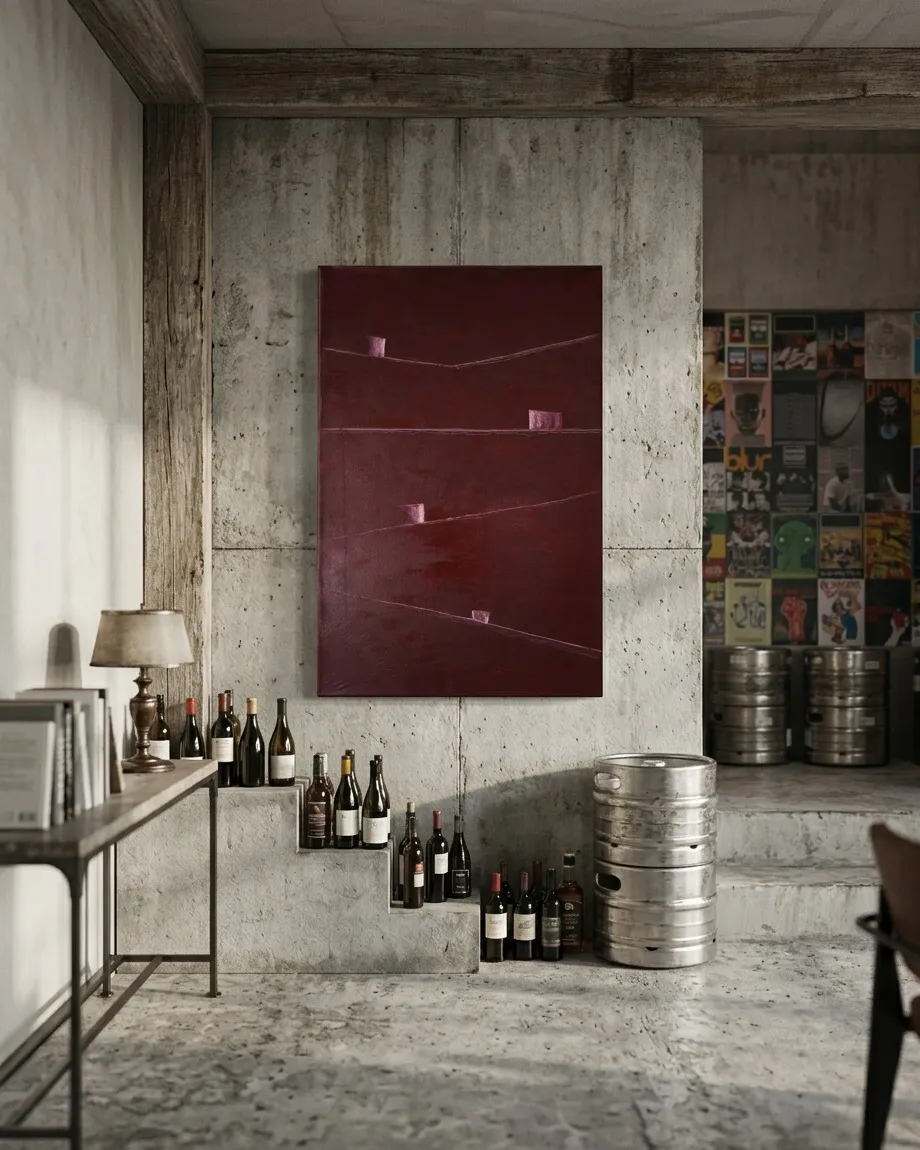
Vestigia Artwork by Maurizio Valch on Exposed Concrete Wall
VESTIGIA (80 × 120 × 3 cm)
Place yourself mentally several meters from the artwork. Do not approach the small pale blocks just yet. First, look at the red that separates them. See if that red feels like a background, an atmosphere, a wall, a skin, a sloped floor, or a darkness that has learned to stand still. From afar, the four pale lines might promise an organization: they seem to distribute heights, assign pauses, hint at an above and a below. Yet none manages to become a horizon. They can barely be followed. The first rises and flattens without settling; the second seems to hold the field and, at the same time, loosen it; the third opens a distance that does not become depth; the last retreats toward an edge as if it had already begun to abandon the painting.
The upper line does not order the red: it makes it vaster. It has something of a slope seen from the side, of an edge that has yielded slightly under an unknown weight. Near it, a small pale presence interrupts the continuity. It could be a block. It could be the corner of something. It could also be a minimal clarity that the red has not yet finished absorbing. Then a possibility of landscape appears, but fails immediately: there is no sky, no stable ground, no distance that can be measured without becoming something else. Only a subtle tilt and a pale mark that seems to have run out of scale.
Charlotte Perriand, an architect and designer who understood space as a form of bodily freedom, coexistence, and a living relationship with the landscape.
Perriand does not see symbolic forms here. She sees small constructions that force us to ask about scale. Are they tiny shelters? Impossible buildings? Remnants of gigantic furniture observed from very far away? Under this suspicion, the first line, which seemed like a slope, transforms into a built edge: a surface upon which something should be able to rest. However, the blocks offer no door, window, or recognizable use. They do not invite. They are there with the somewhat insolent discretion of a minuscule architecture that might be looking at the viewer and not the other way around. Instead of reducing the void, they enlarge it. They make the red seem like a room without walls, too vast for a person to call it a room.
I find myself before these distances as before a silence I did not expect to be so firm. I would like the forms to guide the gaze, for one to lead to the other, but between them the red resists and becomes more autonomous. Sometimes it seems the lines sustain an order; other times, that they barely preserve the memory of having tried. I cannot decide if the small pale shapes are approaching or receding. The image does not entirely obey the reading I offer it, and in that refusal it begins to breathe differently.
The second line seems stiller, though it does not rest. It can be read as a seam running across the surface: a faint union between two extensions of the same matter, or a separation that resists opening. The surrounding red shifts in temperature. Above, it is more contained; below, it seems to thicken, as if it had depth without ever becoming a background. Perriand insists: even an inhospitable place demands imagining a way to inhabit it. Perhaps these pale presenses signal possible positions, not to enter them, but to calibrate from where one is looking. They are measures that do not measure the same thing twice.
But a seam is not enough to hold a body.
Maurice Merleau-Ponty, a philosopher who thought that the body does not only look at the world: it also knows it from within, by inhabiting it and being affected by it.
Merleau-Ponty disorganizes Perriand’s spatial hypothesis without needing to deny it. What happens to the body when a line seems horizontal but ascends, tenses, or slides? What happens when a pale point seems close and yet the eye cannot reach it? The gaze tries to walk through the painting and discovers it has no floor. The second line is no longer a seam between zones: it is an irregular breath, a pause that forces the eye to lose its rhythm. The territory is perhaps not in front of the viewer. Perhaps it occurs between the tilt of the head, the desire to follow a stroke, and the instant that stroke pulls away.
The third line makes it harder to decide. It descends slightly, or seems to. It approaches one of the small pale blocks and leaves it suspended in an imprecise relationship: is it on top, is it behind, has it fallen from there, is it being measured by the line? Perriand might say that every spatial arrangement claims a possibility of stay, however precarious. Merleau-Ponty would reply that here, to inhabit does not consist in settling down, but in accepting an incomplete orientation. The friction between them produces neither a plane nor a landscape. It produces a test of orientation without arrival.
Then a child’s voice interrupts with a precision that no discipline had asked for: if those little houses stand on the lines, why do the lines run away without carrying them?
The question does not make the painting simpler. It makes it strangely tender. Suddenly, the small blocks cease to be architecture, signals, or faulty measures; they could be things that have lost the right to be used. The red surrounds them without embracing them. It does not threaten them, nor does it protect them. It keeps them at a distance that cannot be counted. The third line, once a breath, now seems the edge of something unseen: a platform too narrow, a crack without an opening, the trace of a movement that no longer has a body.
I look at the finished work and find a zone that does not entirely belong to me. The gaze lingers on the red, seeks balance, tilts with the lines, and wants to draw close without quite arriving. I am not sure these marks lead anywhere; perhaps they preserve a trace of movement, not a path. I can imagine the need to inhabit that space, but I also feel that any settling there would be too hasty, as if naming a shelter closed a distance that still insists on remaining open.
The last line is lower down and seems to recede toward an edge. At first, it could have been a final slope, a way of ordering the descent. Now it carries with it the seam, the breath, the faulty measure, and the question of the house that does not wish to be reached. Its tilt does not guide. It barely deviates. Against the reddish field, which absorbs the light around it and returns it with a dense calm, the low line performs a minimal disobedience: it moves away while the eye continues to believe it can follow it.
- Original artwork
- VESTIGIA
- Actual dimensions
- 31.5 × 47.2 in / 80 × 120 cm
- Presentation
- Digital contextual visualization
Context references
abstract painting for concrete wall · original contemporary brutalist painting · industrial decor with abstract art · buy abstract painting maurizio valch · textured wine red painting living room · incised paintings from strata series
About this visualization
This visualization places the artwork within an architectural context to help collectors and viewers imagine its presence in a real space. It is an interpretive reference, not an exact reproduction: the original work remains the sole authority for scale, color, surface and material presence.