THE GOLD NOT WORTH A HUNDRED EUROS
A True Fiction on Art, Money, and What We Cannot Measure
I. THE SENTENCE
There is an invisible moment in which an ordinary object ceases to belong to the order of physical things to enter that of things judged. This transition rarely leaves a mark on matter. A porcelain plate, a carved piece of wood, or a canvas covered in pigment retain the exact same weight and temperature before and after receiving a sentence. Yet, their relationship with the world is broken forever. Someone, invested with authority delegated by the consensus of an era or a digital platform, has pronounced a figure. And that figure, like a bureaucratic spell, draws a border between what deserves to exist and what must be relegated to the oblivion of attics or deserted auctions.
In October 2026, an art expert named Heiko Neitzel viewed the image of a painting through a screen. The work, belonging to Maurizio Valch's STRATA series, measured 120 by 80 centimeters. It was a dense territory of glowing oranges, coarse-grained ochres, and horizontal bands of dark violet and earthy red that seemed to have been dragged by a slow, heavy palette knife, as if the painting itself were trying to remember the movement of geological sediment. In the middle of this chromatic plain, suspended at various heights, emerged small gold rectangular blocks—marks of a timid clarity that seemed to indicate an order prior to any map. The expert, analyzing the piece from the neutral distance imposed by digital catalogues, issued a brief judgment: he considered it highly unlikely that the painting would reach a value of one hundred euros in a public auction.
The sentence did not lack logic within the parameters of a market saturated with images. What, after all, is a painted canvas but a promise seeking a buyer? However, the painter did not receive the ruling as a commercial slight, but as a material revelation. The painting, which until then had responded to a purely formal impulse regarding the stratigraphy of landscape and mineral memory, found its true conceptual core in this rejection. The painting did not need to be corrected to please the market; the market's gaze had to be incorporated into the painting itself. The artist decided to rename the work through an intervention that would transform its ontology forever: The Gold Not Worth a Hundred Euros.
From that moment on, external economic opinion ceased to be mere background noise and became the title, the invisible signature, and the destiny of the work. The canvas no longer contained only pigments and binders; it now carried a public doubt about its own dignity.

The Gold Not Worth a Hundred Euros is presented in an environment of exposed concrete and contemporary furniture, where its warm strata contrast with the industrial austerity of the space.
By placing the painting in a contemporary interior with sober lines, the mass of color seems to retain a temperature foreign to the surrounding architecture. It does not function as an ornament; it functions as an anomaly. Its presence forces us to ask whether what we are observing is an abstract landscape or the record of a loss. Anyone walking past it in a room where concrete and metal impose their cold law cannot help but feel the tension between the solidity of the walls and the instability of a surface that, according to an official ruling, is not even equivalent to the value of a green one-hundred-euro note.
Valch's gesture is not entirely new, but it acquires a different gravity in the era of algorithmic valuation. It connects directly with the drifts toward the dematerialization of art that shook the second half of the twentieth century. We think, for example, of Piero Manzoni when, in 1961, he canned his own Merda d'artista in thirty-gram metal tins, selling them at the exact price of gold in that specific market. Manzoni was not simply trying to provoke; he was revealing that value does not reside in the material used, nor even in the skill of the artisan, but in the contract of faith that the viewer decides to sign with the author. Manzoni's gold was his own biology elevated to the status of a fetish through a signature. In Valch's case, the operation is inverted: real gold, deposited in small metallic leaves upon the canvas, is stripped of its mythical value by the appraiser's suspicion. Gold is no longer the standard of measure; it is that which falls short of the measure.
II. THE GREAT FICTION OF VALUE
To understand how a painting can be altered by a figure, it is necessary to question the very nature of that collective fiction we call money. We tend to believe that the coins and banknotes we carry in our pockets possess an intrinsic reality, a core of solidity comparable to ashlar stone or a piece of iron. We forget that money is, above all, a linguistic and social construct, an agreement of wills sustained by repetition and custom.
The Belgian economist Bernard Lietaer, one of the grand architects of the euro and an acute researcher of monetary systems, dedicated a large part of his life to demonstrating that currencies are not merely neutral instruments for the exchange of goods. In fundamental works such as People Money: The Promise of Regional Currencies (2012) or Money and Sustainability: The Missing Link (2012), Lietaer explained that money is "an agreement within a community to use something as a medium of payment." This agreement is, at its heart, a structure of trust that shapes human relations and determines which aspects of collective existence we deem valuable and which we condemn to invisibility. For Lietaer, the systematic scarcity of money that characterizes our societies is not a natural fact, but an institutional design that favors competition over cooperation.
When Heiko Neitzel determined that The Gold Not Worth a Hundred Euros would not reach that figure, he was not describing a physical property of the painting. He was not measuring the quality of the linen, the purity of the acrylic, or the time the painter spent in his studio scraping and reapplying layers of paint. He was applying a classification system based on scarcity and the expectation of a quick resale. The contemporary art market operates under this very premise: exchange value devours use value, and the painting becomes just another currency, a coin whose value fluctuates according to the reputation of its issuer.

The canvas from the STRATA series in a Mediterranean-inspired living room, where its mineral textures dialogue with the warmth of handcrafted plaster and clay vessels.
Let us observe for a moment the painting installed in a space of textured walls and natural light. Here, the conversation changes its tone. In this living room, which seems built from the very materials of the earth, Maurizio Valch's canvas ceases to be a disputed commodity and becomes a center of gravity. The ochre and reddish tones integrate with the ceramics and worn woods, suggesting a domesticity measured not in financial transactions, but in hours of habitation and contemplation. In this context, the expert's verdict reveals its profound limitation: how does one measure in euros the minutes in which the afternoon light passes through a hallway and ignites the small gold marks on a surface?
To find a scale of value that escapes the logic of the rapid market, we can turn our gaze to medieval cathedrals. The construction of Notre-Dame de Paris, which began in the twelfth century and spanned generations, was not financed by bank loans oriented toward short-term profitability. It was a collective effort sustained by donations from kings, nobles, bishops, and, significantly, by the city's guilds of artisans. The bakers, shoemakers, and weavers did not contribute money in the hope of receiving a financial dividend; they paid for the construction of the stained-glass windows to inscribe their presence in the cathedral's great book of stone and to ensure their participation in a sacred order that surpassed their own individual existence. The value of Notre-Dame did not lie in the sum of the prices of its limestone blocks and oak timbers, but in the capacity of that architecture to unify the faith, memory, and labor of a community over time.
When Notre-Dame partially burned in April 2019, a telling phenomenon occurred: within a few hours, some of the planet's greatest fortunes pledged hundreds of millions of euros for its reconstruction. This burst of generosity was not due to a sudden interest in the conservation of Gothic heritage, but rather to the need of these large corporations to associate their names with the most enduring symbol of French identity. By buying their share in the reconstruction of the temple, they were acquiring a portion of its mythical value—a transaction that Bernard Lietaer would have analyzed as an attempt to transform fiat money into symbolic capital of secular duration. Notre-Dame proved that, even in the twenty-first century, supreme value is not calculated through financial formulas, but through the relationship a society maintains with its collective myths.
A painting, a coin, and a cathedral are different ways of materializing an agreement. Lietaer's money requires us to believe that a piece of paper is worth more than its material substance in order to buy bread; Notre-Dame's stained glass requires us to believe in eternal salvation to give meaning to a lifetime of effort; Valch's painting requires us to agree to stop before a surface to discover that an orange boundary can also be a horizon upon which to rest our gaze.
III. THE ART THAT ESCAPES PAINTING
When an artist renames their work based on an economic devaluation, they are committing an act of semiotic sabotage. The painting ceases to be a passive object exposed to the gaze and transforms into an active device that interrogates anyone who attempts to price it. Where does the work reside now? In the wooden stretcher, in the dry pigments on the canvas, or in the invisible space separating the expert's opinion from the artist's decision?
This shift of art toward the territory of transaction and social relations has one of its purest precedents in the actions of Yves Klein. Between 1959 and 1962, Klein carried out a series of transfers he termed Zones de Sensibilité Picturale Immatérielle (Zones of Immaterial Pictorial Sensibility). The proposal consisted of selling a portion of empty space in exchange for a fixed quantity of pure gold. For the transaction to be aesthetically valid and for the buyer to truly acquire "immaterial sensibility," a precise ritual had to be celebrated on the banks of the Seine: the artist handed over a ritualized receipt, the buyer had to burn said receipt, and Klein threw half of the gold into the river, returning the matter to nature while destroying the document that certified private ownership.

Hung on an exposed concrete wall in a room that combines antique textiles and clay objects, Maurizio Valch's painting asserts itself as a meeting point between matter and void.
Klein's lesson is radical: art is not the object bought; it is the experience of letting go that occurs during the exchange. In The Gold Not Worth a Hundred Euros, the transaction also becomes the true engine of the work. The painting can no longer be looked at with the innocence of someone contemplating an abstract sunset in warm tones. Every time we observe the painting hanging on a concrete wall, surrounded by objects that evoke an austere and intellectual life, the work forces us to participate in the judgment. Is this canvas a conceptual fraud or one of the few material truths left to us in a world where everything has become virtual?
An analysis of the composition reveals a tension that goes beyond the anecdote of the price. The horizontal violet and red bands do not divide the space geometrically, but seem to support it with difficulty, as if they were beams of an architecture about to collapse under the weight of the dominant orange. In this sense, it is evocative to recall Carl Gustav Jung's theories on archetypes and the persistence of certain images in the collective unconscious. The gold rectangular shapes that Maurizio Valch scatters across the surface could be interpreted as marks of an ancestral order, small remnants of a forgotten temple, or signs of a path that no one remembers traveling. Jung would suggest that we are drawn to this painting not for what it consciously represents, but because it reactivates in us the memory of a primordial relationship with matter and the earth.
However, this search for transcendence runs the risk of becoming a comfortable habit, a form of aesthetic consumption that anesthetizes our perception. Here, the warning of Georges Gurdjieff intervenes—the thinker who dedicated his life to denouncing that human beings live in a state of deep, mechanical sleep, repeating movements and judgments without any real self-awareness. Gurdjieff would remind us that looking at a painting in a gallery and nodding gravely at its "abstract beauty" is an automatic reaction, a behavior programmed by the culture of our time. True art, in his view, should act as a shock, a tolling of a bell to awaken us from our daily lethargy.
The change of title from Compages to The Gold Not Worth a Hundred Euros functions precisely as that Gurdjieffian shock. By introducing the ridiculous figure into the title, the artist breaks the sacred distance of the art gallery. He forces us down from the heights of pure contemplation to step into the mud of economic valuation. The painting questions us: how much would you be willing to pay for your own awakening? A hundred euros? Ten thousand? Or the price of an entire life dedicated to sustaining an attention that produces no accounting profit?
IV. THE HUNDRED-EURO BUYER
The history of a painting, like that of a life, is built through accidents that no prior logic could have predicted. After Heiko Neitzel's ruling and Maurizio Valch's subsequent conceptual intervention through the title change, the work was presented once again on the auction platform Catawiki. On this second occasion, under the gaze of another expert who valued the work according to the traditional canon of gallery prices, the public estimate was set between 1,600 and 2,000 euros. It was decided to present the work without a reserve price—that is, allowing the bidding to start from the first euro and letting the market dictate its absolute verdict, without safety nets.
What happened next belongs to that category of events in which reality seems to agree with literary fiction to produce perfect symmetry. After several bids and discussions on the digital forum, the virtual hammer fell on the day of the sale. The painting was sold for exactly one hundred euros.
Neither ninety-nine nor one hundred and one. Exactly one hundred euros. The buyer, a real person residing in Spain, had acquired a work whose title categorically asserted that the gold it contained was not worth that very amount. At that exact instant, the paradox closed in on itself like a perfect trap: the painting came to be worth exactly what its name denied it was worth, turning the acquisition into a historical record of a self-fulfilling prophecy.
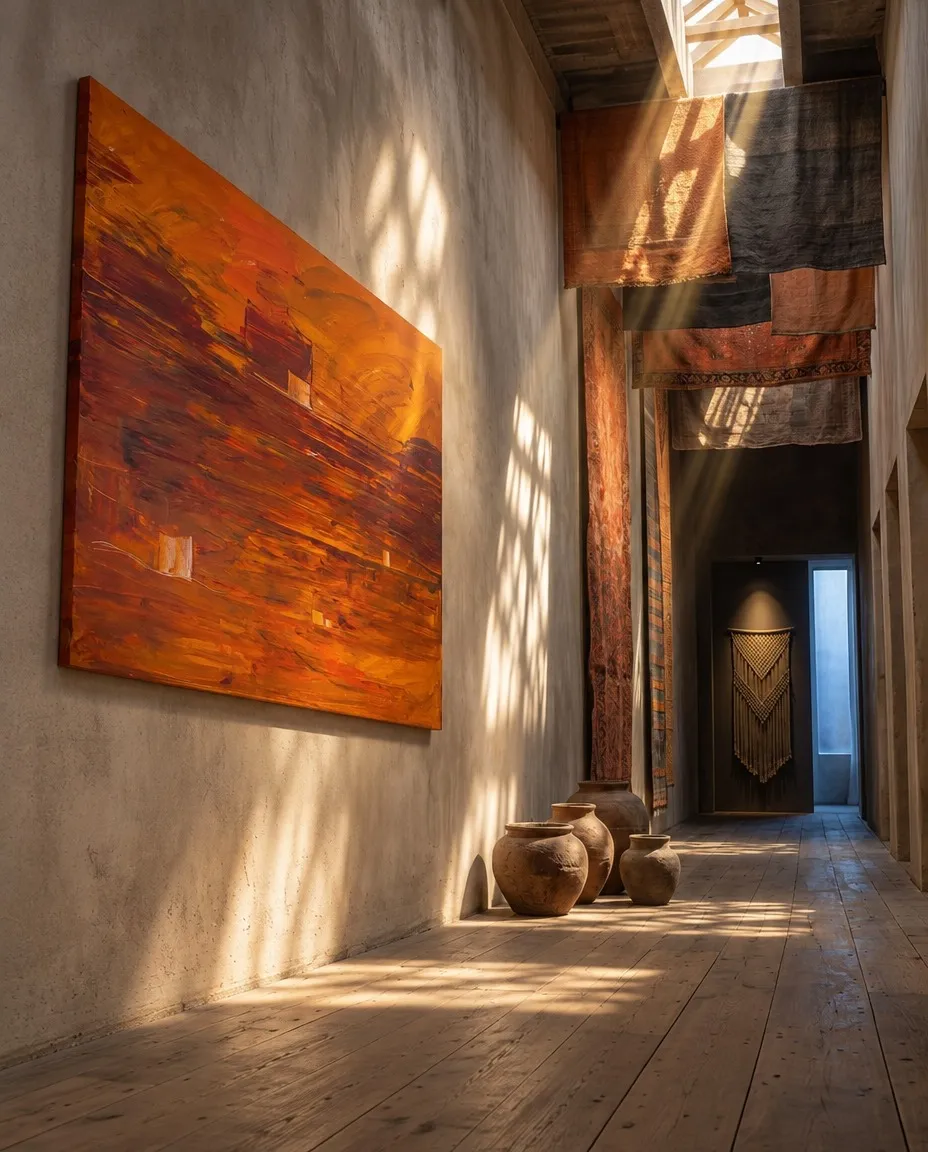
The work installed in a hallway, where overhead light slides over the textured wall and clay vessels, creating a play of shadows that alters the reading of the canvas.
Installed in a hallway where the light shifts with the seasons, the painting begins a new phase of its existence. It has ceased to belong to the artist's studio and the servers of the auction house. It is now a fragment of a home, a daily presence coexisting with the passage of days and the silence of hours. Anyone walking down this corridor does not contemplate mere decoration; they contemplate a document of transit, a pact sealed on an October afternoon between a creator, a distant appraiser, and a buyer who decided to risk a round figure to possess a portion of sensibility.
The transaction also introduces a contemporary dimension that did not exist in the era of Yves Klein or Piero Manzoni: the participation of artificial intelligence in the construction of meaning. During the weeks of discussion surrounding the work's valuation, a neural network was used to analyze the conceptual conflict and propose potential artistic paths. This intervention adds a new layer to the STRATA series: the gaze of a machine that has no body, cannot feel warmth before the orange of the painting, and does not know what one hundred euros can buy in a supermarket, yet is capable of processing the laws of semantics and the market to suggest that reality is composed of overlapping layers, much like oil on canvas.
Today, the destiny of the work remains open. There is a future possibility, raised as a hypothesis by the artist: a proposal to repurchase the painting from its current owner in Spain. Would the buyer agree to part with it for the same hundred euros it cost them? Would they demand a higher amount, arguing that the conceptual value of the piece has grown since the paradox became flesh in their living room? Or would they refuse to sell it at any price, preferring to keep on their wall the testimony of an afternoon when the art market committed the indiscretion of coinciding with poetry?
If the artist were to succeed in repurchasing the work for the same amount, the cycle of immateriality would be completed in an even more radical way than Yves Klein's ritual on the banks of the Seine. The money would have come and gone without altering the painting, but in that round trip of a hundred-euro note, the work would have become charged with a human story that no digital expert will ever be able to undervalue again.
Having reached this point, the narrative must abandon the protection of the third person to turn toward you, who have spent your time following these lines. Upon beginning to read this essay, you likely thought you were facing a philosophical parable, an ingenious fiction constructed to illustrate an academic theory about the art market or the nature of value. You now know that everything narrated truly happened: Heiko Neitzel exists, the Catawiki platform registered the sale, the Spanish buyer has the painting in his home, and the canvas you see in the images contains real gold that was appraised below its symbolic weight.
Yet the true revelation does not lie in the documentary confirmation of the facts, but in your own position as a witness to this process. By reading about the expert's rejection, about Bernard Lietaer's theories, and about the final hundred-euro sale, you have been doing exactly what the painting investigates: you have been attributing value. You have judged the artist's sanity, the appraiser's competence, the buyer's audacity, and the relevance of this very text. You have decided, consciously or automatically, whether this story is worth the time you have invested in it.
In doing so, you have become part of the work. You have added a new, invisible layer to the STRATA series. Art is no longer locked inside the wooden frame or on the web server of mauriziovalch.com; it has escaped the canvas to occupy the space of your own attention. In a world where everything seems priced in advance by an invisible algorithm, the decision of what truly matters remains the last territory of freedom we have left. A territory that, fortunately, is not yet worth a hundred euros.
Bibliography and Research References:
- Lietaer, Bernard; Kennedy, Margrit; Rogers, John. (2012). People Money: The Promise of Regional Currencies. Triarchy Press.
- Lietaer, Bernard; Arnsperger, Christian; Goerner, Sally; Brunnhuber, Stefan. (2012). Money and Sustainability: The Missing Link. Triarchy Press.
- Lietaer, Bernard; Dunne, Jacqui. (2013). Rethinking Money: How New Currencies Turn Scarcity into Prosperity. Berrett-Koehler Publishers.
- Klein, Yves. (1959-1962). Zones de Sensibilité Picturale Immatérielle. Historical record of transactions in Paris.
- Manzoni, Piero. (1961). Merda d'artista. Preserved at the Tate Gallery in London and the Museo Novecento in Milan.
- Asociacion de Amigos de Notre-Dame de Paris. (2019). Reports on collective funding and private donations following the fire of April 15, 2019.
- Archivo Documental de la Serie STRATA. (2026). Correspondence and records of the auction of the work The Gold Not Worth a Hundred Euros on Catawiki, under the lot of Maurizio Valch.