

Published work / STRATA
SIGNUM
From the STRATA series: matter as a record of what remains
- Size
- 31.5 × 47.2 in / 80 × 120 cm
- Series
-
STRATA
 Painting series
STRATA
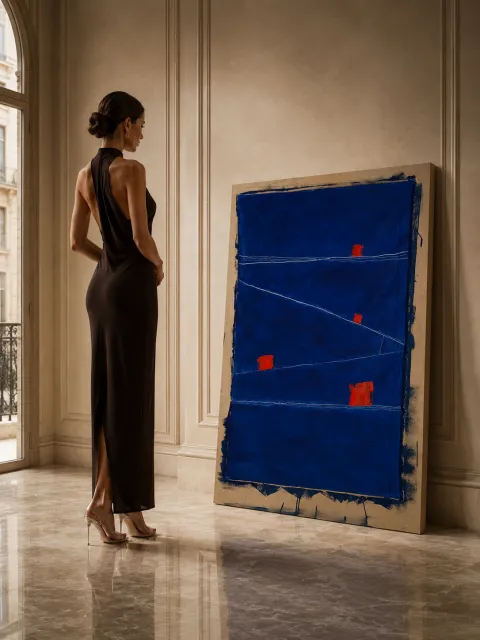
STRATA brings together abstract paintings in which the surface becomes a territory of pressure, cutting and duration. Amid dense chromatic fields, compact blocks and incisions, Maurizio Valch situates memory as a material trace rather than a decipherable narrative. View series
- Context studies
- 8
Conceptual Note
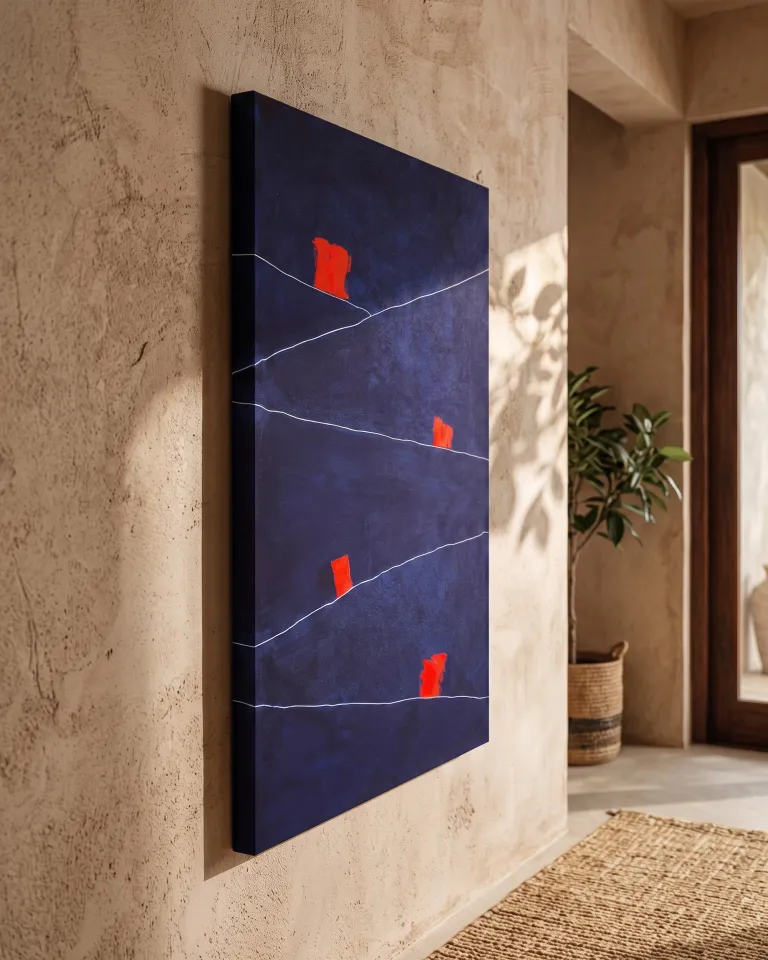
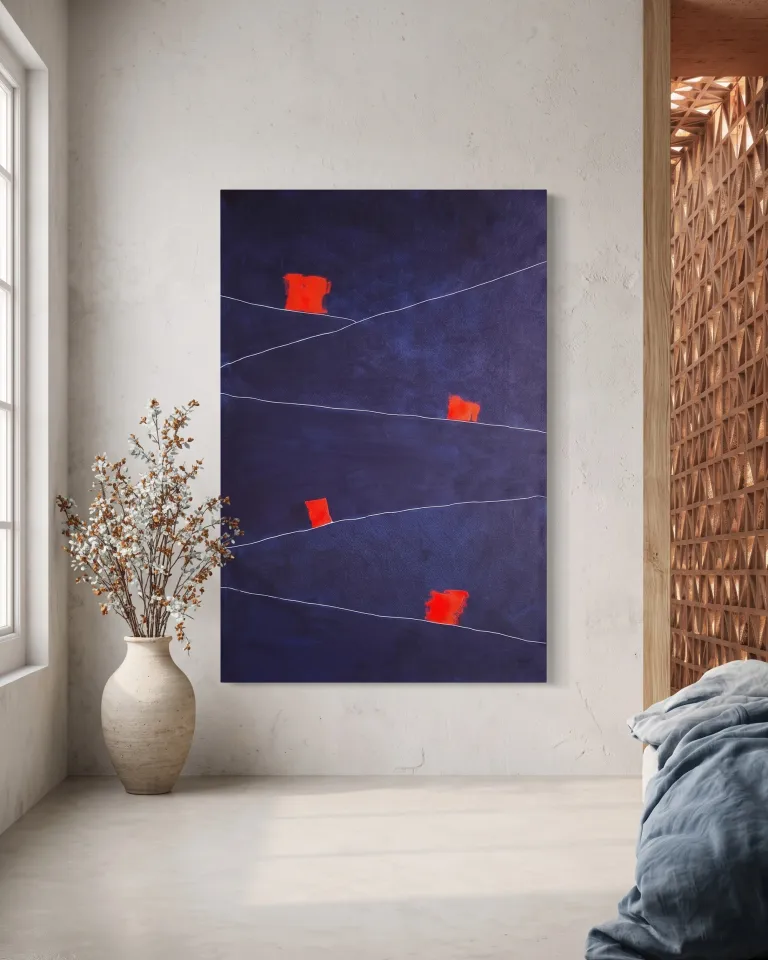
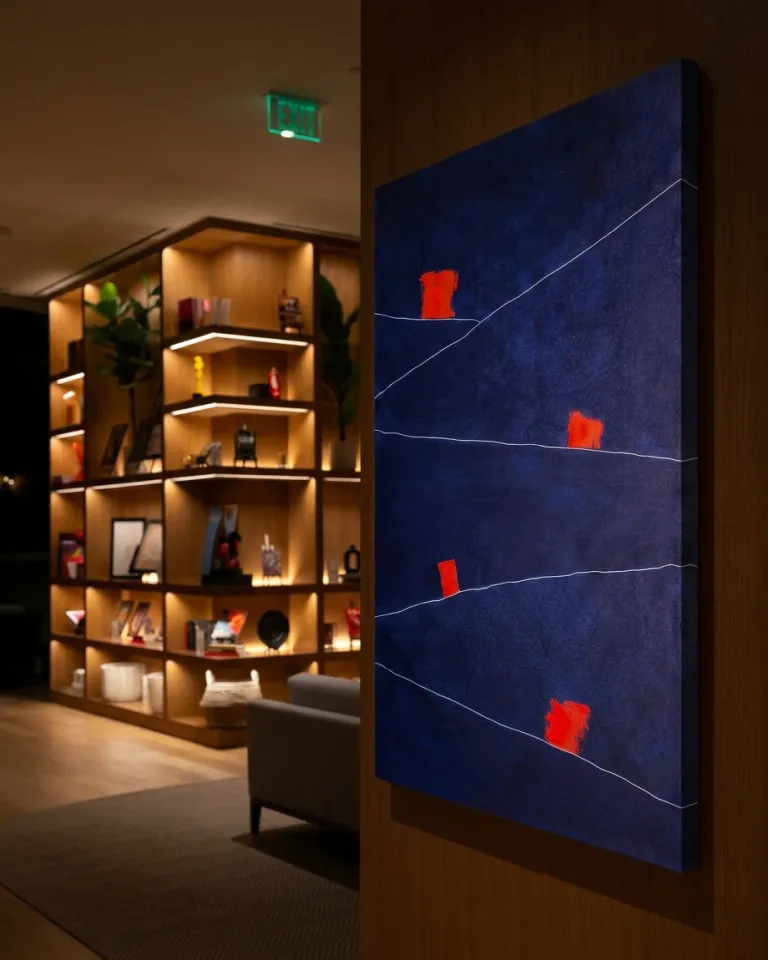
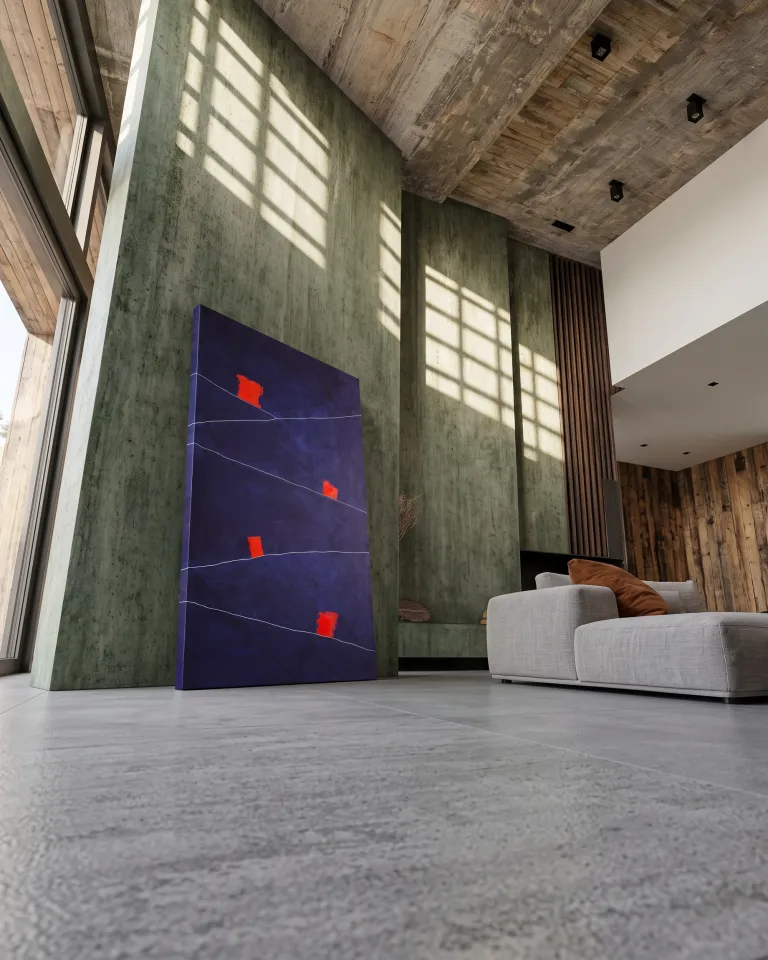
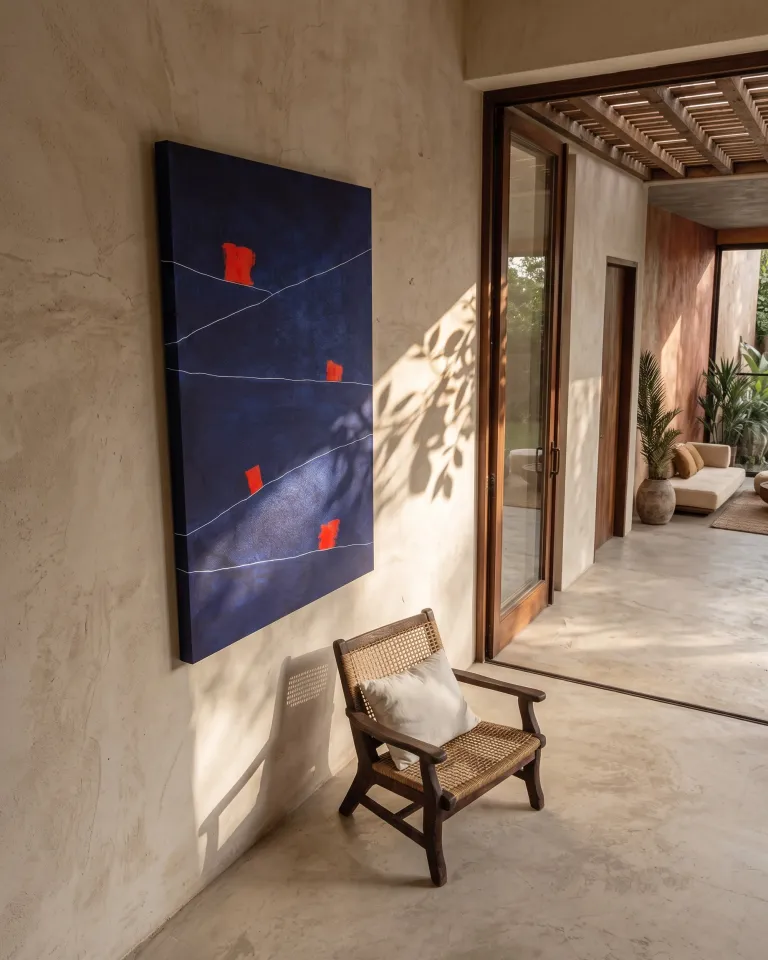
The gaze plunges directly into a chromatic gloom where the density of an almost unfathomable indigo blue acts as the background and resistance to vision. Four textured, crimson red masses appear to ascend discontinuously, supported by very fine white oblique lines that cross the canvas from one end to the other, interrupting the uniformity of space. This arrangement suggests a suspended tension, a structure of calculation where linear trajectories operate almost as rails or predetermined guides to support a series of chromatic weights. At this point, a suspicion arises that is close to G. I. Gurdjieff’s thought on automatism and self-remembering: these diagonal paths could be both the rails of an inevitable perceptive gear and the steps of a scale of attention that forces the viewer to trace the plane to awaken from their contemplative lethargy, deciphering the relationship of gravity and balance between the blocks.
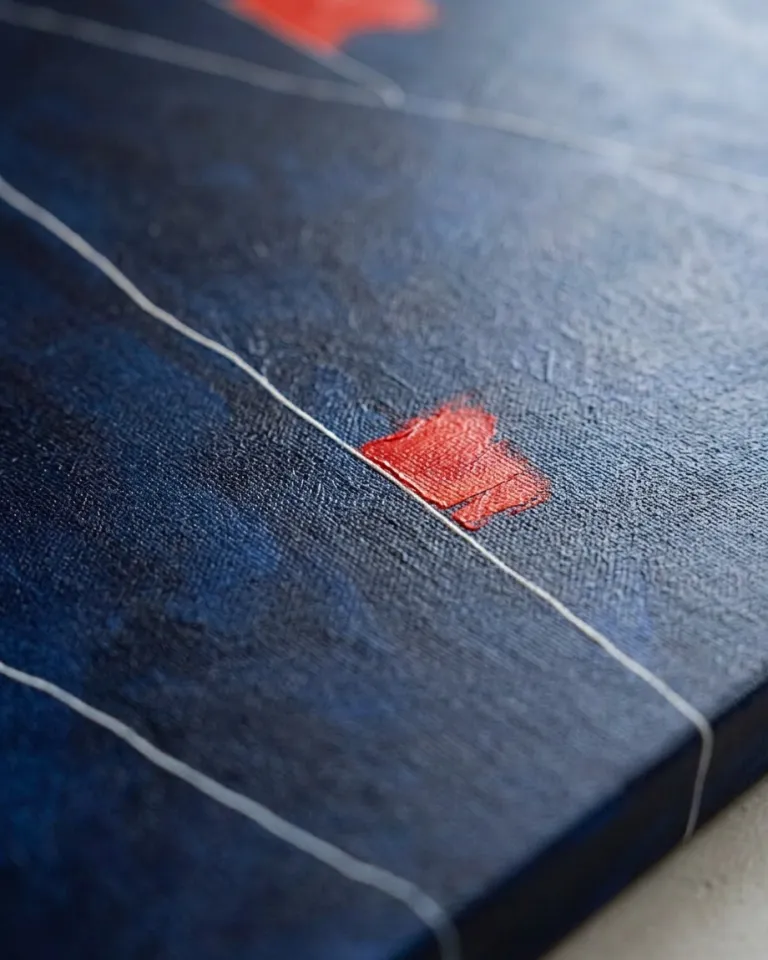
When confronting the linen support, I seek for the material to offer real resistance, a physical weight that opposes the mere illusion of depth. I apply the crimson acrylic with a palette knife, seeking a dense, pasty charge that accumulates light in its reliefs and breaks the apparent calm of the blue surface. The white lines are not light brushstrokes added on top of the finished canvas; they are deep incisions, physical clefts made in the layers of wet pigment that reveal the base of the painting, opening a kind of seam or border within the chromatic mass. Engraving that thin cleft demands a dry and definitive pulse, a direct cut that halts the vibration of the indigo blue and establishes a rigorous spatial coordinate upon which the red blocks must settle and resist.
Stepping back from these red marks and linear cuts, the mind is drawn into an archaic temporal dimension that evokes the birth of the first human sign in the darkness of Paleolithic caves such as Altamira. Those primitive imprints on rock were not born as ornaments, but as gestures of domesticating the void, marks intended to fix a conscious presence before the immensity of nature. Following Mircea Eliade’s analysis of how sacred space is founded from a point of orientation that introduces order into the surrounding chaos, these crimson blocks act as foundational landmarks. They are small dolmens of pure pigment that organize the void of the canvas, transforming a two-dimensional background into a territory that is habitable and comprehensible to the human eye.
However, I do not intend for the canvas to become an illustration of anthropological theories or an archaeological key to deciphering the past. In the silence of my studio, working with paint is a much more physical and immediate matter, guided by the pure intuition of balance and the uncertainty of not knowing where the next plane of color will fit on the blue surface. The deep blue and dense red act here as brute forces, physical polarities that clash on the canvas before any viewer attempts to cover them with words or metaphorical concepts. In the end, what interests me is sustaining that pure vibration of matter in space, letting the painting defend itself in its own two-dimensional reality and resist the desire for explanation.
The vertical format of one hundred and twenty by eighty centimeters establishes a scale that dialogues directly with the physical structure of the observer's body. Approaching the surface, the rough vibration of the red acrylic and the subtle wound of the incised lines catch the eye in the details of its making, while taking a distance allows the composition to regain its geometric severity and its character of spatial score. It is precisely in this play of proximity and distance that the tension between the constructive order of the lines and the organic fracture of the pigment remains suspended. The painting refuses to offer a definitive resolution, forcing us to inhabit that interval where the sign does not seek to explain the world, but simply to present itself before us in its mute and dense eloquence.