Context study / SIGNUM
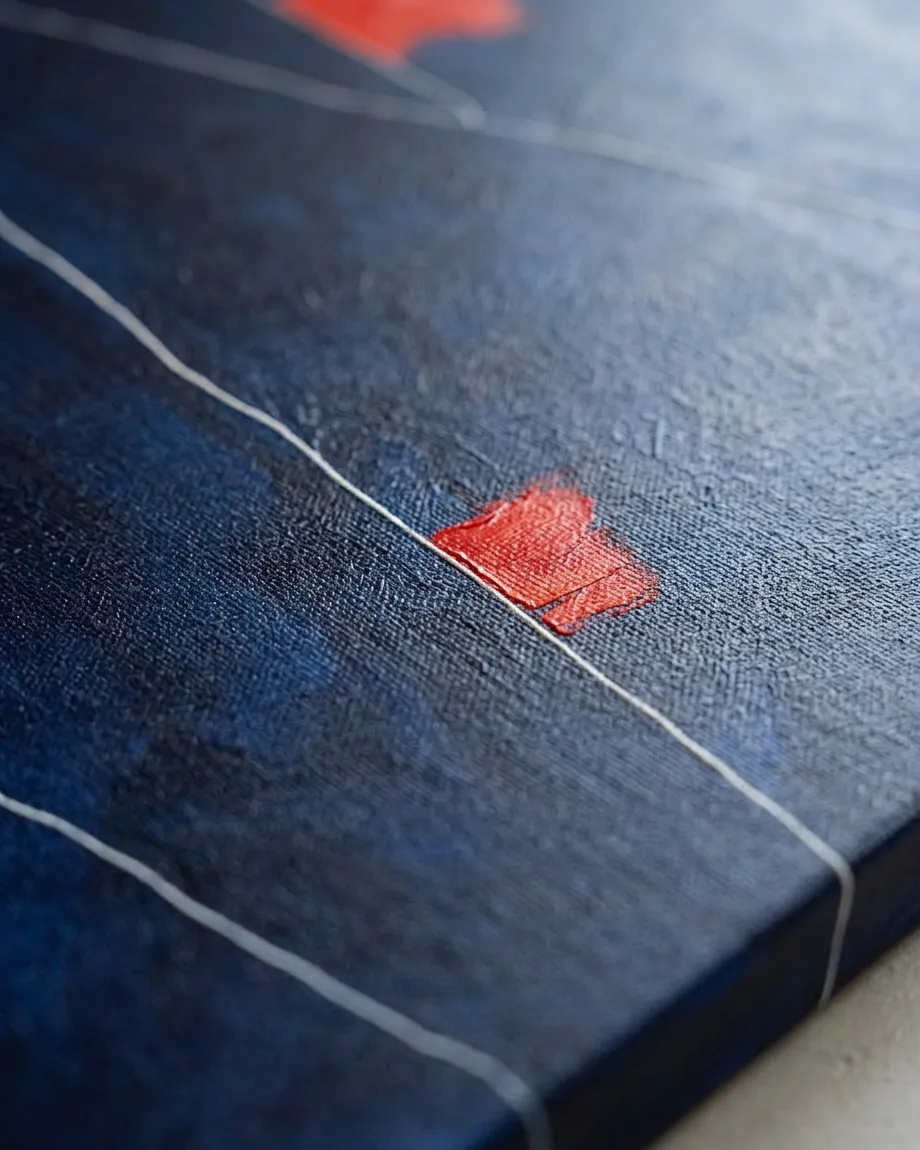
Physical Detail of SIGNUM by Maurizio Valch | Texture and Incised Lines
The encounter with the surface of SIGNUM places the viewer before an expanse of indigo blue that does not present itself as mere atmosphere, but as a dense geography, a void charged with latency. Across this deep, nocturnal space, four fine white incised lines cross the plane obliquely, opening subtle cracks that break the uniformity of the color. This graphic gesture immediately evokes the primordial act of marking out boundaries on the ground, an action that resonates with the investigations of historian of religions Mircea Eliade, who described precisely how archaic humans established cosmic order out of chaos through the consecration of a boundary or sacred space. The incision on the eighty by one hundred and twenty-one centimeter canvas does not function then as a compositional ornament, but as an ontological demarcation: a precise cut that founds a navigable territory and establishes the very possibility of a place, a situs where things, stripped of their wandering, finally acquire weight and presence.
When I confront the wood and canvas in the solitude of the studio, the process becomes a physical struggle against the inertia of matter. I hold the stylus and palette knife with the certainty that tearing these accumulated layers of acrylic and blue oil is not destroying, but revealing; the incision is an exercise in archaeology where the white of the background emerges like a buried light reclaiming its right to exist. In then applying the four blocks of crimson red on these newly traced slopes, I seek an almost tactile friction. I work the pigment directly, building up a rough and thick paste that contrasts vividly with the smoothed silence of the blue, arresting the movement just at the exact threshold of detachment, as if freezing the precise moment in which a heavy body resists rolling down the slope of the canvas.
Observing the unstable arrangement of these material blocks upon the white slopes, the artwork acquires a dimension that immediately dialogues with the ideas of mystic philosopher George Gurdjieff, famous for his warning about human mechanicalness and the need for a conscious awakening. The red quadrilaterals do not float in a lyrical weightlessness, but cling with palpable gravity to the inclines of the canvas, defying the natural tendency to slide. Each of these crimson blocks presents itself as a unit of pure attention, a conscious effort to sustain vigilance on an inclined plane where the simplest thing would be to yield to inertia and slide into the undifferentiated void of the background. The painting thus becomes a theater of tensions where presence must be conquered at every moment against the forces that push toward falling and oblivion.
I know well that there is a temptation to translate these visual tensions into a strictly psychological or mystical map, but I must warn against the danger of intellectualizing what is, first and foremost, a purely physical fact. For me, this crimson red does not symbolize a wound or an internal drive, but operates as a node of pure chromatic vibration and material density that the painting demands in order to breathe and sustain its scale. In the dryness and intense light of the Mediterranean coast where I conceive my works, painting imposes itself on me as a structural necessity, a real boundary that I build on the stretcher to measure my own distance from the world around me. SIGNUM is, in the end, an object with volume reclaiming its place on the wall, a boundary of wood, fabric, and pigment that does not seek to explain anything, but rather to stand up to the space we inhabit.
This constant friction between the order of the lines and the rebellion of the color finds a parallel in the thought of philosopher Osho, who repeatedly explored the perennial contradiction between the restrictive structures of society and the untamed force of individual vitality. The subtle oblique incisions represent the norm, the geometric law that organizes the plane and defines the passable paths; in contrast, the crimson blocks embody the drive of life—dense, imperfect, and ignited—seeking to manifest within those limits. Standing before SIGNUM in the dim light of the room, we perceive that the image does not resolve this conflict, but suspends it in a vibrant balance, reminding us that structure and fire do not cancel each other out, but rather demand one another to sustain the mysterious architecture of our own existence.
- Original artwork
- SIGNUM
- Actual dimensions
- 31.5 × 47.2 in / 80 × 120 cm
- Presentation
- Digital contextual visualization
Context references
palette knife paint texture · abstract painting close up · canvas incision technique · acrylic painting close up
About this visualization
This visualization places the artwork within an architectural context to help collectors and viewers imagine its presence in a real space. It is an interpretive reference, not an exact reproduction: the original work remains the sole authority for scale, color, surface and material presence.