Context study / SIGNUM
SIGNUM Painting in an Interior Exhibition | Maurizio Valch
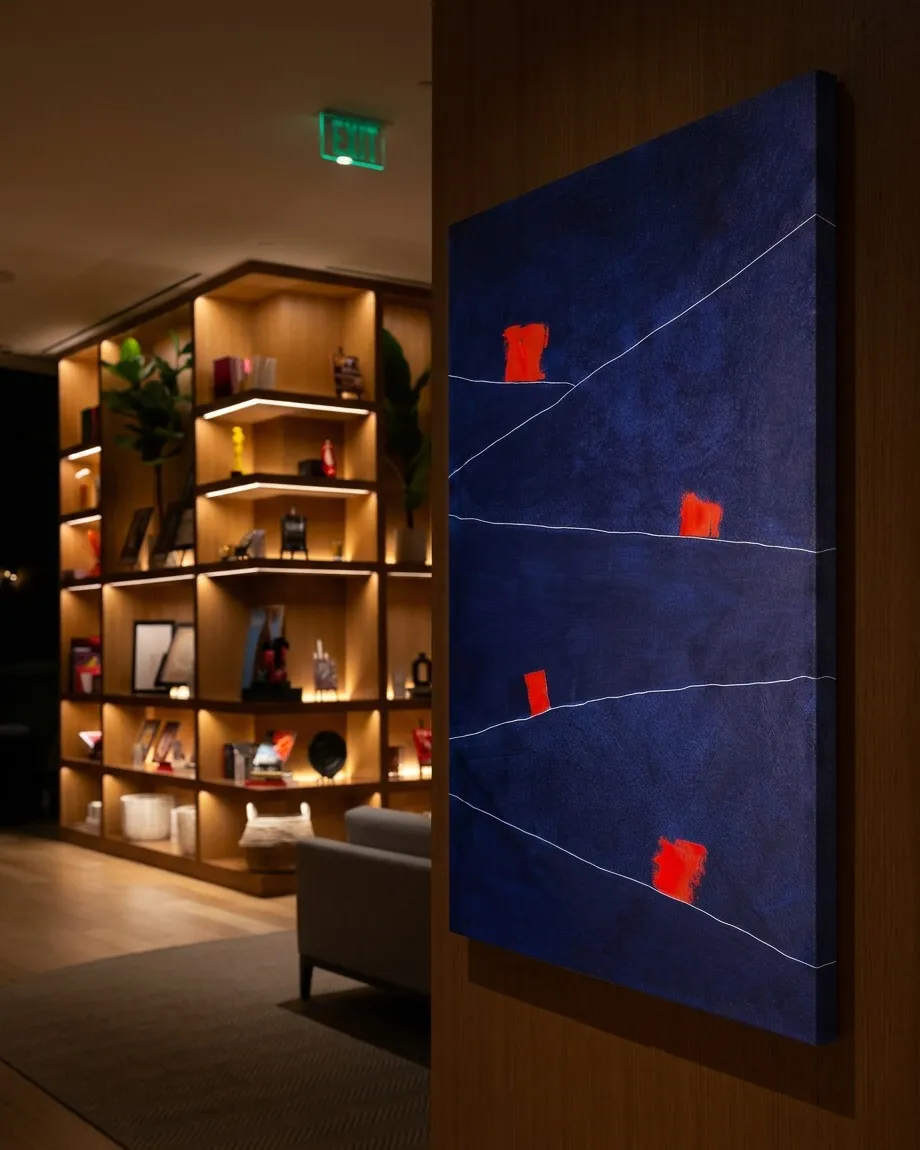
The imposing verticality of SIGNUM, with its eighty centimeters in width by one hundred and twenty in height, stands out against the wall, imposing a contemplative distance that reorganizes the surrounding space. Upon closer inspection, the surface reveals itself as a dense mass of indigo and ultramarine blue, a chromatic abyss crossed by four very fine white incisions that trace slightly tilted diagonals. These snow-white lines, which seem to furrow the canvas like high-voltage cables stretched to their limit or the rails of an invisible gear, configure an implacable circuit. Atop them sit four blocks of a fiery crimson red, suspended on slopes that suggest a movement that is both perpetual and paralyzed. Viewed through the lens of George Gurdjieff’s thought on human mechanicalness, these geometric bodies operate like biological automatons caught in a predetermined trajectory. The composition does not describe a fortuitous accident, but a rigorous geography of automatism, a closed system of structural forces and gravities where each element is condemned to slide along the track assigned to it by the very weight of inertia.
To bring this structure to life, I needed to violate the surface, understanding that the line should not be a mere superimposed trace, but a wound in the density of the pigment. Sinking the tool into the superimposed layers of indigo blue, I felt the physical resistance of the material, a real boundary where the support reveals its white skeleton beneath the accumulated darkness. The crimson red blocks, applied with the firmness of the palette knife, emerged as a tactile counterweight, a vibration of pure color seeking to fix itself in space before being devoured by the gloom of the background. Reducing the territory to these minimal tensions, I constantly asked myself whether these linear incisions act as cages imprisoning the matter or if, conversely, they represent the only possible paths, the only seams of light preventing these red fragments from dissolving entirely into the void that surrounds them.
The vibration of the crimson red on the dark base introduces a chromatic discordance that transcends mere spatial organization. Far from integrating passively into the plane, these masses of color vibrate with the urgency of concentrated blood or fire that refuses to be extinguished, opening a conceptual rift between the mechanical inertia described by Gurdjieff and Carl Gustav Jung’s process of individuation. At this crossroads, each red block presents itself as an instant of focused attention, an attempt at "self-remembering" that tries to halt and regain consciousness in the midst of automated transit. Color acts here as a "signum," an alarm signal that interrupts the monotony of horizontal displacement to confront viewers with their own dispersion. Likewise, the wide voids separating the figures are not dead zones, but active distances, silences charged with energy that sustain the dramatic tension of the whole and keep the structure from collapsing in on itself.
In my memory, this geometric order resonates with the landscapes of transit that have marked my experience of territory. I think of the ancient Phoenician routes and the steep paths of the Andalusian coast, where stone and water meet under a blinding light or an unfathomable shadow. Drawing these trajectories on the canvas is, for me, an act analogous to that of the walker piling stones to mark a route in the middle of the vast steppe or sea. Humans have always needed to wound geography to find their bearings, to mark space in order not to be assimilated by the elements. These red monolithic forms are my own landmarks, passing signs that I have meticulously arranged on the pictorial surface to anchor the gaze and keep consciousness from getting lost in the vast immensity of this ocean of ultramarine blue.
When confronting SIGNUM in the physical space of the gallery, the painting overflows its status as an external landscape to transform into a cartography of the human psyche. The incised slopes and suspended blocks suggest the X-ray of an internal process, a fragmented mandala that has renounced perfect symmetry to reflect the struggle of conscious and unconscious forces. We could interpret this transit as the journey of the Jungian Shadow in search of an integrating assimilation, or as the difficult ascent of the self toward light through successive levels of understanding. Maurizio Valch offers no definitive answers or formal consolations; the work remains open, suspended in an unstable balance. In front of the canvas, the viewer is caught in the doubt of whether these red shapes will slide eternally along their pre-established rails or if, through a sudden spark of will, one of them will break the inertia and fall into the blue to begin, at last, a genuine awakening.
- Original artwork
- SIGNUM
- Actual dimensions
- 31.5 × 47.2 in / 80 × 120 cm
- Presentation
- Digital contextual visualization
Context references
contemporary living room abstract painting · minimalist wall art ideas · blue and red painting for living room · abstract painting in showroom
About this visualization
This visualization places the artwork within an architectural context to help collectors and viewers imagine its presence in a real space. It is an interpretive reference, not an exact reproduction: the original work remains the sole authority for scale, color, surface and material presence.