Series · 2025–Present
SITUS
Elemental forms before the question of the place they occupy

About this series
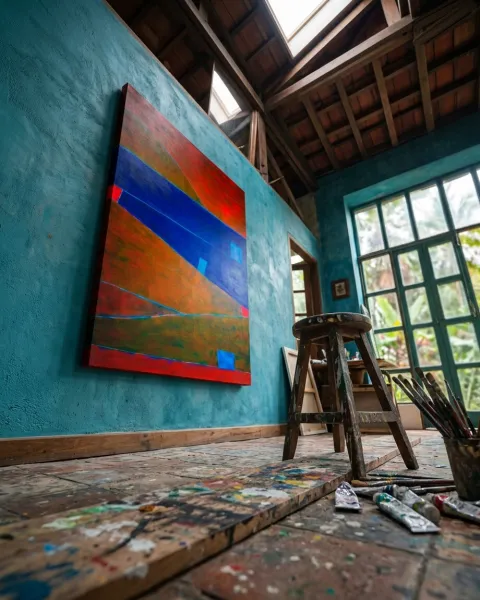
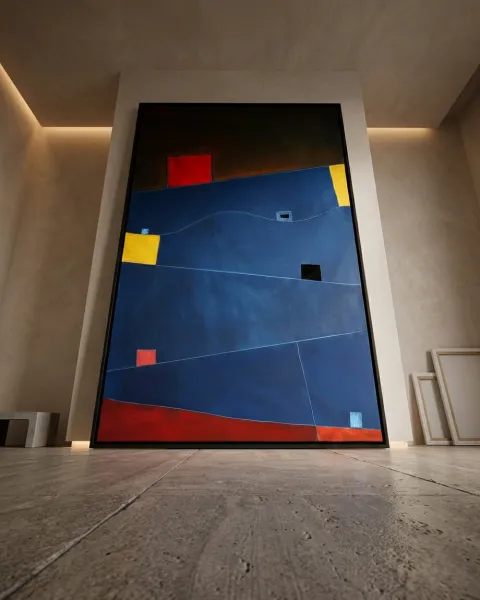
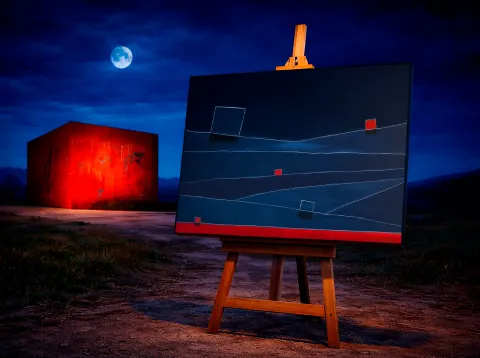
SITUS brings together abstract paintings in which the position of a form, the distance separating it from another, and the activity of empty space construct a territory of relations. Maurizio Valch works with lines, edges, shifts in level, and fields of colour as conditions of presence rather than signs within a closed narrative.
In SITUS, occupying a place never simply means being located. Elemental forms appear upon lines, slopes, edges, and intersections that condition their presence without fully defining it. A solid or barely outlined figure may be felt as a construction, a sign, a refuge, or a body, yet the painting does not require any of these associations to be fixed. What matters is the relationship it establishes with what surrounds it: proximity, margin, shifts in level, and above all, the interval.
This attention to distance connects with a persistent question in Maurizio Valch’s work: how to inhabit a territory without immediately turning it into an explanation. His experience of movement and transitory places has refined a sensitivity to in-between states, to the moment when a presence has already left a previous position but has not yet found a stable sense of belonging. In SITUS, however, this condition does not become biographical narrative. It becomes spatial organisation. Lines may suggest connections or possible routes, though they guarantee neither arrival nor encounter; boundaries organise the field, yet they also leave visible what remains separate.
Empty space thus acquires a density equal to that of matter. It does not function as a passive background or as a simple distance between elements, but as an active zone that alters scale, weight, and isolation. This formal economy has an affinity with Arvo Pärt’s attention to interval and pause: what remains unoccupied participates in the structure. Valch brings this austerity into pictorial territory through fields of colour, spatial divisions, layers, and worked surfaces. When incisions appear, they do not operate as drawings laid over the surface, but as physical traces that pass through the matter and allow a line to retain the character of an action.
The series sustains a tension between the need to locate oneself and the impossibility of fully possessing a place. Its forms do not represent a city, a community, or a recognisable hierarchy; they remain available to perception, suspended between permanence and displacement. This openness also responds to the artist’s mistrust of overly conclusive interpretations. SITUS does not offer a map to be deciphered. Rather, it proposes a field in which to observe how each presence is defined partly by the distance it keeps, by the edge that contains it, and by the space it chooses not to occupy.
Tags
contemporary abstract painting; territorial abstraction; minimalist abstract art; geometric abstraction; material painting; painting on canvas; acrylic and oil; incised lines; fields of colour; spatial divisions; negative space; geometric forms; painterly texture; brutalist art
Series works