Context study / SUBMERSA
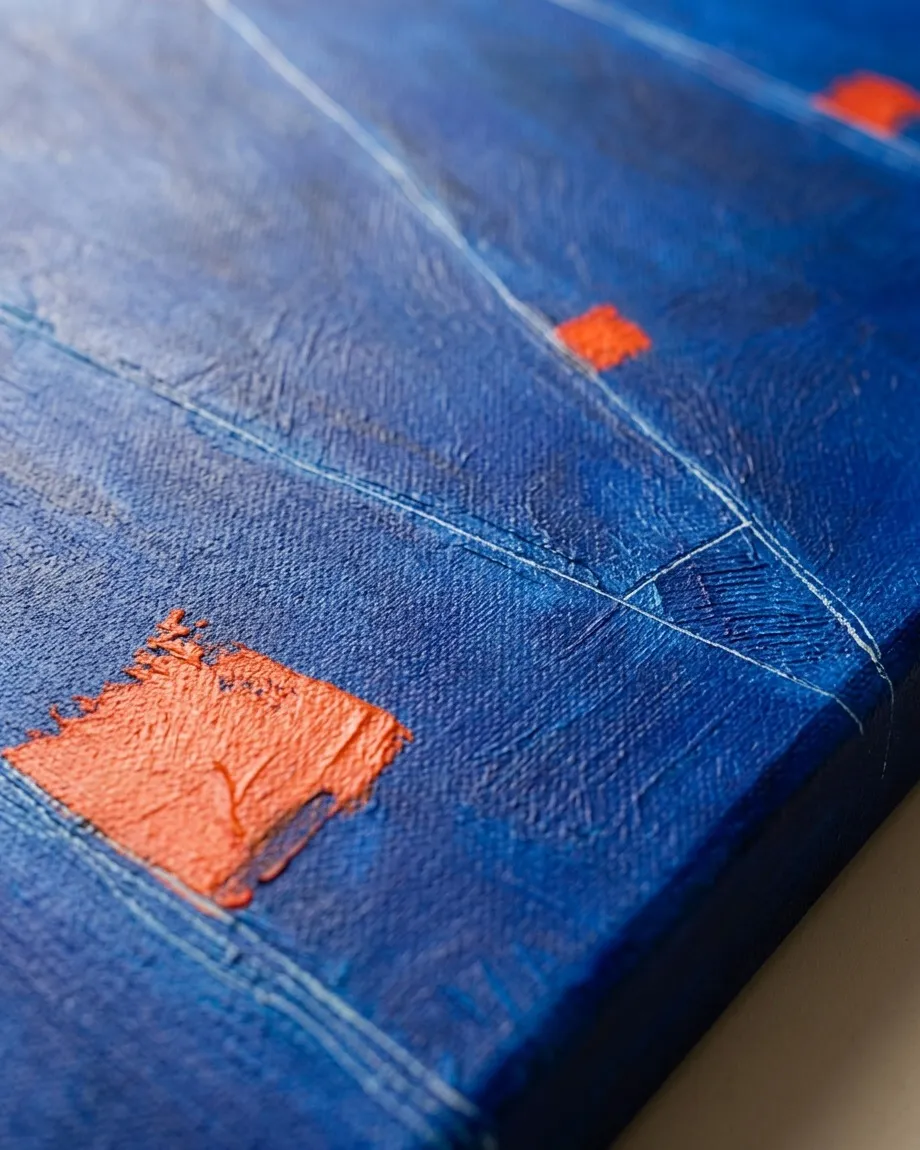
Texture detail of the abstract painting SUBMERSA — Maurizio Valch
SUBMERSA — float test for language
Do not enter by naming.
Enter slowly, as if the blue had a density that does not belong to the air. The vertical format forces the body to raise and lower its gaze: 80 centimeters wide, 120 high; a proportion that does not let the eyes rest on a stable horizon line. Here the horizon shifts. It thins. It tilts. At times it seems to have been withdrawn a few millimeters before we reach it.
The blue does not ask to be called water. It could be; it does not confirm it. It has something of a surface subjected to pressure, something of an extended field that has learned to contain itself. It is not a quiet background. It is a medium: an optical substance in which words begin to behave differently.
"Deep" sinks.
"Vertical" remains suspended.
"Blue" tries to float, but immediately fills with an unexpected gravity.
The first line appears almost without imposing itself. Thin. Light. It trembles slightly as it crosses the blue, as if not entirely sure of being able to sustain its own direction. One must follow it with the eyes, not too quickly. If accelerated, it becomes division; if looked at with patience, it becomes breath.
It rises.
It tilts.
It crosses.
And when it changes direction, the eye changes weight.
You cannot look at this painting from the same distance for long. From afar, the lines order the field. Close up, they stop ordering: they seem vulnerable, exposed, forced to negotiate every change of course. One of them bears an excessive responsibility for being so thin.
Below, toward the left, a red irruption clings to its small territory. It is not exactly a rectangle. Nor is it a free stain. It has an edge, density, apparent wear, a presence that seems to want to grow and, at the same time, stop before declaring itself something. The gaze jumps toward it. Then it tries to return to the blue. It does not return the same.
The body then understands a problem before the head does: to live here one would have to learn to breathe without support. One would have to maintain a kind of balance without ground, follow a line without turning it into a handrail, accept that the blue calm can demand more attention than an alarm.
Jacques Lecoq was a theatre pedagogue who turned the body, movement, silence, and the observation of nature into instruments for thinking and creating scene.
Look at the lines and they immediately seem impossible physical commands.
Tilt the torso.
Do not fall.
Hold the right shoulder higher than the left.
Advance without advancing.
Breathe while the axis shifts.
The diagonal crossing the field would not be for him a description but a muscular tension. The slight curve, near the right edge, would ask for a torsion. The crossing of two lines would force the body to choose a trajectory it cannot complete. But SUBMERSA resists: it offers no ground, does not deliver enough gravity for the gesture to become gesture. The body wants to enter the painting and the blue returns it outward.
Lecoq would want the lower red to act.
To do something.
To interrupt, to push the blue, to assume the energy of an apparition.
But the red does not respond.
It is just there, with a kind of quiet insolence.
In the middle area, another smaller red—perhaps the one that seems to be pretending to be small—alters the line passing nearby. It does not touch it in an obvious way, but forces it to seem more fragile. Higher up, another red stands out with less weight. Near the upper edge, a final apparition shows itself as if it had arrived late to a conversation that was already taking place.
Four pressures.
Not four symbols.
Four points in which the blue can no longer sustain its neutrality.
Maurizio Valch lets a voice enter this separation:
I look at the blue and I cannot keep it gathered in a single distance. I thought I recognized the separation between the field, the lines, and the reds, but my eye mixes them again every time it tries to fix them. I feel that one line moves away while another approaches, even though they remain before me. I do not know if the reds interrupt the blue or if the blue lets them appear for an instant. I breathe in front of that separation and, as I breathe, I discover that the painting departs from what I wanted to retain in it.
After that voice, it is not advisable to look for an explanation. It is best to look again at the line crossing toward the right edge. There it thins. There it seems to bend to avoid an imposition. There the painting stops being a surface containing forms and begins to look like a conversation without a fixed language.
Paulo Freire was an educator who understood learning as a conversation capable of transforming those who ask and what they believed they knew.
He does not allow the red to be named too soon.
"Do not make it act so quickly," he might say to Lecoq.
Because saying "this is a figure" is reassuring. Saying "this is a sign" is too. Even saying "this breaks the blue" can be a way of domesticating what does not let itself be translated. Each red seems to formulate a different question, but not a question that can be placed at the foot of the work like a label.
The low red: what part of the blue fails to cover me?
The middle red: what forces me to look again?
The high red: why do I appear so far and yet so close to the eye?
The red near the edge: who has decided that the edge is the end?
Lecoq grows impatient. A question, he thinks, also needs a body. But Freire returns the discomfort: who has given him the right to speak for that small red form? Why should it obey a dramaturgy? The red is not a student to be made to express themselves. It can refuse. It can remain opaque. It can be just a pressure that changes the conditions of the viewer.
Then someone, with the unadorned precision of a child's intelligence, asks:
"Why don't those reds drown?"
For a moment, all the expert words lose air.
There is no useful answer.
The blue remains blue.
The four reds remain motionless.
And yet, the question modifies the painting. One no longer looks only at whether they float. One looks at what sustains them, what avoids them, what distance lies between each one and the lines. One looks at whether a line approaches to measure them or to avoid touching them. One looks at whether the blue is a medium of immersion or a pressure that does not finish closing over them.
Freire stops too. He notices that even asking can become a capture. A question that is too firm can surround the image like an additional frame. It can force the red to answer in a language that is not its own.
Lecoq, unexpectedly, stays still.
Not motionless like a statue, but motionless like someone who has discovered that a minimal suspension also acts. The body does not need to represent the red. It can sustain, barely, the tension of not knowing whether to approach or withdraw. It can tilt without falling. It can let the blue take away its ground and not immediately fill that lack with an explanation.
Maurizio returns, but no longer to regain control:
I had thought that the reds floated against a blue immensity, but now I suspect something else: perhaps they do not float, perhaps they retain. I cannot measure the distance that separates them from each other, because that distance changes when I follow a line and changes again when I look away. I see that the immense does not necessarily belong to the blue; I find it in the interval between one sign and another, in the impossibility of deciding whether they approach, descend, or remain observing. I cannot close that indecision without losing something of the painting.
The gaze ascends again.
Verticality is no longer just a format: it is a test for the neck, for the eyes, for breathing. Above, the blue seems slightly more open, though not lighter. A line glides toward the edge and then modifies its course. It leads nowhere. It is not a path. It looks more like a delicate negotiation: to advance, to correct oneself, not to invade.
Below, the larger red retains its obstinacy. It has not become an object. Nor an emblem. Perhaps it looks toward the line passing nearby. Perhaps the line is avoiding it. Perhaps both are sustained in a minimal distance that the blue cannot erase.
On the far right, a barely perceptible curve changes the pressure of the field; the nearest red neither advances nor sinks, but the blue around it no longer remains exactly the same.
- Original artwork
- SUBMERSA
- Actual dimensions
- 31.5 × 47.2 in / 80 × 120 cm
- Presentation
- Digital contextual visualization
Context references
textured abstract painting details · canvas texture with acrylic and oil · close up of maurizio valch artwork · incised marks in textured painting · original painting surface texture close up
About this visualization
This visualization places the artwork within an architectural context to help collectors and viewers imagine its presence in a real space. It is an interpretive reference, not an exact reproduction: the original work remains the sole authority for scale, color, surface and material presence.