Context study / SUBMERSA
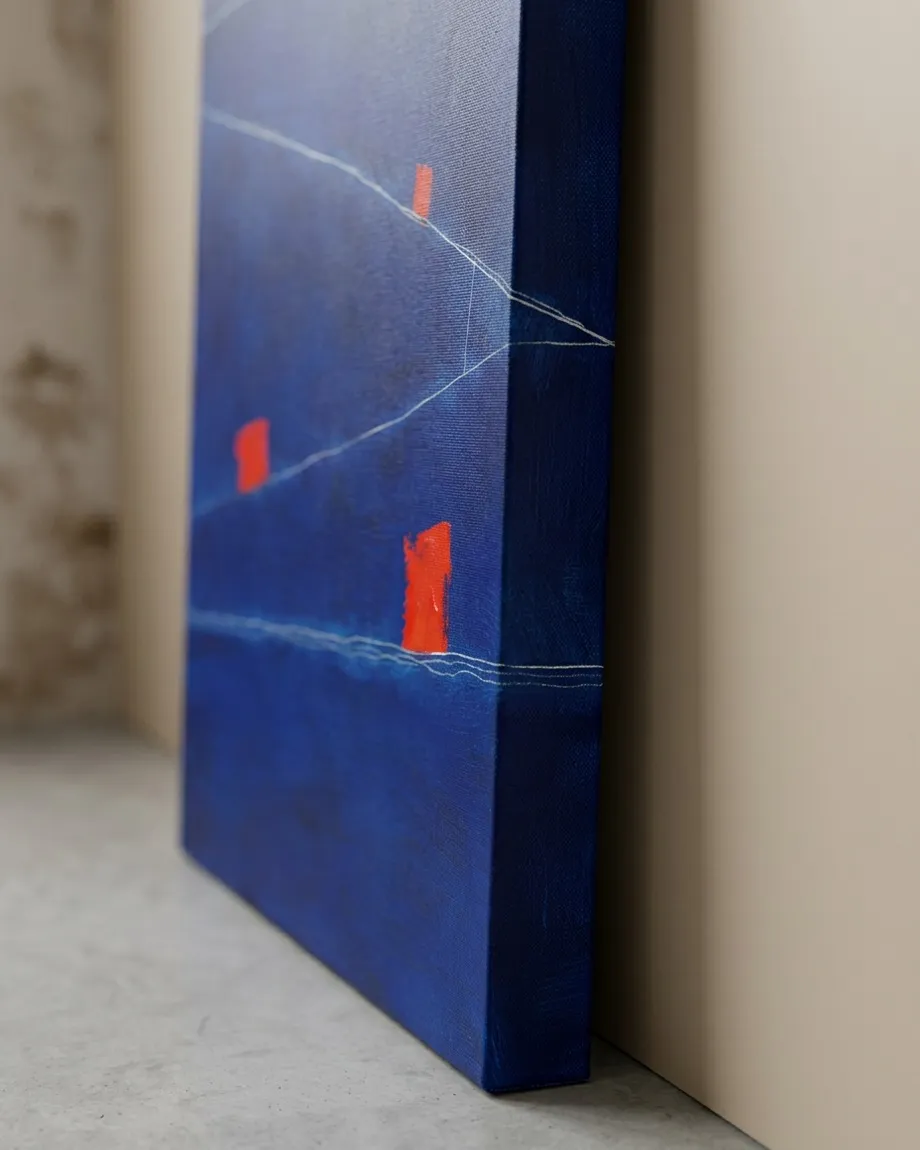
SUBMERSA by Maurizio Valch - Edge Detail and Canvas Texture
At what point must those who approach this blue adjust their breath so as not to fall upward or lean on a background that perhaps does not exist?
The letter begins without a compass. SUBMERSA stands as a vertical extension of deep blue, but its verticality does not rule: it can be a wall, a column of water, a band of night suspended on edge. The clear lines cross it with a fragility that does not match their power. They do not entirely divide; nor do they unite. Sometimes they seem like water levels held in the air, sometimes routes that have lost their destination, sometimes seams tightened to prevent the blue from opening.
There is a first red interruption, small and high, near a line that descends and tilts. It does not manage to occupy the space: it insists upon it.
Beacon I. Roberto Fontanarrosa. An Argentine writer and cartoonist, he knew how to find comic grandeur in the smallest gestures.
Fontanarrosa looks at that red form and suspects it is holding up the sea. Not the entire sea, of course: just a corner that threatens to slip down the oblique line. The figure, small as a misplaced signal, seems concentrated on a ridiculously serious task. It has something of an employee who has received an impossible order and, out of dignity, does not protest. Its red does not conquer the blue: it appears before it with the disproportionate solemnity of someone arriving late to a gigantic meeting.
The joke alters the scale. The blue ceases to be merely vastness; it becomes the setting for a minimal action. The high spot might not be a beacon but someone who has decided, without witnesses, that a white line needs to be watched. The eye, which at first traversed the surface as if measuring distances, pauses. That red interruption is not small because it occupies little space: it is small because it has gotten itself into a problem too big for it.
> I look at the blue and do not know if it is pulling away or approaching to touch me. The lines seem like instructions, but they change as I follow them; one becomes an edge, another a tremor, another barely preserves the right to exist. The reds interrupt my attention as if the painting had found, on its own, a way to breathe outside of me. A distance remains that I cannot bridge: the work is there, but it is not quite where I thought I left it.
> —Maurizio Valch
The first question of navigation has shifted. It is no longer just about breathing without falling upward. Now it matters to know how much air a red form needs to still seem close when the surrounding blue offers no stable measure.
Lower down, another red appearance seems to have detached from the first. It stands to one side, isolated, and yet a clear line almost reaches it, as if having searched for it with hesitation. The line does not behave like a clean border: it vibrates, thins, splits; at times it seems to lose its way before touching the side edge of the painting.
Beacon II. Miguel de Cervantes. A Spanish writer who turned imagination into a restless way of looking at reality.
Cervantes endangers Fontanarrosa's security. What if that figure holds nothing? What if the heroic gesture was invented too quickly because an empty field is unbearable? The blue does not guarantee being water, no matter how much the lines suggest levels. It can be a flat plane, sky turned sideways, a wall crossed by marks, space without volume, or volume that refuses to obey perspective. The line that seemed a route may be a shore only as long as the eye needs a shore.
Fontanarrosa wants to keep his little underwater worker; Cervantes shifts the ground beneath him, or the background, or what until a moment ago seemed to be the background. Perhaps the red spot is not within the blue but in front of it. Perhaps it floats. Perhaps it runs aground against a surface that admits no depth. The painting does not resolve these versions: it lets each hold one end of the line and see how long it takes to yield.
Then a child's test of orientation appears, too concrete to be dismissed: why don't the white lines get wet when they pass next to the reds?
The question remains suspended between two heights. Fontanarrosa takes it seriously: perhaps the lines are not wet because they are the cables of an underwater bus that never arrives, and the red forms have been waiting so long they have already become signals. Cervantes steps back a bit. Answering might undo the entire map. If the lines are wet, the blue gains depth; if they are not, perhaps there is no water to measure; if there is no water, there is also no up and down in the reassuring sense of those words.
The third beacon appears lower down, wider, closer to the body that looks. Not because it is objectively larger, but because the eye reaches it after following a line that seems to yield under attention. That white line is not straight: it tilts, thins, opens into a slight bifurcation, tightens again. In pursuing it, the gaze adjusts its speed. It no longer sweeps the blue: it advances with a caution akin to breathing when crossing a dark place without knowing if there is a step.
Beacon III. The red forces a leap. The sight abandons the clear trace and falls—or ascends—toward that vertical presence. Then it returns to the blue, but the blue is no longer the same field. It seems deep because the lines plunge into it; it seems flat because none of them entirely disappear. The surface sustains both at once: distance and contact.
The body receives this contradiction without resolving it. A clear line, as it approaches the edge, creates the sensation that the painting can continue behind its own side. The nearby red, on the other hand, seems to step forward without actually leaving the plane. The small can be closer than the large; the vast can remain stuck to the surface. There is no automatic emotion in those colors, but rather a more precise physical alteration: the visual balance seeks a support and finds a network of trajectories that promise to lead nowhere.
The eye returns to the child's question and discovers that the lines are perhaps neither dry nor wet. Perhaps they are the mark of a rub: something has passed through there, but it is not known if it traversed the blue, was traversed by it, or remained sewn to its darkest side.
> Upon completing it, I discover that the painting seems to orient itself better than I do. Its lines do not need to decide if they are water, edge, or distance, and the red forms persist without accepting the role I would like to give them. The void does not behave like an absence: it occupies, pushes, guards a presence that I cannot convert into property or an answer.
> —Maurizio Valch
After that admission, the fourth red form no longer lets itself be looked at with the lightness of the first. It is at another height of the field, or at another depth that does not coincide with any height. Near it, the clear lines gather and separate: one seems to arrive from afar; another extends toward the edge; another remains barely as a pale vibration on the blue. They do not form a system. They form the desire that there were a system.
Beacon IV. Fontanarrosa, less sure of his own joke, sees a distress signal. The red form would not be holding up the sea or waiting for the underwater bus: it would be exerting force to be seen from a place that does not respond. But Cervantes does not entirely accept that urgency. He sees a signal sent too late, not because anyone has failed, but because the distance of the painting transforms every call before it reaches anyone.
The disagreement is not resolved. Between the two appears a third gaze, less inclined to name. The last red form can be a call, a resistance, a presence that requires no recipient. The clear lines no longer serve to escape the blue: they make it more uncertain. They measure a depth that cannot be calculated; they invent tilted horizons that fail to obey; they separate zones without isolating them; they support the field just enough for the eye to lose the security of looking at an immobile surface.
The initial question barely retains its form. Breathing before this blue does not prevent the fall nor guarantee balance. It only marks an interval between one line and another, between a red that seems close and a background that has perhaps approached in silence.
Return to the image, squint your eyes, and follow a single clear line until it stops looking like a line.
- Original artwork
- SUBMERSA
- Actual dimensions
- 31.5 × 47.2 in / 80 × 120 cm
- Presentation
- Digital contextual visualization
Context references
abstract canvas texture · minimalist painting detail · incised marks on painting · stretcher bar depth artwork · close-up of abstract artwork
About this visualization
This visualization places the artwork within an architectural context to help collectors and viewers imagine its presence in a real space. It is an interpretive reference, not an exact reproduction: the original work remains the sole authority for scale, color, surface and material presence.