Context study / QUINQUE
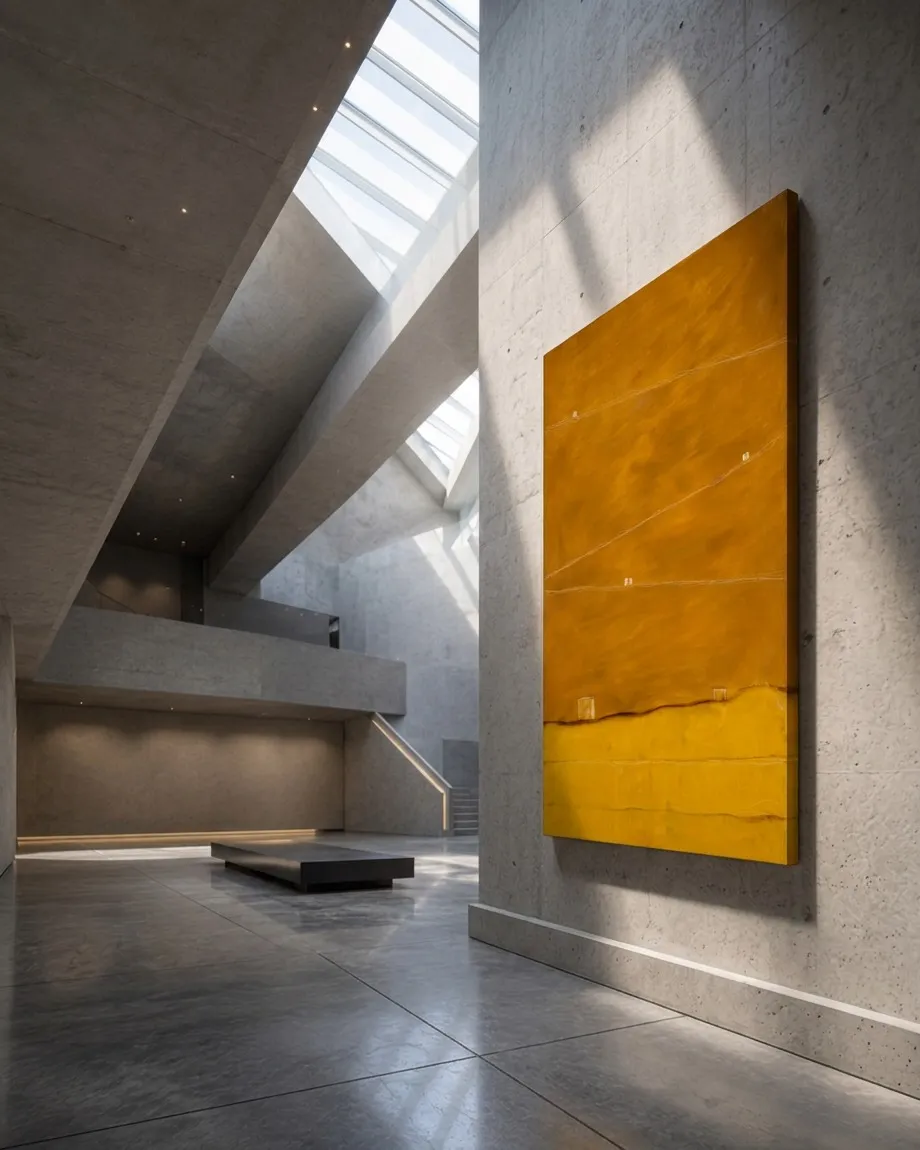
Abstract painting QUINQUE by Maurizio Valch in brutalist concrete lobby
The painting "QUINQUE" by Maurizio Valch presents itself to the viewer as an imposing wall of chromatic and geographical tensions, where a dense yellow lower plane supports a low, sinuous horizon upon which sits a vast sky of warm ochre. Observing the thin incisions scratching the surface of the canvas, it is impossible not to evoke the thought of George Gurdjieff, a mystic and spiritual teacher who investigated human automatism and the laws of the transmission of consciousness, providing tools to understand how human beings transit between lethargy and awakening. These geometric lines, cutting the pictorial matter with the precision of a scalpel, operate like the high-voltage lines of a sleeping civilization or puppet strings imposing a mechanical order on the wild nature of the pigment. At the same time, these suspended pathways seem to propose routes for "self-remembering" amidst an existential desert, connecting the three upper blocks to the terrestrial base. The work does not seek decorative complacency; on the contrary, its brutalist sobriety confronts the observer with the fragility of these connections, suggesting that consciousness is not a given state, but a thin, tense line that must be actively drawn over the void of everyday existence.
When confronting the blank canvas in my studio, I do not seek to illustrate an idea, but to unearth a geography I carry within, marked by the relentless sun of Nerja and the dust accumulated on Andalusian roads. I prepare the medium by building up layers of cadmium yellow and natural ochre, feeling the weight of the binder under the palette knife, seeking for the paint to acquire the density of a calcareous wall exposed to the elements. The incision is the most honest and definitive moment of the process: there is no room for hesitation when I drag the metal point over the still-fresh paint film, opening furrows that reveal the lower layers like scars in the dry earth. Those small blocks I place in space, almost like stone landmarks in a desolate landscape, are not mere compositional whims, but the physical testimony of my own presence in the studio, of my stained hands and the effort to fix an instant of Mediterranean light before it is devoured by shadow. Each scar on the surface is a record of my breathing, a way of clinging to material reality against the abyss of pure abstraction.
The title of the work appeals directly to the arithmetic of form, presenting us with five discrete elements unevenly distributed on the plane: two firmly settled on the lower plain and three suspended on the incised lines. This numerical partition resonates deeply with the theories of Carl Gustav Jung, the Swiss psychiatrist who analyzed archetypes and the symbolism of numbers as projections of the collective unconscious, seeing in them regulatory structures of psychic order. In the alchemical and psychological tradition analyzed by Jung, the number four symbolizes ordered wholeness, the stability of the earth, and the quadrangular structure that provides shelter and boundary, represented here by the lower band and its two bases. The fifth element, the introduction of the quinque, breaks this terrestrial symmetry and introduces the instability of the quintessence—that human factor interrupting the inertia of matter to generate movement. The three upper blocks, suspended like weightless notes, become the representation of that search which destabilizes the natural order, forcing the eye to move from the static to the dynamic, from earthly weight to the uncertainty of the air.
My memories of the Andalusian territory are not idyllic postcards, but sensations of aridity, of hot stones underfoot, and of a horizon trembling from the midday heat. In painting the two chromatic masses of "QUINQUE", I tried to recreate that luminous vibration that seems to flatten the landscape and dissolve details, leaving only the bone structure of the earth. The placement of the five blocks responds to an almost topographical impulse; for me, painting is conducting a mental cartography where distances and voids weigh as much as the accumulated pigment. As I scraped the thin lines supporting the three upper pieces, I thought of the shepherds who demarcate their territories with piled stones in the mountains—minimal markers saving the traveler from getting lost in the immensity. That solitude of the stone on the mount is the same I seek to capture on canvas: a quiet presence, resistant to time, defying the fragility of our memory and reminding us that we belong to a physical geography far older and harsher than our own personal troubles.
In the visual resolution of "QUINQUE", the tension between fullness and emptiness acquires an almost acoustic quality, where the space separating the blocks functions as a visual score of measured silences. This economy of means connects Valch's painting with the musical poetics of Arvo Pärt, the Estonian composer whose music is based on silence and the distance between essential notes, where the extreme reduction of elements allows each sound to resonate with an auratic purity. On the canvas, the vast ochre field is not an inert background, but an active and resonant void, equivalent to Pärt's musical silence that sustains and gives meaning to the notes of his tintinnabuli technique. By distancing the five blocks and suspending them in space, Valch grants pictorial silence a material weight equivalent to that of the yellow pigments and incisions themselves. The viewer is invited to experience this interval not as an absence of information, but as a space of inner resonance where the sobriety of the color plane and the bareness of the line reveal themselves sufficient to evoke the immensity of the landscape and of the mind itself.
- Original artwork
- QUINQUE
- Actual dimensions
- 31.5 × 47.2 in / 80 × 120 cm
- Presentation
- Digital contextual visualization
Context references
minimalist decoration with large paintings · abstract art for concrete walls · modern brutalist decor ideas · large format ochre and yellow painting · decorating high lobby with art
About this visualization
This visualization places the artwork within an architectural context to help collectors and viewers imagine its presence in a real space. It is an interpretive reference, not an exact reproduction: the original work remains the sole authority for scale, color, surface and material presence.