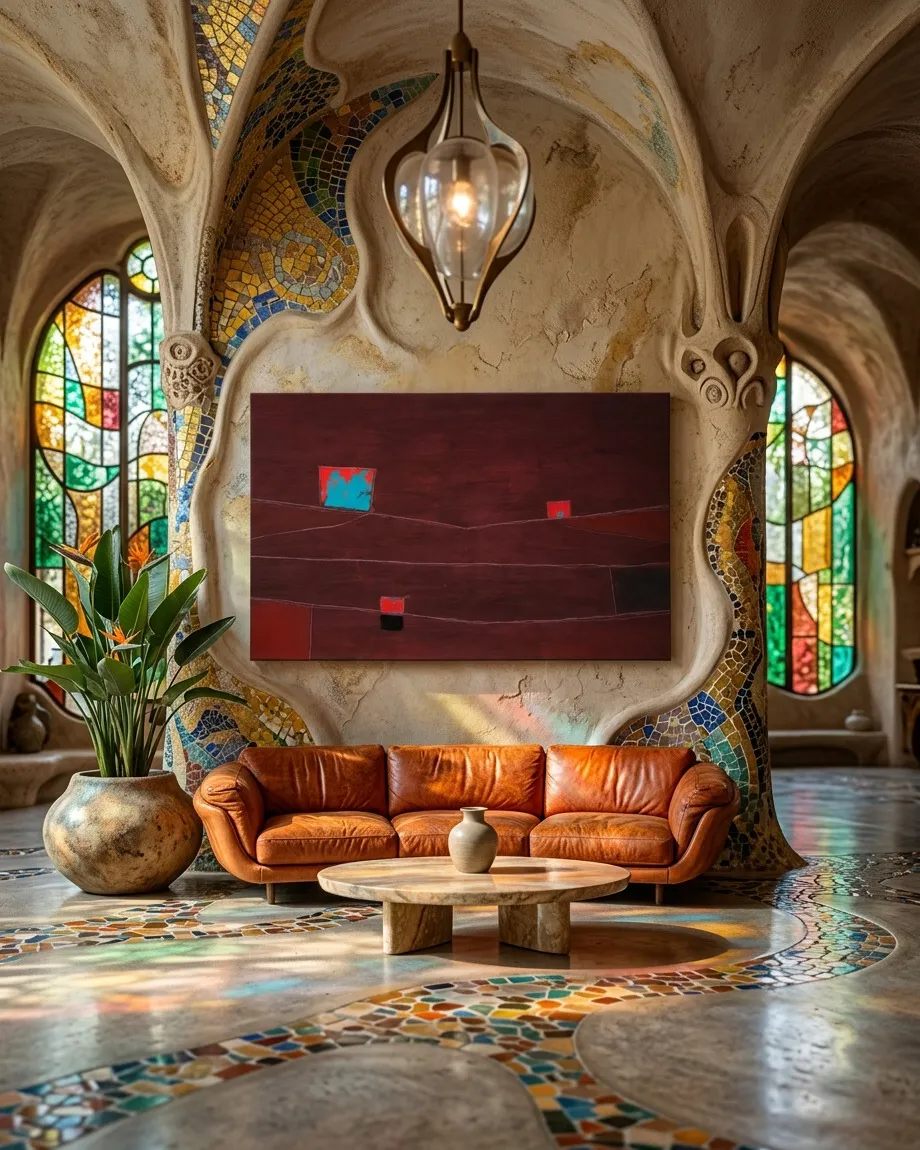
Context study / FISSURA
FISSURA Painting in Organic Living Room Decor | Maurizio Valch
When confronting the horizontal plane of the painting, the viewer is absorbed by a dense chromatic territory that oscillates between the reddish-brown of dried blood and deep clay. This plane is not static; it is furrowed from end to end by thin horizontal incisions that partition the surface into overlapping terraces, like scars inflicted upon an ancient dermis. These dividing lines immediately evoke the invisible prisons analyzed by George Gurdjieff, a mystic and spiritual teacher who investigated human automatism and 'self-remembering.' In this pictorial geography, the furrows represent the limits of our mechanical life: habits, mental structures, and daily divisions that we trace to shelter ourselves from uncertainty, but which ultimately dull perception. The surface thus behaves like weathered skin, deliberately marked to contain the chaotic tide of existence under an artificial order.
When I face the blank canvas, I seek to have the material resist my own hand, to oppose a physical force to the gesture. I work by accumulating successive layers of acrylic and dense oil, seeking that organic quality of matter that has matured over time. The crucial moment arrives when I sink the metal tip into the still-wet paint; the friction of the tool tearing through the layers reveals a controlled void, an incision that cuts the continuity of the plane. In placing the block on the left, I decided that the red should not be a mere external boundary, but a floodgate about to yield to the pressure of that fragment of turquoise blue. It is a physical pulse between the opacity of the earth pigment and the insistence of a cold light pushing from the depths of the matter, a cut that interrupts my own technical automatism.
The spatial distribution of the three red elements establishes a dialogue of contained tensions and precise geographical distances. While the large block on the left vibrates under the internal pressure of the cyan, its counterpart on the right is reduced to a tiny spark on the horizon line, like a distant signal barely surviving the immensity of the reddish wasteland; below, a perfectly upright red square rests on a black base, embodying the dull weight of what remains static. This subtle arrangement of scales resonates with the insights of Carl Gustav Jung, the psychiatrist who mapped the images of the unconscious. These geometries do not function as openings or decorative windows, but as vessels of hermetic containment, archaic temples that preserve an archetypal intensity—the Self or pure consciousness—against the devouring tide of the shadow surrounding them.
I do not intend to portray a specific landscape, but to salvage the mineral memory of the land I inhabit, that ancient, clay-like dryness that characterizes the Mediterranean landscape. There is a silent heritage in the strata of caves and in the first human settlements, a geological temporality that accumulates in paint like dust on stone. In tracing the horizontal divisions, I am doing nothing more than repeating the ancestral gesture of the human being who delimits their territory, introducing a human measure into the vastness of time. For me, painting is this temporal sedimentation, a record of superimposed layers that is suddenly interrupted by a deliberate rift, a clean cut that unveils the hidden core of matter under the sun of history.
Ultimately, the contemplation of FISSURA places us before the possibility of a rupture in the plane of ordinary experience. The material incision on the canvas is transformed into a gap of attention, a fissure in the wall of our habitual consciousness. The turquoise-blue flash emerging from the red box does not represent a mere chromatic contrast, but the evidence that beneath the hardened sediment of our routines and the clay-like silence of existence beats a light of strange and primordial origin. Upon looking away from the torn surface, a silent suspicion remains that our solidest certainties are nothing but thin layers of paint waiting for the strike of the tool to awaken them.
- Original artwork
- FISSURA
- Actual dimensions
- 47.2 × 31.5 in / 120 × 80 cm
- Presentation
- Digital contextual visualization
Context references
modernist living room painting ideas · large wall art decor · artwork in living room with mosaics · decorative ideas with abstract painting
About this visualization
This visualization places the artwork within an architectural context to help collectors and viewers imagine its presence in a real space. It is an interpretive reference, not an exact reproduction: the original work remains the sole authority for scale, color, surface and material presence.