Context study / ATHAR
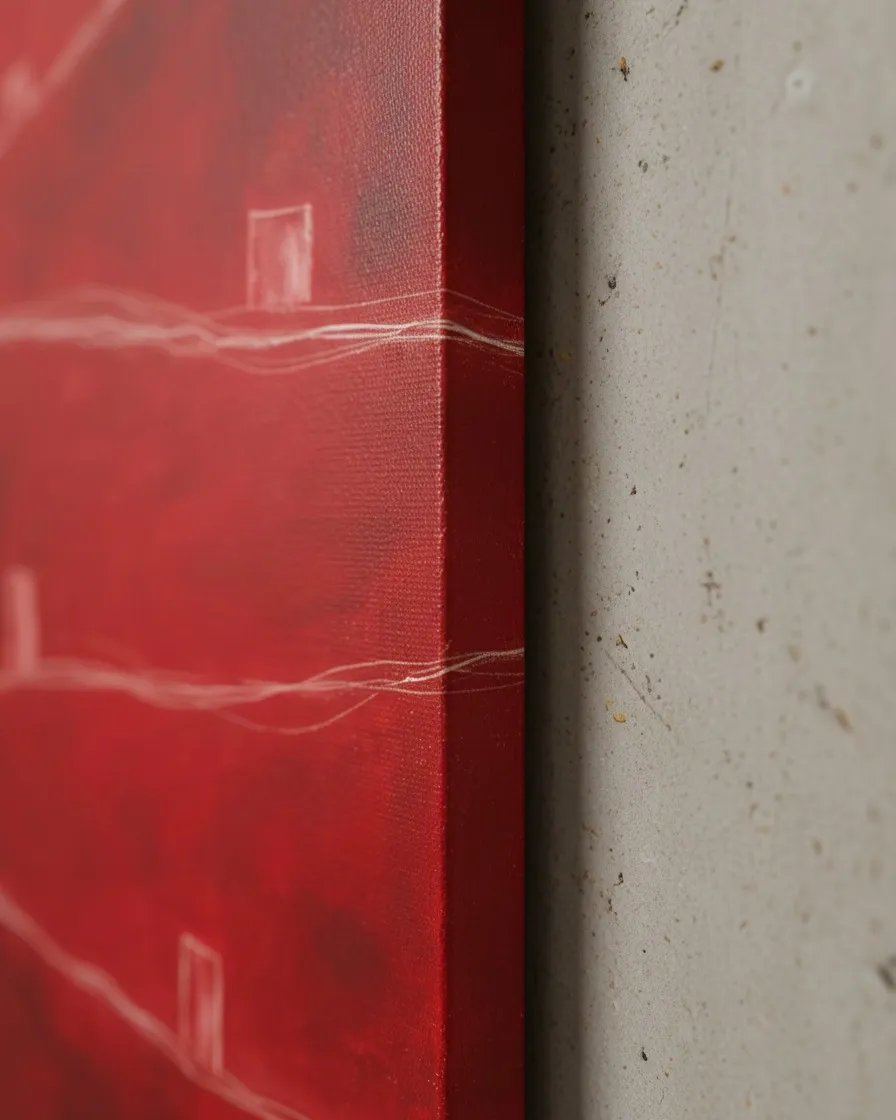
Edge and texture detail of Maurizio Valch's red canvas ATHAR
The surface of ATHAR presents itself as a territory of chromatic and textural confrontation, where a dense, fiery red, saturated with material vibration, devours the compositional space. Over this fiery field, four white quadrangular structures, barely sketched and subjected to a subtle process of erosion, are distributed in an ascending progression that challenges the flatness of the support. These minimal geometries do not float in a vacuum; they are supported and articulated by a series of slightly tilted horizontal lines that traverse the canvas like scaffolding, paths, or tension cables. This visual device functions as an archaic cartography, a record of strata where the human mark attempts to impose a primal order upon the hostility of the raw material. Contemplating the physical incision against this fiery background, it is inevitable to recall the gesture of the first European cave paintings, such as the Paleolithic imprints and marks found in the Caves of Nerja, a key environment in Mediterranean memory that reminds us of the precise instant when an accidental scratch on the rock is transmuted into a symbol, a boundary, and a memory of settlement.
In the studio, my relationship with the painting is a physical and tactile struggle with matter in its most untamed state. I do not conceive painting as a mere accumulation of passive layers, but as a living body that responds to the pressure of the spatula and the combined viscosity of acrylic and oil. Those white lines crossing the space of ATHAR were not added with the ease of a brush on a dry surface; they were excavated directly into the wet pictorial mass through an act of incision that was both violent and calibrated. By removing the red material to reveal the underlying light support, I do not seek to draw, but to scar the plane, leaving tectonic traces that expose the vulnerability of the support and act as controlled wounds structuring the chaos of color.
From a strictly conceptual standpoint, the rigorous arrangement of the four blocks generates an intellectual tension that activates opposing readings of order and repetition. On one hand, we can evoke the thought of Carl Gustav Jung, the celebrated Swiss psychiatrist and pioneer in the study of the collective unconscious, to decipher this ascending quaternity as the archetypal effort of the psyche to structure internal chaos; the four seasons or pillars would thus be a map of the process of individuation rising laboriously over a background of fire and blood. However, this analytical reading collides immediately with the disenchanted vision of George Gurdjieff, the Eastern mystic and philosopher who harshly questioned the automatism of human existence. Under the Gurdjieffian lens, these horizontal lines and their blocks would not represent a path of spiritual illumination, but rather the cold geometry of confinement: rails of an existential machinery where the individual moves in a repetitive and predictable way, believing they are advancing upward when in reality they are only trapped in scaffolding that perpetuates the same pattern of conditioned behavior.
I often watch from a distance the interpretations that attempt to pigeonhole these shapes into intricate psychological or esoteric systems; for me, the origin of the painting is much more immediate and telluric, linked to the constant transit through Andalusian lands and the Mediterranean coast. In my SITUS series, painting responds to the almost biological need to establish a landmark, to drive a stake into the landscape so as not to lose orientation in the midst of immensity. Those red and white blocks do not pretend to be universal symbols of the psyche, but silent and stubborn presences that simply claim their right to occupy a physical place on the plane. They are minimal shelters, coordinates of a personal journey seeking silence and stillness in a world in permanent dissolution.
In the end, the strength of ATHAR resides in its refusal to be completely domesticated by theory, forcing the viewer to always return to the eloquence of its own materiality. In its dimensions of 80 x 120 centimeters, the painting imposes itself not as a window to an illusory dimension, but as a concrete object sharing our same three-dimensional space. The incisions tearing the red plane remain open as physical questions, reminding us that any delimitation of territory—whether on prehistoric rock, on the canvas, or in existence itself—is an attempt as fragile as it is tenacious to leave a mark in time. The work thus subsists, suspended between order and accident, as a silent threshold inviting us to contemplate the trace of our own journey.
- Original artwork
- ATHAR
- Actual dimensions
- 31.5 × 47.2 in / 80 × 120 cm
- Presentation
- Digital contextual visualization
Context references
close-up of red painting texture · painting canvas edge · crimson red paint detail · incised lines on canvas · Maurizio Valch close-up · concrete wall and painting texture
About this visualization
This visualization places the artwork within an architectural context to help collectors and viewers imagine its presence in a real space. It is an interpretive reference, not an exact reproduction: the original work remains the sole authority for scale, color, surface and material presence.