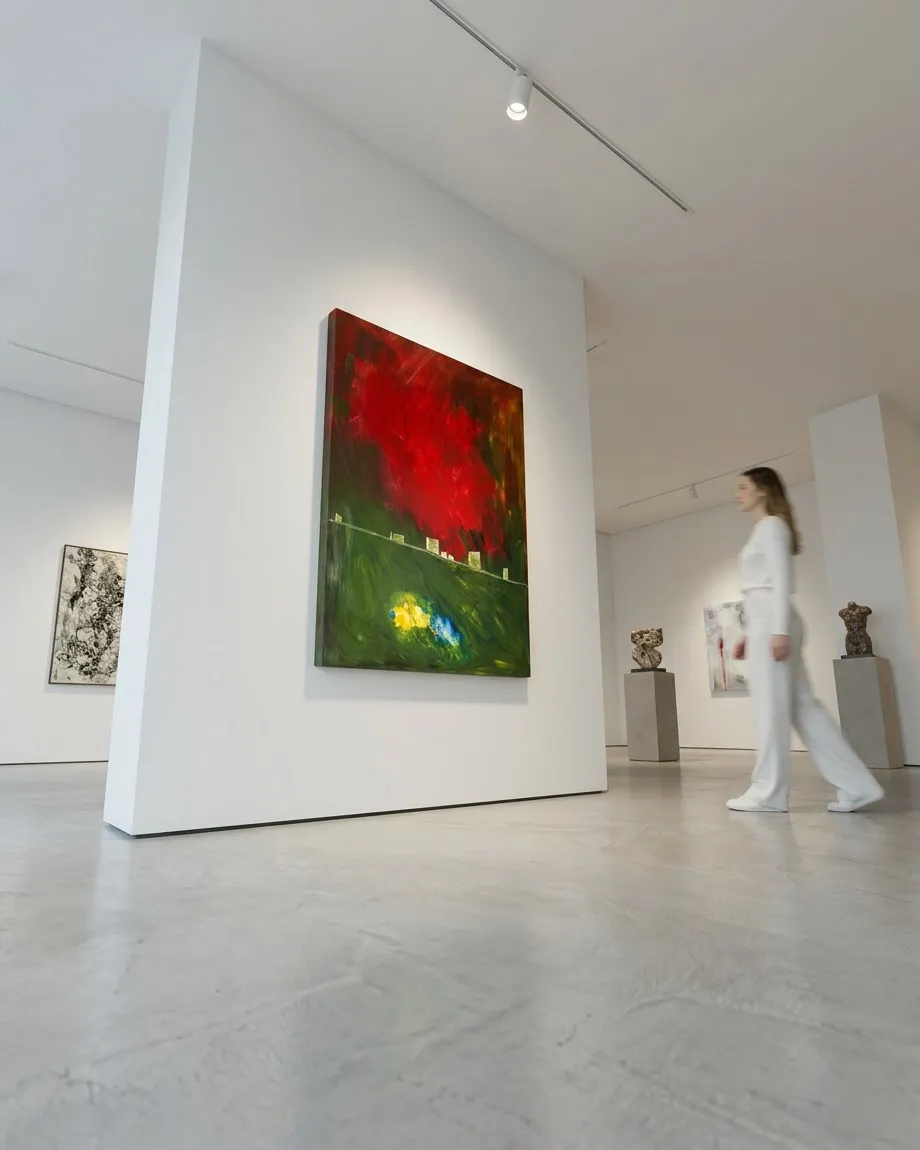
Context study / A THEORY OF LIGHT AND SHADOWS
A Theory of Light and Shadows - Maurizio Valch | Gallery View
Fragment I
Facing the vertical abyss of the canvas, the silence takes on the weight of dry acrylic. Ibn Tufail, an Andalusian sage who believed that the pure observation of nature, without teachers or texts, could reveal the deepest secrets of the universe, narrows his eyes and tries to calculate the exact distance between the small quadrangular screens hovering over the hillside. His mind searches for a geometry, a stellar order in that fragile handrail of light dividing the brushfire. Beside him, Zhuangzi, a Chinese mystic who suspected that reality is a dream so fluid that it is useless to try to catch it with words or definitions, lets out a soft, almost imperceptible laugh that reverberates across the gallery floor. Zhuangzi points a curved finger toward the massive carmine bulk crowning the work: he does not see a destructive fire, but a heavy exhalation, a sky that has decided to incarnate and collapse upon the earth with the density of cold blood. While the Andalusian philosopher tries to decipher whether those suspended monoliths are temples or eyelids, the Taoist simply breathes the space, sensing how the heat of the upper plane presses against their chests like a strange, humid atmosphere.
Fragment II
Sometimes I walk in here and do not recognize myself in what my hands have cast. I know it was I who dragged the palette knife, I recognize the violence of the gesture, the creak of the canvas yielding under the pressure of the medium. But this red… this red no longer belongs to me. It has detached itself from my memory like a dry scab. I stand a few feet back and feel a physical distance, an almost mineral coldness before this carmine surge that I myself provoked. It is as if the painting had taken advantage of the silence of my sleeping hours to devour the purpose with which it was conceived and replace it with a harsh, alien will of its own. I look at that dividing line, that horizontal gash where the light seems to hold itself up by a sheer miracle, and I doubt that I was the author of its balance. Was it I who decided that the light should be born there, or did I merely clear the space so that something already hidden in the canvas could breathe?
Fragment III
The precision of Ibn Tufail’s measurements crumbles as his gaze descends to the lower quadrant. There, where the green slope darkens and turns almost to mud, pulses a tangled nest of electric yellows and blues. There is no geometry there; it is a spasm of the medium, a luminous wound defying all physics of refraction. The Andalusian philosopher feels his stomach turn as he realizes his rational tools are useless: this glow does not behave like sunlight; it does not bounce or project. It is then that Zhuangzi stops smiling. The mystic takes a step back, his pulse altered by a sudden suspicion that makes his skin prickle. That yellow and blue nest is not there to be illuminated by the fire above, nor to decorate the penumbra of the grass. It is alive. It is an inverted pupil staring back at us, an inverse lighthouse scanning the darkness of the room to see if we—who believe ourselves to be real on the other side of the canvas—truly exist, or are merely shadows projected by its own brightness.
Fragment IV
I remember the metallic cold of the palette knife slicing through the flesh of the paint, the sharp sound of the acrylic being torn to shape those small, floating monoliths. It was night. Outside the studio, my dogs suddenly fell silent, as if they sensed a threshold was opening within. As I slid the metal over the canvas, I did not feel I was creating, but making an incision in time, halting its course to leave a slower, heavier dimension exposed. Today, looking at the finished work under the gallery spotlights, I realize the painting has returned my own shadow to me, but distilled, free from the urgency of the body. That dark stain supporting the electric nest at the bottom is the residue of my own sleepless nights, a reminder that painting is not a record of what I saw, but the physical sediment of what I was while the world slept.
Fragment V
Before the canvas, the two intelligences and the invisible creator reach a truce made of wonder and bewilderment. No one tries to measure the distance of the monoliths anymore, or define whether the sky burns or dreams. The lower nest of light continues to watch them, claiming its right to be the true center of gravity in the room, the eye that dreams the space outside. Ibn Tufail accepts the limit of his reason with a silent bow; Zhuangzi now knows himself to be the inhabitant of a painting that is, in turn, watched by another; and the artist accepts that his work has completed the journey, breaking free from his hands to become a living theory, where light and shadows are not explained, but inhabited like a territory where reality is but one of the many forms of mystery.
- Original artwork
- A THEORY OF LIGHT AND SHADOWS
- Actual dimensions
- 31.5 × 47.2 in / 80 × 120 cm
- Presentation
- Digital contextual visualization
Context references
red and green abstract painting · maurizio valch painting · large vertical format paintings · contemporary art in art gallery · works from incarnate series · buy original abstract painting · modern art home decor ideas
About this visualization
This visualization places the artwork within an architectural context to help collectors and viewers imagine its presence in a real space. It is an interpretive reference, not an exact reproduction: the original work remains the sole authority for scale, color, surface and material presence.