Context study / SUBMERSA
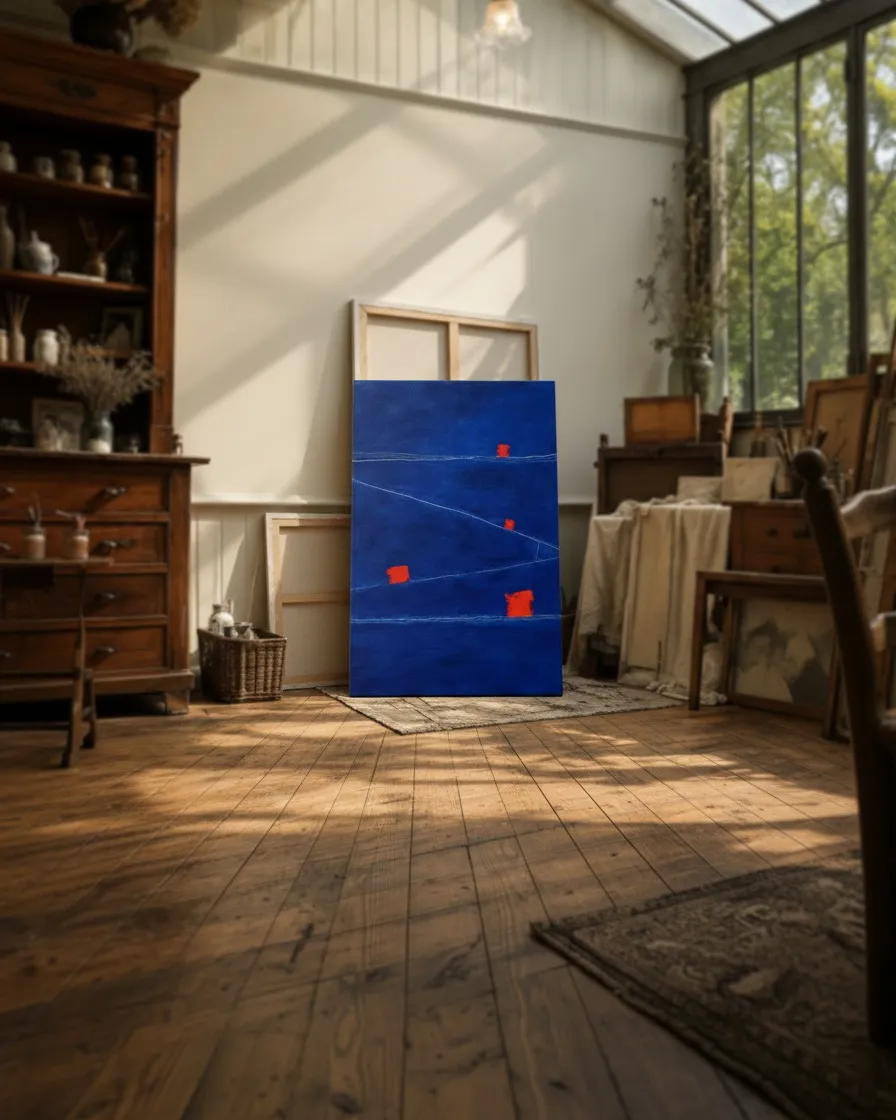
SUBMERSA Abstract Blue Painting by Maurizio Valch - In Art Studio
SUBMERSA
Maurizio Valch — 80 × 120 × 3 cm
At first, the blue seems self-sufficient. It does not open a landscape or promise depth: it occupies. It is a vertical, compact field, with a density that is not quite wall, water, or night. In its presence, the air still feels redundant. One can look from a distance without sensing danger; four small red irruptions hang suspended in this expanse as if they had arrived late to an appointment whose hour remains unknown.
The question takes its time to approach: what minimal rules make it possible for four red presences to share a blue ocean without ever touching?
From afar, perhaps there are no rules. Only distance. One red near the top, close to a pale line; another lower down, shifted toward the center; one to the left, broader, as if it had retained a portion of blue around itself; the last, at the bottom right, seems to possess its own gravity. It is best not to decide what they are just yet. At times they behave like remnants; at times like small decisions; at times like something that refuses to disappear. One of them, the lowest, gives the impression of cheating: it seems to have installed itself with a security the others lack.
Then the lines come into view.
They do not arrive with the authority of a grid. They are pale, thin, fragile; they traverse the blue without dominating it. One passes almost horizontally through the upper area and approaches the small red without touching it. Another tilts, descends, and changes direction. Lower down, a line seems to extend, lose strength, and reappear as if it had forgotten what it was meant to order. They could be routes, but none leads clearly from one place to another. They could be boundaries, but they do not enclose. They could be currents, though they do not visibly drag anything along.
Follow one from left to right. Do it slowly. At first, it seems the line will lead you to the upper red, like a rule of approximation. But it veers off, thins, and leaves a minimal, unresolved distance. Notice what your breath does when you discover it does not reach where you expected. Perhaps you inhale a little more than usual. Perhaps the blue, which seemed breathable, becomes too vast for those four signals.
I look at this blue now and it returns a different distance from the one I imagined. I follow a line with my eyes and feel it knows something I do not; I look at the reds and can no longer ask them to remain still within a single function. It makes me uneasy that they seem to hold themselves up without asking my permission.
The first line, then, is not a solution: it is a promise cut short. It suggests that the red at the top is protected by its proximity, but perhaps that very proximity is its risk. Being next to a rule does not mean being safe from it. A line can point to where one may pass; it can also mark the exact spot where no one must linger.
Charles Darwin was the naturalist who learned to think of life through small variations, changing relationships, and unheroic survivals.
Here he does not serve to turn the blue into a lesson. His presence introduces a more humble discomfort: the four red shapes do not seem like isolated individuals, even though they do not resemble one another. They share a medium that presses upon them without crushing them. Each persists differently. The highest seems to maintain itself through economy: it barely occupies space, barely declares its presence. The central one, smaller, hangs suspended near an oblique line, as if it had discovered a pause in a current. The one at the lower left seems to push against the blue, or be pushed by it. The one at the bottom right seems to have reached a secret agreement with weight.
But what if adapting does not help you get anywhere? What if the only way to persist is to retain a minimal difference, a visible red mark, without a coast, without a destination, without a confirmed rescue?
The blue does not answer. It absorbs the question and keeps its lines.
The central presence forces a pause. It is small, tilted, difficult to fix. Viewed alone, it seems vulnerable; viewed alongside the one at the top, it seems displaced by the same pressure; viewed with the two lower ones, it seems like the first attempt at a conversation that did not prosper. It touches no one. Nor is it completely alone. A line passes nearby and goes on its way, with the distracted politeness of something that does not know it is being observed.
A child might ask: why do the lines pass close to the reds but do not pick them up?
The question seems small, but it alters the entire field. We had assumed a line serves to connect, lead, or save. Yet perhaps the lines are not there to pick anything up. Perhaps they sustain the separation. Perhaps they are the minimal agreements that prevent one presence from invading the breathing space of another. A rule does not always build proximity: sometimes it preserves a distance without which everything would merge.
Elinor Ostrom was the thinker who showed that a community can care for what is shared by inventing concrete, imperfect, and living rules.
Her arrival makes the immensity of the blue suspect. It is no longer just a medium that selects differences: it is also something shared, too vast to belong to a single red shape and too delicate to lack agreements. The light lines could be provisional arrangements: not walls, not firm borders, but ways of distributing passage, waiting, and closeness. Yet they are so faint that perhaps no one can fully obey them.
Then a question appears that displaces the four figures: which of the four red presences is guarding a limit that the others do not even know exists?
The highest might be watching the upper strip, not out of will but position. The central one perhaps guards a crossing no one has noticed. The lower-left red, somewhat larger, could be holding back lateral pressure. Or perhaps the one at the bottom right, so close to a low line, is the least visible guardian: defending not a territory, but the possibility that the others do not come too close.
And yet, none seems heroic. There is no gesture sufficient to claim they are caring for anything. That is the difficulty. Care can be almost indistinguishable from drift. Maintaining a distance can look like abandonment. The lines have convened a meeting, but no one has brought chairs, minutes, or the certainty that those attending know they are gathered.
The friction between these two ways of looking begins to change the painting. The red differences are no longer only responses to the blue pressure; nor are they just participants in a pact. A collective rule can transform, fail, disappear, and return with a different tilt, like a line that weakens and reappears a little lower down. There can be agreements that do not produce harmony, but rather a carefully managed separation. An order that allows the four presences to continue there, precisely because it denies them contact.
Now try something else: fix your gaze on the red at the lower left and try not to look at the other three. Hold it for a few seconds. The blue around it will begin to grow. After a moment, the other reds do not disappear: they weigh from the periphery. They become a kind of visual responsibility. You will understand then that distance is not emptiness; it is a form of relationship that demands attention.
I do not know whether to call these shapes variations, or if I should imagine they have made some pact. I look at them and my need to classify them loses its footing. I wonder what keeps them afloat, but also what they would lose if an explanation managed to pin them down too well. I do not want to protect them from the blue; I want to let the blue continue to call their permanence into question.
The last red, at the bottom right, closes nothing. It seems more settled than the others, but that stability may be an illusion caused by the nearby line. If you look at it for a while, it begins to seem separate even from its own position, as if the blue underneath could withdraw without warning. It is not an end or a refuge. It is another way of not touching.
The light lines continue to act without obeying a single law. One seems to establish a common strip; another crosses it as if it had forgotten it. One suggests descent; another returns the gaze upward. None fully maps the blue, and perhaps that is the most demanding minimal rule: leaving a part unmeasured so that the four presences are not reduced to their coordinates.
To one side, there remains a blue zone where a line thins until it is almost erased; near it, one of the reds seems lonelier after being observed, and the surface continues to organize a distance that the text does not manage to close.
- Original artwork
- SUBMERSA
- Actual dimensions
- 31.5 × 47.2 in / 80 × 120 cm
- Presentation
- Digital contextual visualization
Context references
blue abstract painting · maurizio valch artist · abstract paintings for workshop · rustic art studio decor · original blue and red artwork
About this visualization
This visualization places the artwork within an architectural context to help collectors and viewers imagine its presence in a real space. It is an interpretive reference, not an exact reproduction: the original work remains the sole authority for scale, color, surface and material presence.