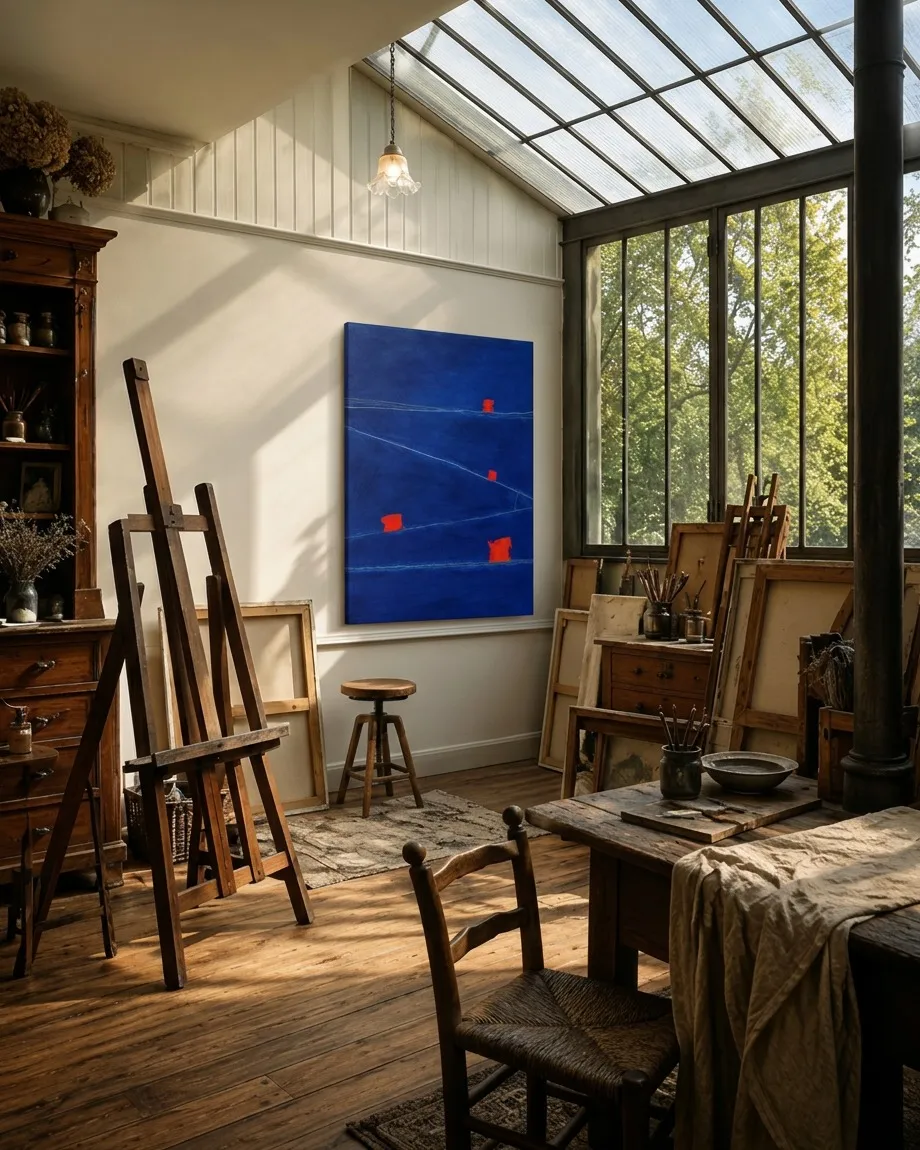
Context study / SUBMERSA
Maurizio Valch - SUBMERSA in the artist's studio | Original artwork
Immersion Report: Cartography without Top or Bottom
At 3 centimeters from the surface
The upper strip offers neither sky nor ceiling. It offers resistance. The blue begins before the eye manages to name it: not as an empty extension, but as a gentle pressure that forces one to look slowly. Near the top, a pale line glides from side to side with an almost administrative discretion, as if recording a border that no longer knows between which territories it was drawn.
The first red spot appears at that height like a sign placed too early. Small, square, or barely irregular, it does not announce a reliable direction. It could indicate danger, but there is no place to move away from; it could point to an arrival, but the painting has lost all notion of harbor. It is a terrible navigation aid, though perhaps that is why it is necessary. How can something as small as a red spot modify the gravity of a blue world without explaining it?
I look at this blue surface and it does not fully obey my eyes. From a certain distance it seems still; if I slightly change my breathing or let my body draw closer, the lines begin to appear as if they had been waiting for another rhythm of gaze. Now I no longer know if they were hidden or if it is my eyes that are late to them. The blue does not open: it forces one to remain standing before it.
At the height where the line begins to yield
Dōgen imagined practice as a way of completely inhabiting the instant, without turning it into a stepping stone toward something else.
Before this work, that idea interrupts the impulse to descend. The verticality of SUBMERSA invites the gaze to go down, but the large central curve distrusts that mandate. It leaves one side, tilts, falls slightly, rises again: it does not lead. If followed as one follows a channel, it disappears; if looked at as a horizon, it becomes cluttered; if one tries to measure it, it seems to change level without moving.
To rise, to descend, to advance, to stop: verbs that are too human for these lines. Here a line is arriving and has already arrived. The curve does not seem to record a path but a coexistence: it is above and below itself, near and far from its own detour. The eye wants to accompany it, but it needs no company.
The second red form remains suspended near that line, as if it had been dragged by it and had decided to abandon the route at the last moment. It no longer seems exactly a sign. It has something of an improvised refuge, of a minimal air pocket within a depth that does not allow itself to be turned into an ocean. Its red does not warm the blue. It makes it harder to cross.
At mid-curve
The painting begins to withdraw coordinates. The lines brush against each other without completely crossing; one seems to continue in another, though there is no proof they belong to the same stroke. The viewer mentally tilts their head. Not because the work is crooked, but because the body seeks a gravity that the blue dispenses with avarice.
Here it is best to cover one of the red spots with a finger—the one closest to the central curve, for example—or imagine covering it. An ornament is not lost. A small shift in weight is lost. The blue flattens out too much. The neighboring line becomes obedient, almost decorative; the curve stops threatening to fall toward a nameless place.
Remove the finger.
The red does not return the same. It does not return to its place like a piece replaced on a board. Upon reappearing, it alters the temperature of the entire space: the blue areas around it seem thicker, the lines more vulnerable, the void less empty. The spot illuminates nothing. It makes everything else unable to hide behind its immensity.
A child might ask: "What if that little red is learning not to fall?"
The question disarms the report's confidence. Because the red form does not exactly float, nor does it rest. It is neither supported by a line nor detached from it. If it learns not to fall, it does not learn a heroic lesson: it learns a minimal, obstinate, almost ridiculous clumsiness. A tiny creature that refuses to behave as an emblem.
Where the lines brush and orientation fails
Walter Benjamin paid attention to minor details because he knew they could suddenly alter the entire order of a scene.
The four red irruptions form, under that gaze, a constellation that does not need to become an allegory. They are not equivalent to each other. One seems more isolated; another approaches a line as if listening to something; another asserts itself with a suddenness that is almost comical; the last remains below, near an area where the blue has become heavier. Relating them does not mean translating them. It means admitting that one spot can affect another from afar without any visible route between them.
Benjamin's thought would want to gather them: four scattered anomalies, four interruptions of a blue continuity, four small events capable of shaking the order of a gigantic extension. But the painting responds with a difficulty. The reds do not compose a code. They do not form a sentence. They barely manage to be distant neighbors.
Dōgen distrusts this need to gather clues. The constellation, the curve might say, still wants to arrive at a figure. It still desires that the scattered be allowed to be looked at from a higher elevation. But here there is no height. Each red occurs now, each line occurs now, and the now has no center from which to organize itself.
Benjamin protests, without solemnity: too much serenity before these small alarms can seem a refined way of not seeing them. Those spots have cut the blue. They have introduced something that does not dissolve by remaining present. An interruption does not disappear because it is contemplated with patience.
And yet, Dōgen finds his obstacle: one of the red forms persists as an interruption that fails to become pure presence. It remains slightly outside the instant. It insists. It seems to have arrived from a different logic and retained it.
Benjamin finds his lower down: a blue zone without citation, without memory, without dialectical image. A zone that delivers no fragment to be gathered. The blue keeps no secret; neither does it reveal void. It simply continues, and that continuation serves as proof of nothing.
After watching them argue, I discover that the red forms no longer completely belong to me. A part of me would want to leave them still, without forcing them to declare whether they are interruptions or presences; another part recognizes that their stillness is precisely what perturbs. They do not seem to come from outside the blue, but neither do they accept being absorbed by it. Perhaps the contradiction is not between them: it lies in that small red obstinacy that does not fully enter the painting and, yet, has already changed its entire breathing.
At approximately 80 centimeters deep
The lower strip does not respond to the descent as a bottom. It does not receive. The lowest line approaches the edge without completely surrendering to it; it thins, trembles slightly, and lets the blue remain between it and the exit. In common cartography, that final space would demand a legend. Here the legend would be another spot, another false certainty.
The four red forms have stopped being clear signs, safe havens, recognizable creatures, or errors of scale. They are points of view not offered to the viewer. They are small bodies without anatomy. They are cuts in a continuity that was not as joined as it seemed. Each modifies the blue gravity in a different way, but none explains it.
Returning to the image, it is best to look at the pale line running near the upper edge: it does not manage to touch it. It seems to brush the exit and withdraw a fraction before. Also the highest red form is slightly displaced from that line, as if it had arrived late to an appointment that was never set.
- Original artwork
- SUBMERSA
- Actual dimensions
- 31.5 × 47.2 in / 80 × 120 cm
- Presentation
- Digital contextual visualization
Context references
SUBMERSA Maurizio Valch · blue and red abstract painting · vertical abstract painting · interior design with art · art for studio or office
About this visualization
This visualization places the artwork within an architectural context to help collectors and viewers imagine its presence in a real space. It is an interpretive reference, not an exact reproduction: the original work remains the sole authority for scale, color, surface and material presence.