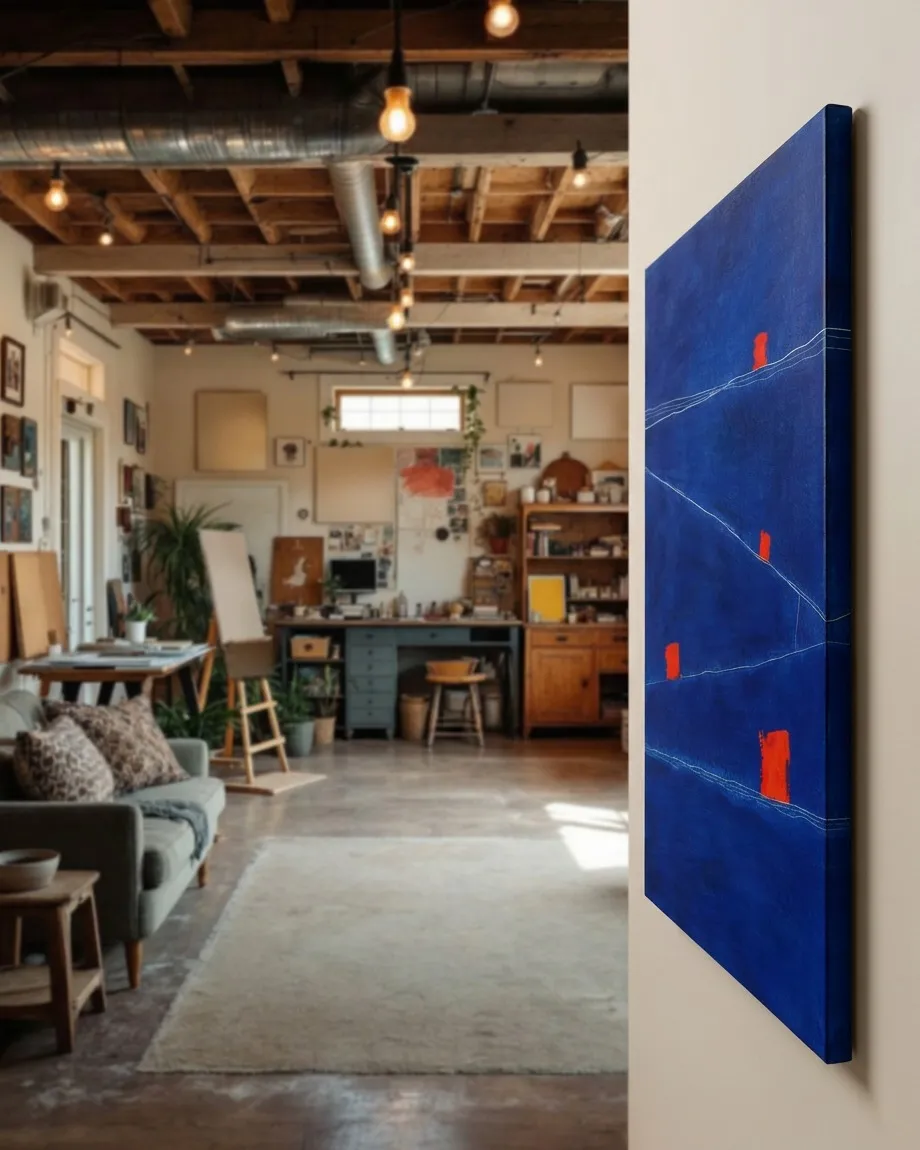
Context study / SUBMERSA
SUBMERSA Abstract Painting in Artist Studio — Maurizio Valch
The first red appearance is at the top, small and standing against the deep blue, as if it had arrived before the rest of the painting and still did not know where to place itself. It does not dominate by size; it commands by interruption. The eye descends towards it and stops: an absurd authority, that of something minimal that manages to make everything around it seem to hold its breath. The pale lines passing nearby do not entirely hold it. One grazes its height and turns away, another seems to want to establish a border but hesitates. Jorge Oteiza is a Basque sculptor attentive to the void, the disoccupation of form, and the active power of what seems to be missing. Here, he attempts to withdraw the red mark, to clear the field, to let the blue act as a mass emptied from within. But the blue does not remain clean or monumental: it ripples, thickens to the sight, and seems to keep stains of depth. The small upper mark does not occupy that space; it disrupts it.
I am before this blue and I cannot feel it as something that belongs to me, even though it came out of me. I look at it and it recedes; I try to follow a line and the line resists, as if it had decided not to fulfill the direction I attribute to it. I feel that the high red patch is not placed in a spot: it is altering the distance between my eyes and everything else. When I want to possess the field, the field becomes deeper. When I want to fix the red, the red seems to move without moving.
A little further down, towards the right, the second red appears: brief, suspended, almost like a splinter caught between two water levels. Now the lines stop being borders. They become waves. They do not advance straight, but tense and hesitant, as if they were trying to agree on where the world passes and could not reach a decision. The gaze approaches to check their fineness, to follow that almost invisible trembling; then it needs to step back, because up close the red seems too little and, from afar, it presses upon the entire blue again. A child's question then enters with uncomfortable precision: do the reds know they are floating?
The question changes when the descent meets the red on the left. It is small too, but less alone: one line reaches towards it, another diverts above, another seems to cross the blue without quite touching it. There is no longer a wave but a seam. A poorly obeyed seam, made to join two extensions that do not quite coincide. The red on the left does not cover that separation nor illustrate it: it makes it felt. It has something of a signal, but it does not point to an exit; it has something of a body, but it does not let itself be turned into a figure. It seems to have interrupted a measure and left the blue miscalculating its own height.
Yasujirō Ozu is a Japanese filmmaker capable of making silences, everyday objects, and the small distances between people decisive. He remains still before that lateral red as if before a shot where something has just happened out of frame. He waits. The immobility begins to weigh. But there is no room to order the waiting, no face, no domestic narrative that can gather it: only blue, lines, and a red interruption that yields no explanation. His camera would have to learn to film a depth that does not want to tell a story. Oteiza would want to clear it; Ozu would want to hold the silence. The painting forces both to fail a little, because the space does not empty and the silence does not stabilise.
The lines, meanwhile, are no longer sufficiently routes, waves, or seams. They have become a defective measure of the world. They go down and tilt; they seem to grope for a division, correct themselves, forget the correction. The childhood question returns modified: if the reds know they float, do they also know that the lines fail to straighten out to support them? The blue does not answer. It only makes the question weigh more, as if one had to descend with it beneath a surface that is never quite touched.
I look back at the finished work and notice an unexpected consequence: my body wants to tilt with those lines, even though I know they will not take me anywhere. I do not agree with the idea of a serene void, nor with the expectation of a story that might arrive later. I perceive a kind of pressure on my shoulders, a need to adjust something that cannot be adjusted. When the red seems still, it is I who lose stability. When the blue seems immense, I cannot decide whether it contains or expels me.
The fourth red appearance, below, is more extensive and lower, though it does not quite become a complete figure either. Its irregular edge occupies a little more space, as if it had grown while crossing the descent, but it resolves nothing: it concentrates the tension without closing it. Near it, the pale lines fold back and continue; one seems to graze it, another passes underneath, another remains suspended like a border that no one has managed to draw straight. The line that above could seem like a horizon has ended up being something else: a clumsy breath, an open seam, perhaps the proof that the blue is not behind the marks but working between them. The lower red does not fill the field. It leaves it larger. And, above it, remains a blue zone without an answer, still active, where the gaze sinks once more.
- Original artwork
- SUBMERSA
- Actual dimensions
- 31.5 × 47.2 in / 80 × 120 cm
- Presentation
- Digital contextual visualization
Context references
large paintings in painters studios · decorating with blue abstract painting · artworks in designer interiors · minimalist art decor ideas · presentation of paintings on wall
About this visualization
This visualization places the artwork within an architectural context to help collectors and viewers imagine its presence in a real space. It is an interpretive reference, not an exact reproduction: the original work remains the sole authority for scale, color, surface and material presence.