Context study / QUINQUE
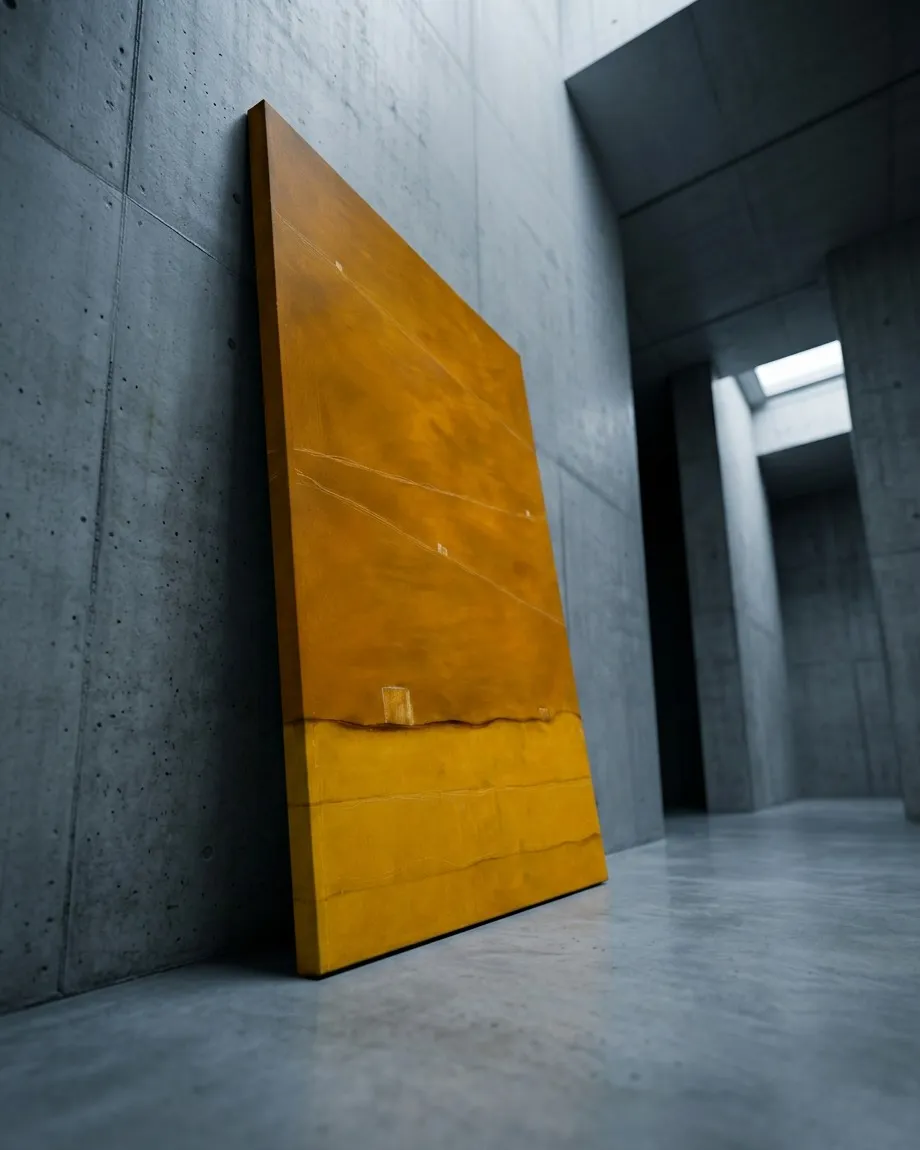
Abstract artwork QUINQUE leaning on gray concrete floor
Far from the polished walls of a gallery, leaning directly on the gray floor of a brutalist concrete architecture, the canvas of "QUINQUE" behaves like an exhumed fragment, a material block that does not decorate the space, but interrupts it. The composition, fractured along an irregular horizon that separates dense ochre from vibrant yellow, does not describe an external landscape or evoke a chronology. The artist's life is deposited on this surface, yet stripped of anecdotes: there are no chronicles of journeys, moves, or recognizable losses here. Instead of a narrative, the painting offers a geological accumulation of layers, where color and relief act as the silent record of an existence that has learned to weigh itself through matter.
I have traveled thousands of kilometers on foot and by bicycle, inhabited temporary rooms, and dismantled camps in the open, yet I have never felt the need to illustrate those days on canvas. In sinking the palette knife to open the three thin incisions at the top of "QUINQUE", I do not seek to draw a path on a map or commemorate a specific date. I simply record the physical trace of a passage, the habit of wounding the surface to see what lies beneath. Painting is, for me, a process of subtraction where the fact of having lived does not translate into a story, but into the actual wear of the oil, into the pressure exerted by the hand on the plane to leave a mark that can no longer be erased.
This renunciation of biographical illustration aligns Valch's language with the material poetics of Antoni Tàpies, where the pictorial surface is assumed as a wall or a weathered skin retaining the marks of time without explaining their origin. In "QUINQUE", the blocks of oil settling on the central scar and the three tiny elements suspended in the upper incisions function as conceptual anchors. They do not represent specific memories or milestones of a personal quest; they are mute presences measuring the gravity and resistance of the support. Autobiography becomes purely tactile here: life appears not as a succession of explainable events, but as the accumulated density of strata and the fragility of the lines traversing them.
Under the overhead light sliding down the concrete walls, I observe how the lower yellow supports the weight of the ochre field, as if the canvas retained the same tension I feel when daily urgencies give way to silence. Those five blocks giving the work its title are my only anchor points, elemental structures I placed to defend myself against the dispersion of memory. I do not need the viewer to decipher my past through them, nor do I intend to offer a theory about who I am. It is enough for me that these fragments support their own weight in the void, proving that even in falling or in the uncertainty of drift, matter can build a refuge in which to pause and breathe.
In the end, "QUINQUE" proves that a biography can dispense with the word to manifest itself in all its rawness and honesty. The painting does not ask to be read like a memoir, but invites us to inhabit a "tactile shore" where time is measured by the thickness of the pigment and the depth of the cuts. By refusing to narrate, the work remains open, leaning against the wall as an autonomous testimony that seeks to convince of nothing. It is life presenting itself in the form of a territory under pressure: an exposed body that, without recounting its wounds, proudly shows the scar of having been there.
- Original artwork
- QUINQUE
- Actual dimensions
- 31.5 × 47.2 in / 80 × 120 cm
- Presentation
- Digital contextual visualization
Context references
designer paintings leaning on the floor · decorating minimalist hallway with art · ochre and yellow painting for industrial living room · brutalist design with art paintings · abstract textured work concrete wall
About this visualization
This visualization places the artwork within an architectural context to help collectors and viewers imagine its presence in a real space. It is an interpretive reference, not an exact reproduction: the original work remains the sole authority for scale, color, surface and material presence.