Context study / QUINQUE
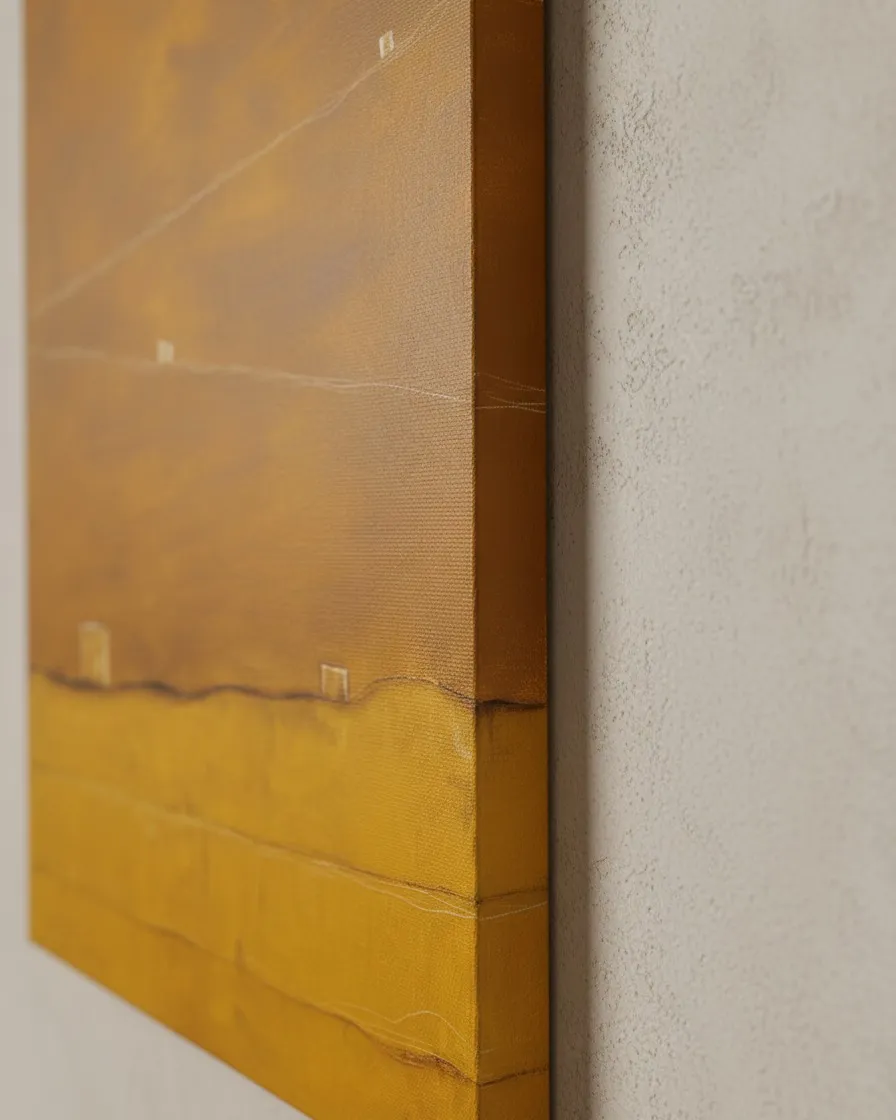
Texture and Edge Detail of Abstract Painting | QUINQUE by Maurizio Valch
We find ourselves before a vertical canvas measuring eighty by one hundred and twenty centimetres, establishing its physical presence through a thickness of three centimetres where the pictorial plane extends around the edges, accentuating its quality as a three-dimensional object. The colour field is organised through a horizontal division separating two large zones: an upper one, dominated by a vibration of ochre and earth tones suggesting a dense and atmospheric space, and a lower one of mustard yellow functioning as a plinth of greater visual weight. Distributed in a calculated yet asymmetrical manner across this surface are five small light-toned blocks or cubes, designated under the Latin concept of quinque, which break the chromatic homogeneity. Three of these elements are suspended in the upper zone, aligned and supported by thin incised lines that cross the canvas horizontally from end to end, while the other two sit directly upon the irregular dividing line, acting as terrestrial counterweights anchoring the composition.
When confronting this vertical format canvas, I do not pursue the illustration of a predetermined idea, but rather a direct dialogue with the physical resistance of oil and acrylic on the weave of the fabric. The act of making incised traces on the dense matter demands a precise gesture that cuts, scrapes, and removes the still-fresh layers of color to reveal the base of the canvas; it is not a matter of drawing on the paint, but of physically intervening in its thickness. The five light blocks were not projected as preconceived symbols within a rigid scheme, but emerged as accidents of the matter during the process of scraping and shaping the surface. As I dragged the metal tools, these small pigment reliefs resisted the movement, consolidating as visual support points that I chose to respect and refine, allowing the composition to find its own weight and balance in an organic and unplanned way.
This distribution of minimal elements and linear trajectories confronts us with a formal structure that critically dialogues with the theories of George Gurdjieff, whose proposal on the mechanical nature of human behavior and the pursuit of conscious attention resonates with the rigidity of the structures supporting the blocks, suggesting a tension between the automatism of the lines and the uniqueness of the isolated bodies. The horizontal guides crossing the canvas could well be interpreted as the threads of a shared mechanical quality conditioning the position of the suspended elements, raising the question of whether these small blocks represent states of waking or simply inert bodies swept along by a structural current. Nonetheless, the work eludes dogmatic explanations by suspending these questions in a visual silence akin to the musical aesthetics of Arvo Pärt, a composer whose tintinnabuli technique and strict economy of notes help us understand how the void and the silence between the blocks take on a plastic force greater than that of the elements themselves. The ochre space separating each cube functions in a similar way to the silent intervals in the Estonian composer's scores, lending density to the distance and allowing the stillness of each point to resonate with greater intensity within the plane.
My memory of landscape is deeply linked to the quality of light I experienced on the southern coast of Spain, in areas like Nerja, where the intensity of the afternoon sun on dry terrain reduces the environment to a stark contrast of ochres and yellows. In those arid territories, human architecture often appears as small, isolated volumes, white blocks silhouetted against the immensity of a sun-baked earth and an unperturbed horizon. I need to resort to incised lines on the surface of my paintings to establish a personal geometric order against the immensity of the colour, a form of containment preventing the matter from completely dissolving. The linear boundaries dividing the canvas are for me marks of geographical and mental location, gestures necessary to delimit the void and allow the elements to find a stable place within an atmosphere that would otherwise be overwhelming.
The phenomenological reading of the work concludes in the observation of an unresolved tension between aerial suspension and physical anchoring, defined by the distance separating the three upper blocks from the two settled on the lower band. While the elements hanging from the horizontal lines suggest a state of precarious floatation, untouched by the gravity of the ground, the blocks at the base assert their weight by resting on the dividing line of the mustard terrain, generating a dialectic of stability and suspension that lacks a narrative resolution. We are not offered a moral interpretation of the elevation or static nature of the components, but rather the coexistence of both conditions within the same physical space. In this way, the work resists closed interpretations and returns our attention to the vibration of the ochre colour and the rigour of the grooves in the canvas, leaving the experience to resolve itself on the strictly material plane of the painting.
- Original artwork
- QUINQUE
- Actual dimensions
- 31.5 × 47.2 in / 80 × 120 cm
- Presentation
- Digital contextual visualization
Context references
abstract canvas texture detail · unframed painting thickness · minimalist abstract painting texture · maurizio valch strata · close up oil painting
About this visualization
This visualization places the artwork within an architectural context to help collectors and viewers imagine its presence in a real space. It is an interpretive reference, not an exact reproduction: the original work remains the sole authority for scale, color, surface and material presence.