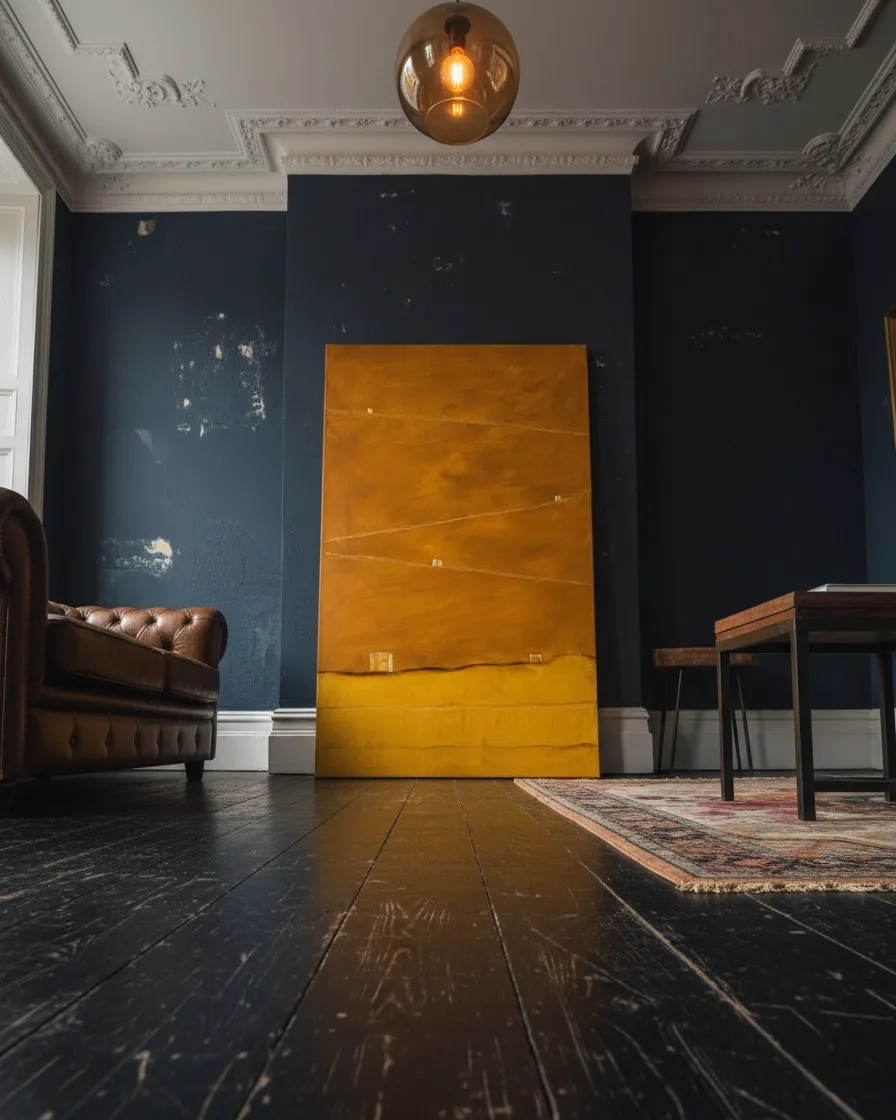
Context study / QUINQUE
Ochre and Yellow Abstract Painting in Classical Living Room | QUINQUE by Maurizio Valch
QUINQUE unfolds before the gaze as a rigorous architecture of chromatic and tectonic tensions, structured through a clear horizontal division of its chromatic fields. At the base of the canvas, a band of dense and compact yellow establishes itself as a sedimentary stratum, a geological mass that seems to support the accumulated weight of time and the pictorial matter itself. This firm ground embodies the notion of permanence; it is a foundation zone where the tool marks have settled with the gravity of an ancient and resilient territory. Above this telluric base rises a vast field of golden and rusty ochre, a suspended space that dominates the composition and extends towards the edges of the painting. In this upper atmosphere, the solidity of the ground dissolves and is crossed by subtle incised horizontal lines that score the surface from side to side. These suspended threads in the void act as minimal coordinates, traces of a latent fragility that prepare the ground for the appearance of vulnerable elements exposed to the elements.
When I confront the density of the canvas, the act of painting becomes a physical labor of excavation and resistance. I score and scrape the thick layer of oil to open those incised lines, seeking a groove, a wound on the surface that breaks the homogeneity of the ochre plane. Placing those small cubes of matter upon those vulnerable threads—three-dimensional niches operating as barely sketched lanterns or oil lamps—I experience a profound sense of exposure. They are mere millimetres of relief exposed to the immensity of an implacable chromatic void. There is no shelter for them in this golden desert; they hold themselves at the edge of disappearance, suspended from a line so thin it seems about to give way under the weight of the pigment. For me, incising the canvas and placing these small structures is an attempt to trace a limit, to leave a minimal sign of presence and orientation amidst a vastness that threatens to devour everything.
The visual impact of the work lies in the drastic scale separating the immensity of the colour field from these five small isolated cubes. This vulnerability of the geometric figures in relief should not be interpreted as a defeat or a gesture of weakness, but as a condition of absolute openness and exposure to space. If we approach the surface of the canvas, purely tactile details become apparent: the rustic, raking light skims the imperfect edges of the cubes, revealing their rough texture, their appearance of small uninhabited houses or extinguished lighthouses that, nevertheless, manage to hold their ground and resist upon the horizontal incisions. The painting transitions from being a static landscape to revealing itself as a cartography of vulnerability. These small modules resist the void and communicate with one another through the silence of the ochre, establishing a subtle counterweight to the massive permanence of the lower yellow stratum.
It is in the insistence of those small blocks, in their stubborn permanence upon the vibrant surface of the matter, where the initial feeling of exposure is transformed for me into a silent wonder. Observing how the light strikes the irregular texture of the oil and settles on the edges of each cube, I discover with amazement that these small reliefs possess enough strength to alter the gravity of the entire painting. A simple piece of accumulated oil paint, held by a scratched line, becomes a beacon reordering the surrounding void. The wonder I seek in my painting does not reside in a sudden effect or a grandiloquent revelation; it is, rather, the realization that fragility and permanence can inhabit the same plane of existence, as if each small niche were a lit lamp that humanizes and gives meaning to the night of the territory.
Ultimately, "QUINQUE" operates as a poetic and material synthesis where the permanence of the earth and the exposure of the celestial wilderness are resolved in the miracle of everyday wonder. The small suspended cubes are no longer perceived as lost bodies in the immensity, but operate as indispensable points of support, rhythmic intervals of a visual score or lanterns that humanize the void. The work invites us to shed our fear of exposure and learn to inhabit our own vulnerability. By maintaining a balance as tense as it is harmonious between the weight of the geological base and the lightness of the incised lines, the painting demonstrates that the true beauty of existence arises precisely where the line breaks, suggesting that matter, despite wear and time, always retains its capacity to harbour light.
- Original artwork
- QUINQUE
- Actual dimensions
- 31.5 × 47.2 in / 80 × 120 cm
- Presentation
- Digital contextual visualization
Context references
large ochre abstract painting · classical blue living room decor · original abstract painting · maurizio valch quinque · yellow and ochre living room painting
About this visualization
This visualization places the artwork within an architectural context to help collectors and viewers imagine its presence in a real space. It is an interpretive reference, not an exact reproduction: the original work remains the sole authority for scale, color, surface and material presence.