Context study / QUINQUE
Abstract Painting on Brutalist Concrete Wall | QUINQUE
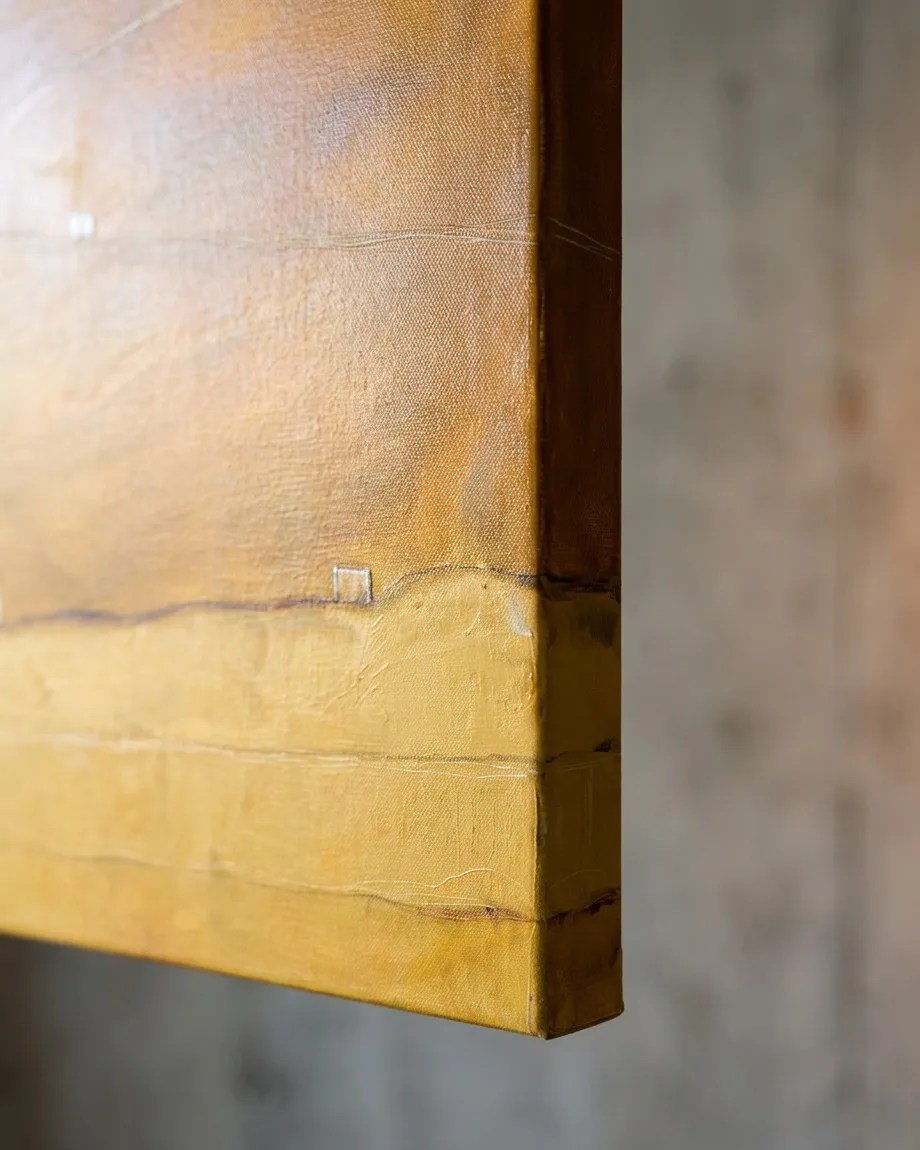
The mineral glow emanating from "QUINQUE" requires no altars or sacred calligraphy to consecrate the space it occupies. In this tight framing, where the exposed edge of the canvas reveals the stratification of pigment, the painting behaves like a fragment of an ancient wall—a vestige where ocre light and vibrant yellow seem to contain a primordial liturgical vibration. There are no saints, halos, or crosses here; transcendence shifts entirely toward the gravity of matter and the mystery of the boundary. It is precisely within that rough, dark seam cleaving the canvas that the gaze experiences an almost reverent pause—a threshold where the visible falls silent to allow the appearance of a pure presence, ungraspable by the intellect.
When I sink the tool to score incisions into the dense surface, I am not seeking to map out a rational path or illustrate a doctrine. For me, the act of wounding the oil is an exercise in stripping away—a silent ritual of removing layers to see what supports the framework of experience. I often find myself working in absolute silence, where the only sound is the scraping of the spatula against the linen weave, feeling that this physical resistance is the only real thing amidst the inconstancy of thought. These fine incised lines, where small suspended blocks rest, are not symbols of a mystical ascent; they are furrows where I have deposited my own need for silence, a blind faith that the emptiness of the scratch can hold the weight of an entire existence.
The way the work floats against the gray roughness of the bare concrete wall accentuates its character as a contemporary devotional object. The brutalist architecture of the setting does not compete with the warmth of the painting; on the contrary, it functions as the austere container for a silent revelation. By dispensing with traditional frames, the painting exposes its vulnerability to the lateral light, which highlights its roughness and imperfections as if they were sacred scars of time. The scale and isolation of the piece in this stripped-back space compel the viewer to set aside analytical haste, transforming contemplation into an act of waiting—a liturgical pause where the painting ceases to be an ornament on the wall and becomes a portal to the ineffable.
I have always distrusted closed theologies and psychological explanations that attempt to label every movement of consciousness; I know well that thought is expert at burying the fact beneath infinite interpretations. Therefore, when painting "QUINQUE," I consciously avoided any iconography that could be translated as dogma. I did not want the viewer to search for a pre-written meaning, but rather to confront the direct impact of this dense ocher that seems to contain a desert night, and this yellow that behaves like an illumination without a name. In the end, silence arrives only when the mind understands its own noise, and these monolithic forms I have arranged on the unstable border are nothing more than ramparts to protect that silence from our own urge to explain everything.
In this dematerialization of dogma lies the true transcendent power of Valch’s abstraction, which approaches mystery with an attitude akin to the silent immersion of Mark Rothko's color fields, but with a much more tactile and bodily urgency. Here, the sacred is not a celestial elevation that pulls us away from the earth, but a deep immersion into the skin of the territory and the marks left upon it by time. By laying down the arms of representation and explanatory narrative, the work returns us to the shore of pure existence. Transcendence, then, is revealed not as a future promise, but as the humble and persistent capacity of matter to shelter mystery, reminding us that the boundary of painting is the place where silence regains presence.
- Original artwork
- QUINQUE
- Actual dimensions
- 31.5 × 47.2 in / 80 × 120 cm
- Presentation
- Digital contextual visualization
Context references
painting for concrete wall · brutalist decor with art · textured gray abstract painting · minimalist contemporary art · concrete wall with ocher painting
About this visualization
This visualization places the artwork within an architectural context to help collectors and viewers imagine its presence in a real space. It is an interpretive reference, not an exact reproduction: the original work remains the sole authority for scale, color, surface and material presence.