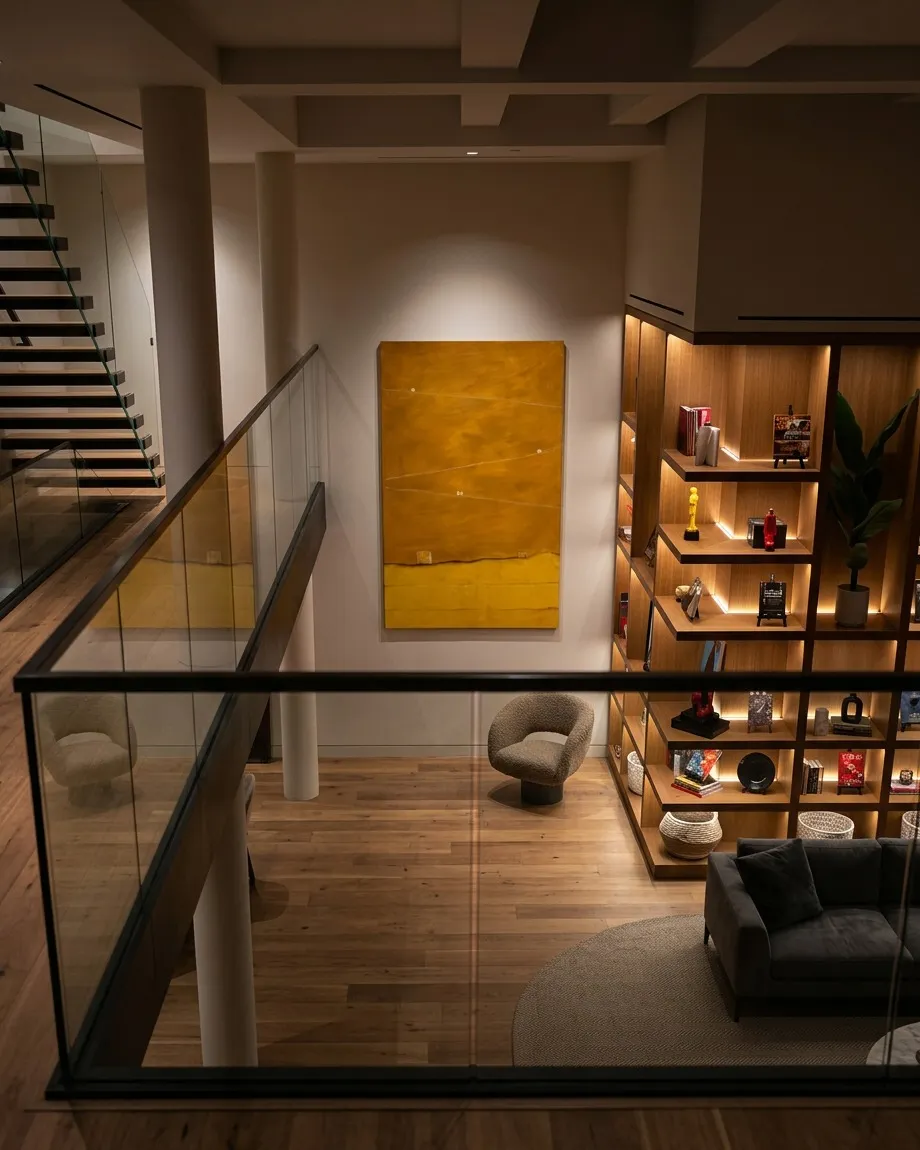
Context study / QUINQUE
Abstract Painting in Modern Living Room | QUINQUE by Maurizio Valch
The Essay on the Five Things That Do Not Fall
The vertical field does not offer a finished landscape: it offers an inclination. Ochers, amber, earthy yellow; areas that seem to absorb light and others that return it with an opaque reserve. Below, the brightest strip does not yet behave like a ground. It could be a platform, a cut, a thickness of denser air, a part of the painting that has descended too far. Upon that expanse, five clear, small presences alter the measure of everything. They do not dominate the plane: they barely interrupt it. Yet, from the moment they appear, the amber void is no longer empty.
The question arrives first as a physical problem: how do five tiny things manage not to fall within a world that seems tilted, stitched, and still in formation? They do not seem nailed, supported, or demonstrably suspended. Some are closer to extremely thin lines; others are set apart, as if they had lost the thread that was meant to justify them. Those lines are not yet paths. Before becoming routes, they bend, brush against each other, weaken, cross an area, and almost erase themselves. They look like wires seen from far away, seams that do not quite close a fabric, staves whose sound has remained in another room.
The first mark, high up and near one edge, forces the amber to cease being a background. An strange distance opens around it: not the distance between two objects, but that which separates a thing from its possible support. The ground, then, is not below; the ground is that which the mark has managed not to need. A delicate line passes nearby, or seems to: the gaze cannot quite decide. There, the instability begins.
[Maurizio Valch] might want to bring order to that doubt, but painting does not easily concede a single order.
I look at the painting from a distance where the lines seem to obey me, and I draw closer until they stop doing so. I hesitate between calling them trajectories or seams, and in doing so, I feel both words become too heavy for them. I watch a visual decision drift away from me the very moment I try to fix it; I follow one line, lose another, return to a light mark, and no longer find the same surface.
Pina Bausch. She was a choreographer who turned everyday gestures, repetition, fragility, and bodies into situations capable of thought.
Faced with the lines, she proposes improbable displacements. A figure would have to cross the amber without leaving a trace, stop before each white mark, tilt their torso in a direction that does not align with gravity. Then they would have to repeat the gesture: move forward, almost fall, hold an arm, wait. Repetition would transform the everyday into something uncomfortable. Walking would no longer be walking. It would be negotiating with an inclination that is not entirely visible.
But there are no visible bodies.
Absence is not a decorative void: it ruins the initial safety of that reading. If no one performs the trajectories, the lines cannot simply be a score. Or worse: they are a score that demands bodies and, at the same time, has withdrawn them. The five marks remain as insufficient substitutes for a human presence. They are not miniature people. Nor are they abandoned furniture on an immense plane. They seem like notes, knots, topographic signs, lightboxes, errors of scale, or creatures that have stood still before deciding what size they will be.
The second presence, shifted to the other side, changes the question. It is no longer about not falling, but about not obeying the fall. There is something dry, almost comical, in that small brightness: the whole world seems slightly defeated and she responds with an unheroic immobility. She does not even strive to appear stable. She is there. That is enough.
Moving the image away, the five shapes can look like minimal objects distributed across a golden wall. Bring it closer. The lines lose their appearance of secure connection; each begins to behave as a barely perceptible interruption in the color. Move it away again. The five presences are no longer objects: they are cuts in the continuity of space. At a certain distance, the eye does not ask what they are, but why the field changes scale around them.
The childhood question might be this: if those five things are so small, who drew the threads so they wouldn't escape from the yellow when night falls? It is not a question about what lies behind the painting. It is a question about a strange vigilance: who holds a thread so fine it is barely visible, and why not tie it completely?
The third mark, located more toward the center, complicates the matter because it seems less affirmative. It is almost nothing. But that almost nothing opens a crack in the word "line." A line no longer necessarily joins two points; it can pass next to something without touching it, it can promise a relationship and withdraw it. The space becomes less architectural and more susceptible: any minimal detour produces a new distance.
Gottfried Wilhelm Leibniz. He was a thinker who imagined the world composed of infinite singular units and sought relationships where others only saw dispersion.
The five marks offer him five centers: not five symbols, but five small units of perspective. Each organizes the amber plane differently. From the first, the tilt seems a threat; from the second, a pause; from the third, a deviation; from the two lower ones, a matter of edge and thickness. There would be no absolute ground, but five local versions of the ground. There would be no single distance, but distances that change depending on the point from which the painting remakes itself.
The hypothesis is elegant. Too elegant.
Pina Bausch introduces an objection without needing to raise her voice: a choreography is not resolved simply because its positions are well distributed. Between one position and another, there is delay. There is a knee that trembles before supporting weight, a weight that arrives late, a repetition that twists. The vibration is not in an isolated mark, but in the waiting that separates them. That intuition forces us to abandon the idea that the five presences can be calculated as self-sufficient points. They do not only have a place: they have a delay.
Then Gottfried Wilhelm Leibniz formulates a question that changes the problem: if none of those things move, why does the gaze need to traverse them in a certain order? Immobility ceases to equal quietude. For Pina Bausch, a motionless figure can contain the previous gesture and the gesture that will not be fulfilled. A halt does not cancel the dance; it makes it harder to locate. The absent body is perhaps not a lack, but a pressure exerted upon the space.
I look again at the five presences and fail to possess the relationship they have assumed among themselves. I thought I could follow them as small, separate decisions, but now I find them holding back something from one another. I lower my gaze to the yellow strip and no longer take it for a horizon: I feel it as a zone that returns to me the question of where I rest my eyes, of which part of the painting supports which.
The two lower presences change the weight of the entire work. Close to the bright strip, they seem to have a more problematic relationship with the ground: they could be resting, emerging, sinking, or simply coinciding with an edge that passes through them. The lower yellow does not receive them with docility. A fine line reaches there, becomes difficult to follow, and reappears as if it had crossed a layer of air. The surface does not promise stability; it barely manages short truces.
Here the question becomes mathematical, but without comforting numbers: what kind of equilibrium allows five singularities to remain without an obvious center? There is no large figure organizing them. There is no reassuring symmetry. There is a distribution that seems contingent and, yet, every imaginary displacement alters the whole. If one of the five marks rose just slightly, the amber would be wider. If another descended toward the yellow strip, the ground would acquire too much power. If a line disappeared completely, it would not be a detail missing: the very breathing of the painting would change.
Pina Bausch insists that the five are performing a suspended choreography. Not a frozen scene, but a rehearsal paused just before someone loses their balance. Gottfried Wilhelm Leibniz does not fully accept that image: for him, the five seem to resolve a problem whose rules remain hidden, a relationship without a sufficient diagram. Neither wins. The dance demands delay, body, and repetition; the calculation demands perspective, correspondence, and a reason for everything to be where it is.
The lower yellow strip receives this dispute. From afar, it looks like a brighter base. Up close, it becomes an ambiguous extension that is not quite ground or horizon. The eye can feel its own balance there: a slight tilt of the head, the need to adjust the distance, the almost childish impulse to straighten the image even though the image does not seem crooked. The painting does not fall. But it makes you feel like it could.
And, near that strip, one of the small light shapes remains so discreet it can be mistaken for an accident of light. It is enough to look at it again to discover that the line passing near it does not actually touch it.
- Original artwork
- QUINQUE
- Actual dimensions
- 31.5 × 47.2 in / 80 × 120 cm
- Presentation
- Digital contextual visualization
Context references
large painting for double height living room · wood and light interior design · ocher abstract painting modern living room · modern living room art ideas · wooden staircase and art painting
About this visualization
This visualization places the artwork within an architectural context to help collectors and viewers imagine its presence in a real space. It is an interpretive reference, not an exact reproduction: the original work remains the sole authority for scale, color, surface and material presence.