Context study / FISSURA
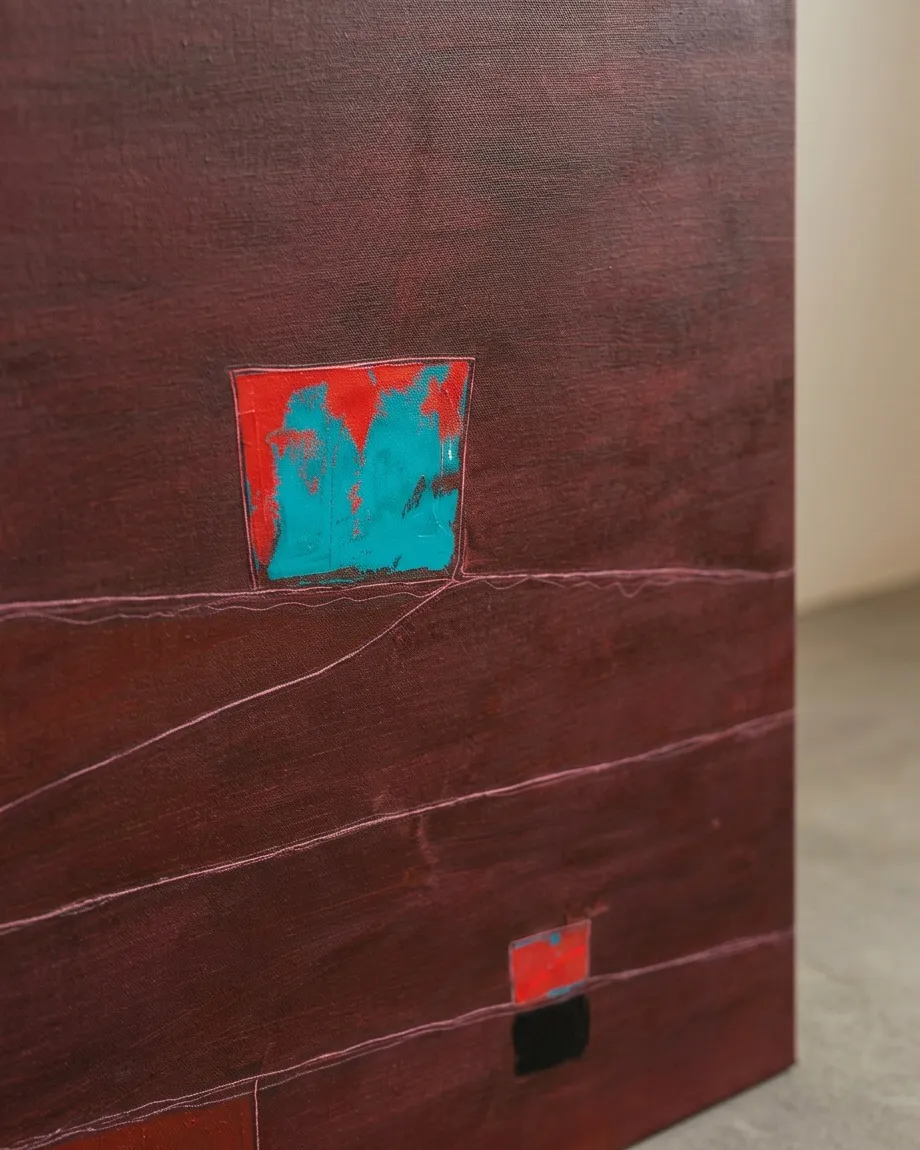
Texture Detail of FISSURA - Abstract Painting by Maurizio Valch
The dark crimson surface of FISSURA does not function as a passive background, but as a sedimented accumulation of matter that resists the eye. Depth is not built here through the optical illusion of three-dimensional perspective, but through a real physical density that is revealed only when violated. The thin incised lines that horizontally traverse this territory act as geological cuts; they are not additions to the canvas, but subtractions, subtle wounds caused by a scraping that removes the upper strata of paint to reveal the memory of the underlying support. In this territory of dried-blood color, the pale groove is a vector of negative light: it is born from the removal of the pictorial mass, from the physical gesture of subtracting to see deeper, turning the space into a body that keeps its layers of color under a dense and opaque crust.
When I sink the metal tip into the still-tender crust of oil and acrylic, I do not seek to destroy, but to expand the space of the canvas. For me, generosity in painting is completely removed from decorative accumulation; rather, it consists of a forced stripping of the matter. By sliding the spatula or the stylus to trace these incised marks, I allow the support to breathe and deliver what it guards at the bottom. The large upper block is the clearest example of this delivery: under the containment of the crimson and the limits of its own red frame, the scraping releases a thick turquoise that bursts forth with the force of a recently discovered mineral. That light is not superimposed; it was there, latent, waiting for the cut of my tool to open the necessary window to overflow. Generosity is this act of shared vulnerability between my hand and the canvas: opening a pathway so that the inner color offers itself without reservations.
This material opening establishes a dialogue of silent tensions along the entire surface of the canvas. Observing the distribution of the suspended elements, communion is revealed not as an idyllic fusion of forms, but as a tense and magnetic bond that subsists despite distance. The luminous turquoise block in the upper zone and the tiny red fragment on the black base in the lower zone seem to inhabit separate worlds within the crimson immensity. However, they are indissolubly linked by the physical thread of the incised lines that cross the plane. This line is both a boundary and a bridge; a common scar that sutures the distance and forces the isolated elements to recognize each other. Communion here is the certainty of sharing the same wound in the territory, a structural echo that vibrates from one end of the painting to the other, proving that spatial separation does not annul belonging to the same ragged matter.
In the solitude of the studio, the weight of this encounter becomes a purely physical matter of balance, weight, and resistance. My hands constantly search for the exact point where the density of the support and the fragility of the stroke sustain each other to structure the space. As I slide the tools over the thick crimson, I understand that these fissures and divisions I make on the canvas do not aim to isolate the forms, but to create the physical channels necessary for them to communicate. The dark red color, worked with heavy spatulas, behaves like a receptive body, a mass that endures the mark to give meaning to the void. Without that physical resistance of the paint, the encounter between the turquoise and the lower black would lack gravity. Each incised line I trace is a tactile decision that joins what distance seems to separate; it is the laying of a wiring that connects the ends of the painting through the pain of the groove.
Ultimately, FISSURA functions as a tactile membrane where rupture stops being a destructive accident to become the only possible place of revelation. Standing before the work, the viewer experiences a confluence of forces where depth is no longer an abyss, but the generous revelation of what beats beneath the skin of the crimson, while the physical distances between the chromatic blocks are resolved in a communion sustained by the tense thread of scraping. The surface of the painting remains open, vibrating in the ambiguity of a cut that heals and divides at the same time. By renouncing simple resolution or soft harmony, the canvas retains its mystery in the rough edges of its incised lines, reminding us that the true encounter with matter always occurs where the skin of the paint breaks to reveal its inner light.
- Original artwork
- FISSURA
- Actual dimensions
- 47.2 × 31.5 in / 120 × 80 cm
- Presentation
- Digital contextual visualization
Context references
abstract painting detail · oil paint texture · incised lines in oil · red and turquoise abstract art · close-up of art canvas
About this visualization
This visualization places the artwork within an architectural context to help collectors and viewers imagine its presence in a real space. It is an interpretive reference, not an exact reproduction: the original work remains the sole authority for scale, color, surface and material presence.