Context study / FISSURA
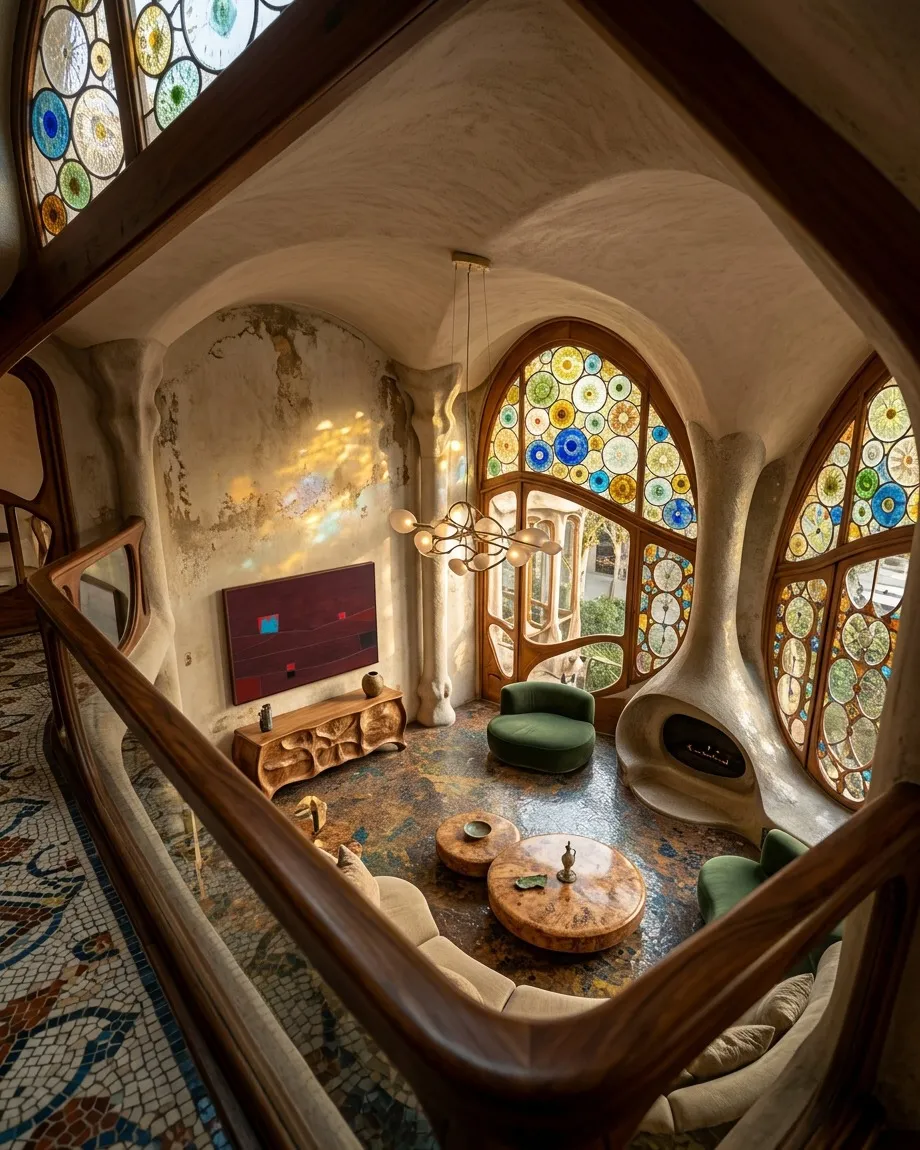
FISSURA Painting by Maurizio Valch in Modernist Room
From the wooden railing of the mezzanine, the gaze descends toward a living room of sinuous shapes and circular stained glass windows where golden light filters with an almost liquid delicacy. Amid that plant-like and organic fluidity, the rectangular presence of FISSURA introduces a gravity of an entirely different order. There is no story here to explain the crimson color or the incisions that cross it; what is immediately perceived is a state of absolute concentration that halts the movement of the surroundings. The canvas does not describe melancholy, isolation, or resistance, but holds those states physically through its material density, acting as a visual anchor that absorbs and concentrates the vibration of the space.
I am often asked what that small turquoise shape suspended near the upper incision means, as if the painting were a riddle with a solution hidden in my memory. When I hold the awl and scrape the wet layer of oil to reveal what lies beneath, I am not thinking of a past pain or a psychological explanation that must be illustrated for the viewer. I seek an exact pressure, a material boundary that opposes resistance to the hand. That block of color is not a symbol of salvation or hope, but a temperature colliding with the weight of the purplish crimson; it is the instant when the material itself becomes pure tension, without any need for words to justify it.
This way of condensing experience without translating it into anecdotes connects with the sensibility of Antoni Tàpies, for whom the rough surface or the marked wall was not the stage of a representation, but the very body of the event. In the context of this modernist room, where the architecture seems to breathe and curve, the 120-centimeter canvas functions as a condensation that claims its own space of silence. The fine incised lines crossing the dark field are not paths intended to guide the viewer toward a narrative resolution; they are the physical trace of a cut, the record of a force trapped in the thickness of the pigment and shown without explanation.
Seeing the work hanging on that aged plaster wall, under the reflection of the colored glass, I understand that the canvas has ceased to belong to me to become a completely autonomous presence. There is no message to decipher or personal wound to be narrated; the painting simply offers its own resistance to the emptiness of space. The process of accumulating layers and then eroding them with the spatula does not seek to create an image that illustrates a prior thought, but to build a territory where emotion stops being an internal voice and becomes a weight, a relief, a vibration that sustains itself before the light of day.
Observing the painting from the distance imposed by the height of the railing allows one to understand that emotion does not require a linear narrative to become perceptible. It is felt before it is understood geometrically, like a dense mass that dialogues with the circular stained glass windows without letting itself be dissolved by their colors. The unstable balance of the small blocks of color over the incision does not narrate danger, but embodies the fragility of the moment. It is in this renunciation of explanation that the work acquires its true dimension: a silent threshold that tells nothing and, precisely because of that, allows everything to remain contained on its surface.
- Original artwork
- FISSURA
- Actual dimensions
- 47.2 × 31.5 in / 120 × 80 cm
- Presentation
- Digital contextual visualization
Context references
crimson red abstract painting living room · contemporary minimalist abstract painting · large format abstract art living room · Maurizio Valch artist FISSURA · modernist interior design with art
About this visualization
This visualization places the artwork within an architectural context to help collectors and viewers imagine its presence in a real space. It is an interpretive reference, not an exact reproduction: the original work remains the sole authority for scale, color, surface and material presence.