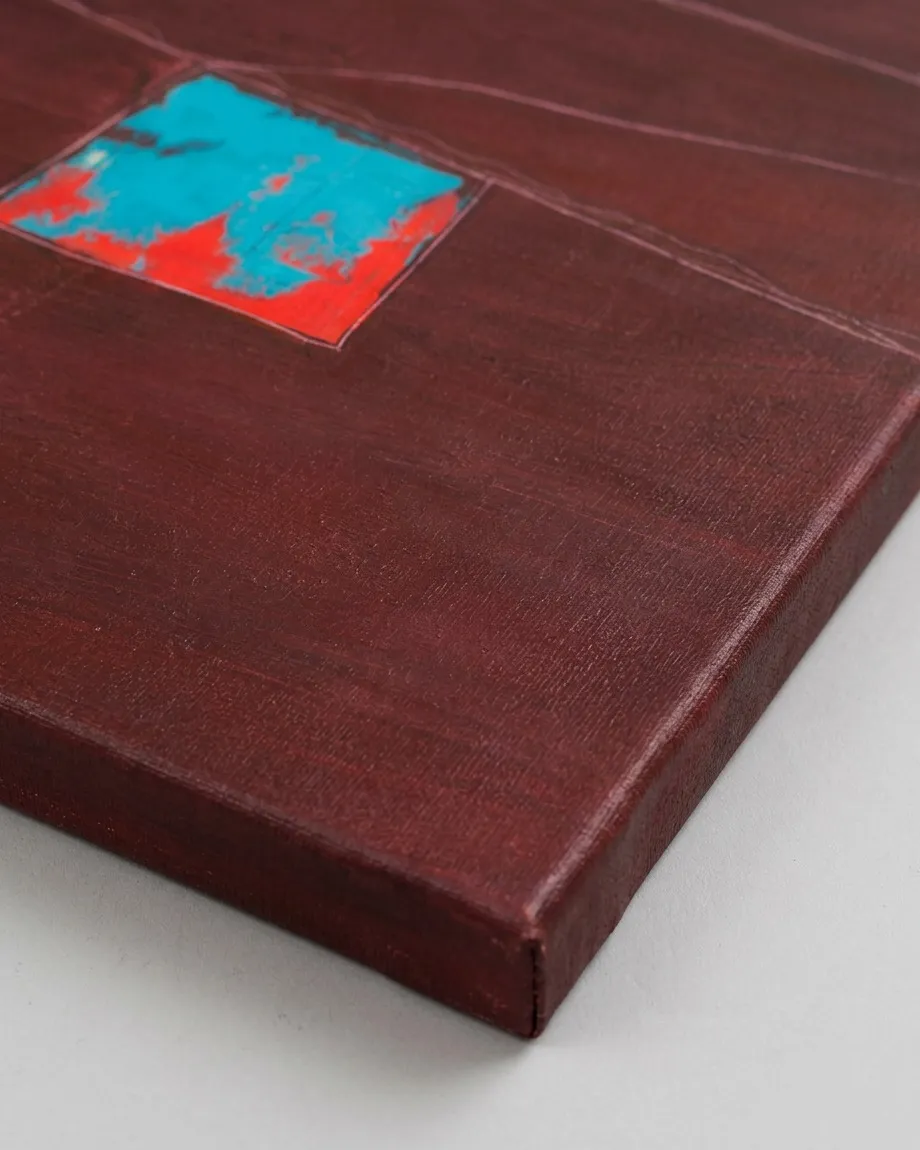
Context study / FISSURA
Incision and Texture Detail in FISSURA | Maurizio Valch
A clean cut in the material is not just a visual accident; it is a chronological decision that interrupts the continuity of silence. In this detailed shot of FISSURA, the crimson plane, dense and textured like time-weathered leather, is violently contrasted by the insertion of a turquoise and incandescent red quadrant. Observing the work from this extreme proximity, where the weave of the canvas and the thickness of the oil paint become almost tactile, it becomes clear that the painting does not function as an abstract representation, but as a physical autobiography devoid of anecdote. Maurizio Valch's life is not narrated here through recognizable events—there are no dates, no names, no explicit geographies—but is sedimented within the material's own resistance, in the superimposed layers that have been covered, salvaged, or definitively cleft by the palette knife.
How much of what we consider our identity is nothing but a silent accumulation of strata we prefer not to disturb? When I sink the stylus into the wet oil surface to trace these incised lines, I am not drawing a boundary in space; I am opening a rift in my own memory. Each furrow crossing the canvas is a physical mark, a trace of transit that needs no explanation of its origin to certify that something has occurred. By scraping away the dark pigment and revealing the light underlying the lower layers, the painting process becomes an exercise in material honesty: an excavation where the act of painting replaces the need to explain my story through words.
The absence of a sequential narrative in Valch's work shifts the viewer's reading from illustrated biography toward somatic resonance. This way of understanding painting as a body that retains its scars finds a deep echo in the work of Antoni Tàpies, for whom the wall or the textured surface functioned as records of time and existential wear. However, where the Catalan artist emphasized the trace of debris and the calligraphy of accident, Valch maintains a stricter geometric tension. The turquoise block, imprisoned and defended by its burning red perimeter, is not a fortuitous spot; it is a containment structure, a redoubt of pure light struggling not to be buried under the weight of the besieging crimson.
I do not seek to construct an idealized self or offer an illustrated theory about my internal conflicts; I paint to see the workings of my own resistances. This luminous quadrant standing out on the surface is a transitory refuge, a small plot of order I needed to raise against the tide of a background that always threatens to absorb everything. In the end, the painting returns an uncomfortable truth that literature or psychology often attempt to soften with comforting explanations: that the solidity of our convictions is as precarious as this block suspended over an incision, and that coexisting with the fracture is the only way to inhabit the territory given to us.
The scale of the work in its actual presentation—a stretcher whose three-centimeter edge extends the color and the cut to the sides—reinforces this condition of painting as a three-dimensional object sharing our own physical space. By dispensing with the frame and leaving the edges exposed to the play of light, FISSURA abandons the category of illusory window to present itself as an autonomous monolith. The artist's biography dissolves into this objecthood: it no longer matters what specific event caused the wound, but rather the fact that the surface has survived the pressure. The artwork remains before us as a territory that does not pretend to be intact, inviting those who observe it to lay down the demand for a coherent narrative and rest in the honesty of their own fissures.
- Original artwork
- FISSURA
- Actual dimensions
- 47.2 × 31.5 in / 120 × 80 cm
- Presentation
- Digital contextual visualization
Context references
close-up oil texture · canvas and textured painting detail · incised lines in abstract painting · thickness of abstract paint
About this visualization
This visualization places the artwork within an architectural context to help collectors and viewers imagine its presence in a real space. It is an interpretive reference, not an exact reproduction: the original work remains the sole authority for scale, color, surface and material presence.