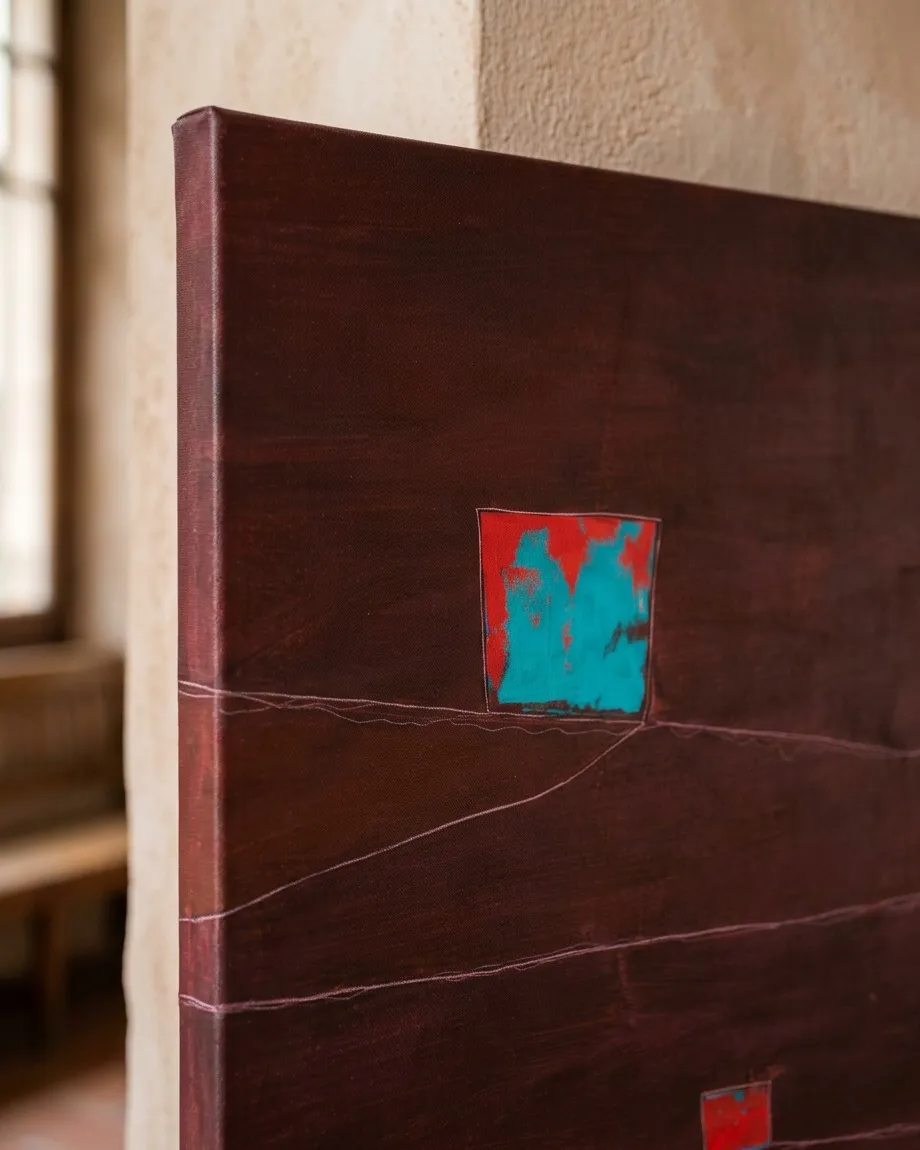
Context study / FISSURA
FISSURA Detail - Maurizio Valch | Texture and Incision
Guide to crossing a fissure that might not exist
Imagine the painting is not hanging: it is lying on the floor, at ankle height.
Step forward slowly and try not to step on the light lines; it is not yet known whether they are fragile cracks, tense threads, or boundaries deciding whether they separate something or hold it together.
The dark red occupies so much space that it is not easily called a background. It seems to spread sideways, beneath your feet, even toward the wall from which it was thought to be separate. It is not a surface that receives small shapes: it observes them. It lets them appear without immediately granting them a function.
A pale line seems to lead to the left. You follow it with your eyes and it quickly ceases to be a path: it thins, veers, stumbles into another, becomes a seam. Perhaps it joins two tensions of the field. Perhaps it tries to close something that does not want to close. Perhaps it trembles because it cannot bear to decide which side it is on.
I approach these lines without being able to fix them. Sometimes I feel them as an opening and other times as the mark of something that has been carefully gathered. I do not want to force them to choose too soon between crack, route, or boundary. A small shape began to weigh more than its size allowed, and since then the field ceased to be a peaceful extension: it seemed to withdraw from me, as if the painting had understood something else before I did.
The larger rectangle, turquoise and red, does not settle: it appears. Its edge seems to propose a stability that the rest of the surface rejects. There is something red at its top, something turquoise occupying a wider area, and a dark vibration preventing it from being seen as a clean figure. It could be a room without an interior, but the idea dissolves when looking at it again. It could be a measure, though no known body seems to fit it.
Ailton Krenak matters here because he helps look at a territory as a living presence and not as available space.
Under this gaze, the dark red stops behaving as a support. It does not offer itself to be measured, partitioned, or crossed. It observes whoever tries to measure it. Nor are the lines simple divisions: each seems to hold the memory of a wounded, refined, or interrupted relationship. They do not necessarily separate one part from another; sometimes they are the place where two parts discover they were never entirely separate.
The eye goes from left to right. It finds the turquoise rectangle, descends toward a line that forks, follows a detour toward the lower area, and thinks it recognizes a horizon. But the horizon duplicates: there is another lower down, fainter, and another that fails to form because it curves, breaks off, brushes against a neighboring line. Returning to the left, the first rectangle no longer seems close. It seems placed at a distance that cannot be measured in centimeters. The two smaller red bodies, scattered to the right and below, do not reduce this distance: they make it stranger.
A child, leaning close to the ground, asks: “Why does the turquoise rectangle have a red part on top, as if it had to breathe through a hole the others haven't found yet?”
The question forces us to stop looking at shapes as signs. The upper red spot is no longer an identification mark or a decorative detail. It seems like a difficulty in breathing, but also a possibility of exchange: the turquoise is not alone within itself, nor does the red remain outside. The smaller rectangles, predominantly red, might be waiting for that opening or might not need it. Their smallness does not make them weak; it makes the size of everything else uncertain.
Hassan Fathy matters here because he thought of building from climate, local materials, and the dignity of inhabiting.
Before these small bodies of color, a material question arises: how does a tiny construction modify the breathing of an immense field? It is not a matter of deciding that the rectangles are buildings. Rather, they force us to try out the idea of shelter and withdraw it. One could be a refuge that does not protect; another, a room without thickness; another, a measure of scale rebelling against scale. Their edges promise a threshold but do not let you through. They seem to offer shade, although there is no certainty that any creature could remain beneath them.
Krenak is suspicious of this impulse to make the territory inhabitable. Before raising a threshold, perhaps we should listen to what that red extension is saying, what relationship the lines hold, what interruption does not ask for repair. Fathy, however, insists on the necessity of a situated body: there is no listening suspended in the air; listening is also having a place to rest one's weight, where to shelter, from where to look without turning the ground into property.
The discussion finds no reconciliation. Instead, it alters the fissure. It no longer seems to be between a supposed landscape and a possible architecture. It opens between two ways of being: one that fears domesticating too quickly what is alive, another that fears abandoning the body to the exposure of a listening without a threshold. The light lines do not resolve the dispute. Every time they seem to unite both positions, they reveal themselves as a border; every time they seem to separate, they reveal themselves as a seam.
Now the painting returns a question to me that I cannot resolve from outside it. There is an area I do not feel entirely mine, a strip where the fissure stops looking like a wound and becomes a form of attention. The turquoise figure resists receiving a house, a name, or a function; the more I try to bring it closer, the more the distance from which it looks at me changes.
The lower dark zone holds another kind of instability. It is not simply shadow or depth. It makes the upper lines seem less secure, as if they were traced on a surface that can shift slightly. The head tilts to follow a fine line, and in that gesture, the breath is held for a moment: not out of fear of falling, but from the feeling that the ground may have already moved before the body notices it.
Perhaps the turquoise rectangle is the most distant of the three, even if it is higher up. Perhaps the smaller red shapes do not move away, but remain in another scale of proximity. Perhaps the red field is a wall, a skin, a horizontal night, or something that does not yet accept any of those words.
Return to the pale line passing below the turquoise rectangle: near its left edge, where it seemed straight, it begins to veer as if it had just remembered it was not alone.
- Original artwork
- FISSURA
- Actual dimensions
- 47.2 × 31.5 in / 120 × 80 cm
- Presentation
- Digital contextual visualization
Context references
oil painting texture · incisions in oil · abstract painting details · color fields and lines · close up abstract art
About this visualization
This visualization places the artwork within an architectural context to help collectors and viewers imagine its presence in a real space. It is an interpretive reference, not an exact reproduction: the original work remains the sole authority for scale, color, surface and material presence.