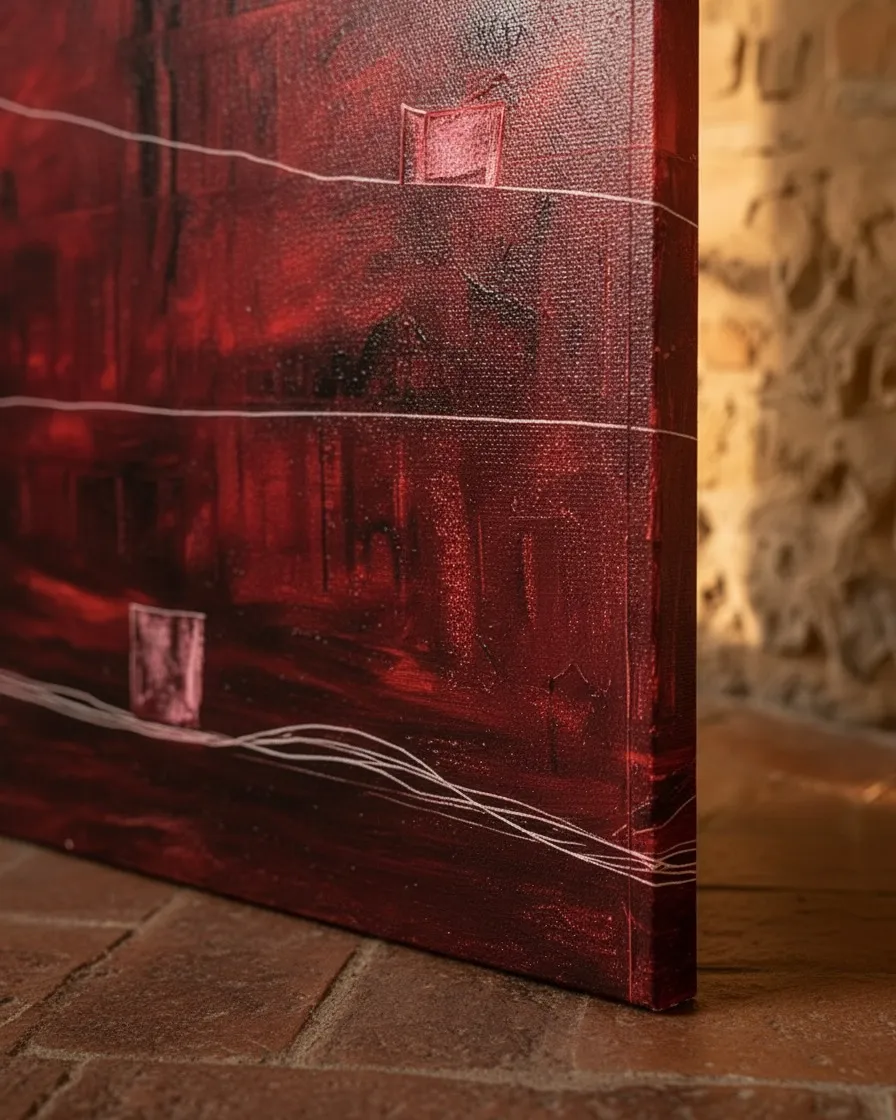
Context study / DISPERSA
Detail of texture and incised lines in Maurizio Valch's DISPERSA
From the height of the top edge, DISPERSA looks like a wall encountered at nightfall: not a wall that encloses a room, but one that is still deciding on which side the elements are happening. The blackened red does not allow itself to be called a background. It accumulates, recedes, and presses forward again from denser zones; it has something of a vertically trapped climate. The gaze searches above for a point of rest and finds a first thin, barely tilted white line that crosses the darkness without dominating it. It could be a wire stretched between two buildings that are no longer there. It could be a seam holding together a surface on the verge of opening. It does not indicate an exit; it merely implies that someone, at some point, calculated a distance.
A little further down, near that line, a pale form appears: a small, crooked rectangle with an interior that does not quite clear up. It is best not to ask what it represents. It is best to ask what responsibility it installs. Since it has been there, the surface can no longer be merely surface: it has to answer for its weight, for its suspension, for the possibility that it might fall or that no one might recognize it. Shigeru Ban is a Japanese architect capable of imagining dignified shelters with modest materials and temporary structures. Faced with this small light body, Ban would not look for an allegory but for a problem of support: where it rests, what holds it up, how long it could remain in that position without becoming a threat to whoever lives beneath. But the white line passes too close and too far at the same time. It seems neither a beam nor a reliable rope. It seems like a promise traced before knowing what it was meant to carry.
The second white band, more tense, crosses the painting at mid-height and changes the atmosphere. It no longer seems a simple line accompanying the dark field: it forces one to measure. It divides without establishing two clear zones. It connects without guaranteeing communication. Faced with it, a child's question interrupts the seriousness of the plane: “If that little square falls asleep, why doesn't it fall?” The question does not ask for interpretation; it demands an inspection of the ground. Suddenly, the upper rectangle no longer seems a possible window or a torn label: it seems like something that has a body, weariness, and an absurd need to remain suspended.
Ban would have to temporarily abandon the language of loads and joints. There is no satisfactory structural answer for a place where that which must be protected does not even touch the support. And the painting does not offer the tranquility of a ruin either: here there is no construction that has failed after functioning. There is an arrangement prior to use, a sort of evacuation plan drawn for an emergency whose inhabitant has not yet arrived. The red, meanwhile, does not warn or threaten; it surrounds. It makes the space feel narrower than it is, like a dark room where a rope is stretched between two points that move when someone tries to fix them.
I look at the distance between the lines and the small light spots, and I feel that the space has become less obedient than I expected. I sense a tension that continues to grow even though I can no longer order it. I approach a rectangle and fail to give it a definitive place; I move away and still cannot return it to the background. I receive a silent resistance from the painting, as if it preserved a distance that does not depend on me.
In the next level, the red thickens and the lines seem to have been forced forward. That is where Emmanuel Levinas enters. He is a philosopher for whom the presence of another person obligates before it can be reduced to an idea. Faced with those small rectangles, Levinas would suspect Ban's haste to turn them into habitable units, modules, minimal rooms, or bodies to be housed. To name them too quickly would be to make them manageable. And perhaps these light presences are unsettling precisely because they do not accept being entirely useful: they do not say if they wait, if they have been abandoned, if they look from an impossible distance, or if they are proof that someone tried to inhabit this surface without managing to settle.
However, the painting also obliges us to distrust an ethics that remains suspended with them. If each light figure demands care, what happens when there is nowhere to support it? Levinas may warn that no rectangle should be reduced to a function; Ban may respond that vulnerability without support risks turning into contemplation. In this intermediate zone, neither wins. Ban discovers that a structure is not useful simply because it stands: it can be perfectly calculated and yet receive no one. Levinas discovers, with some discomfort, that the obligation toward the newcomer needs something more than attention: a shadow, a breathable distance, a line that might not save but at least does not block the way.
Lower down, another white line extends like a half-made decision. It no longer crosses the field with the firmness of the first ones; it trembles, shifts, and seems to graze the shapes without gathering them. The network begins to be visible. Not a protective net, but a net of incompatible decisions: to leave open or to close, to stretch or to withdraw, to separate to prevent a fall or to bring closer so that something can be reached. Ban's architecture would want to attempt a shelter here, even a precarious one. Levinas would ask him not to confuse shelter with possession. Between the two remains the lowest rectangle, pale and slightly heavy, as if it had descended too late to receive help.
It is no longer known whether it is hung, retained, lost, or waiting. Its edge seems to touch a line and, at the same time, reject it. The gaze feels a physical discomfort before this lack of support: the desire to push it gently toward a more stable place, just as one adjusts a wobbly chair in someone else's room. But any imaginary gesture would be excessive. If placed on the line, perhaps it ceases to be that which obliges one to look. If allowed to fall, perhaps it confirms an indifference that the painting has managed to make unbearable.
I breathe more carefully when I return to this lower part. I do not fix the shapes because I feel that, by fixing them, I also distance them. I maintain a distance that is not abandonment and I do not call shelter what cannot yet protect. I accept the discomfort of looking at a small presence without knowing if it expects support, passage, or silence.
In the final band, the white threads multiply and lose the obedience of the previous lines. They cross, open, and turn back on themselves; they no longer organize the verticality, they dismantle it. They look like routes, but none leads clearly. They look like seams, but the fabric they should repair continues to open. They look like cables, though no one could trust them to carry energy or sustain weight. The dark red does not yield beneath them: it remains pressure, depth, a night that does not finish becoming night.
There, the evacuation plan stops indicating an exit and begins to record a more elemental difficulty: how to prepare a place without deciding in advance who deserves to occupy it, how to stretch something between two points when neither accepts being fixed. The lower lines are not horizons. They are the instant when a structure, in trying to touch ground, begins to come apart or to invent itself anew.
- Original artwork
- DISPERSA
- Actual dimensions
- 31.5 × 47.2 in / 80 × 120 cm
- Presentation
- Digital contextual visualization
Context references
close up canvas texture painting · incised marks on oil paint · abstract painting details
About this visualization
This visualization places the artwork within an architectural context to help collectors and viewers imagine its presence in a real space. It is an interpretive reference, not an exact reproduction: the original work remains the sole authority for scale, color, surface and material presence.