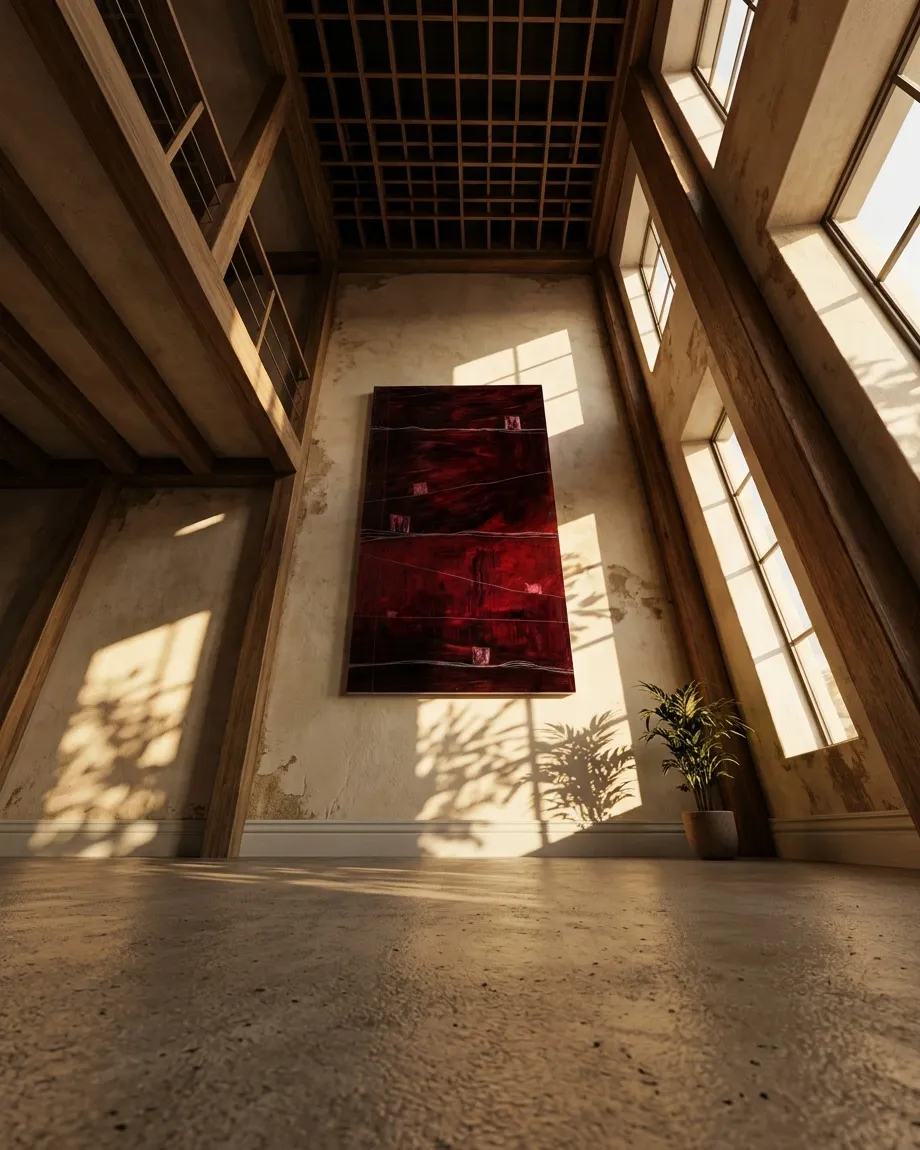
Context study / DISPERSA
DISPERSA — Context Study
The artwork DISPERSA imposes itself upon the gaze not as a mere two-dimensional surface, but as a container of sediments where the dark crimson-red color operates with the density of living matter, a geological stratum retaining a latent, accumulated heat. This background is not a passive plane; it is a thick, almost tactile atmosphere vibrating with a contained temperature that seems to emanate from the interior of the canvas. Upon this chromatic, almost magmatic mass, a network of fine incised lines unfolds horizontally across the composition. These incisions do not function as mere graphic marks or decorative dividing lines; on the contrary, they act as tension filaments or suspended cords that demand from the viewer an exercise of deep visual listening. They are like the traces of an emotional and physical seismograph, where the cut into the red matter generates a dull vibration that interrupts the dense silence of the background. Contemplating the work thus requires fine-tuning the ear of the eye to perceive how space is rent and how tension propagates along these thin channels that structure the chaos of color.
When I face the canvas, the pictorial act is transformed for me into a battle of subtraction rather than accumulation; I seek to make way by scraping the still-wet matter, patiently penetrating the dense strata of oil paint to reveal the hidden support. This gesture of incising firmly upon the surface is, at its heart, an exercise of absolute surrender: I consciously decide to renounce decorative addition and the millimetric control of the brush, allowing the palette knife or the metal stylus to follow their own organic course and find their natural decline upon the canvas. I remember perfectly how the suffocating heat of the studio and the heavy viscosity of the red pigment opposed a stubborn physical resistance to my hands, demanding a purely bodily and exhausting dialogue with the material. Each line I managed to trace was not a cold calculation, but a clean and necessary wound engraved by hand, an indentation that now proudly sustains the tension of the entire plastic space and bears witness to that hand-to-hand combat with painting.
From both a formal and conceptual perspective, the dispersion in this work is articulated through the presence of small geometric blocks or niches that seem to hang or settle precariously upon the horizontal incised lines. Within these minimal elements lies a suggestive paradox of abandonment: on one hand, they resemble uninhabited boxes or vestiges of a dismantled architecture drifting in a crimson abyss; on the other, they find an exact hold, an almost miraculous refuge upon the subtle network of incisions. The physical distance and empty space separating these modules is not inert space; rather, it activates a temporal dimension that functions through the listening of intervals. Like the silences in a musical syncopation, it is precisely the absence of matter between the blocks that gives meaning and rhythm to their dispersion along the tense thread, converting the void into an active presence that structures the vertical reading of the work.
Once I bring the process to an end and decide that the work is finished, I witness the detachment from DISPERSA with a mixture of respect and strangeness, especially when I see it leaning against the workshop floor on bricks or bare wood under the changing light of day. In that moment I assume my own abandonment as a creator, accepting that the painting has ceased to belong to me to begin existing on its own in the physical world. Sitting before it in absolute silence, I surrender to an attentive listening of its purely objectual presence: I observe how the incised lines, which now look like autonomous, whitish scars, react changeably to the natural light from outside, and I perceive that the very dense heat projected by the crimson is no longer the reflection of my physical effort in the workshop, but a mysterious radiation of its own emanating from this three-centimeter-thick, three-dimensional object that I have released forever.
Ultimately, DISPERSA reveals itself as a tactile and conceptual shoreline where the concepts of heat, listening, and abandonment converge to bestow a secret order upon what seemed fragmented. The apparent disconnection of the blocks suspended at different heights finds its internal logic in the network of scars that sustains them, demonstrating that the dispersion of existence can be contained by invisible but firm threads. To fully inhabit the chromatic wound of this canvas, the viewer must set aside the rigidity of their intellectual gaze and renounce the search for Cartesian exactitude. What is required instead is an act of generous surrender of protective judgments and prejudices, allowing oneself to be enveloped by the latent, rough heat of the pictorial matter—a surface that only reveals its true depth to those who prepare themselves to sustain an attentive listening, stripped of all interpretive noise.
- Original artwork
- DISPERSA
- Actual dimensions
- 31.5 × 47.2 in / 80 × 120 cm
- Presentation
- Digital contextual visualization
Context references
brutalist design with paintings · double height wall decorating ideas · red and wood artistic painting · large painting for contemporary living room · original artwork on high wall
About this visualization
This visualization places the artwork within an architectural context to help collectors and viewers imagine its presence in a real space. It is an interpretive reference, not an exact reproduction: the original work remains the sole authority for scale, color, surface and material presence.