Context study / DISPERSA
DISPERSA — Context Study
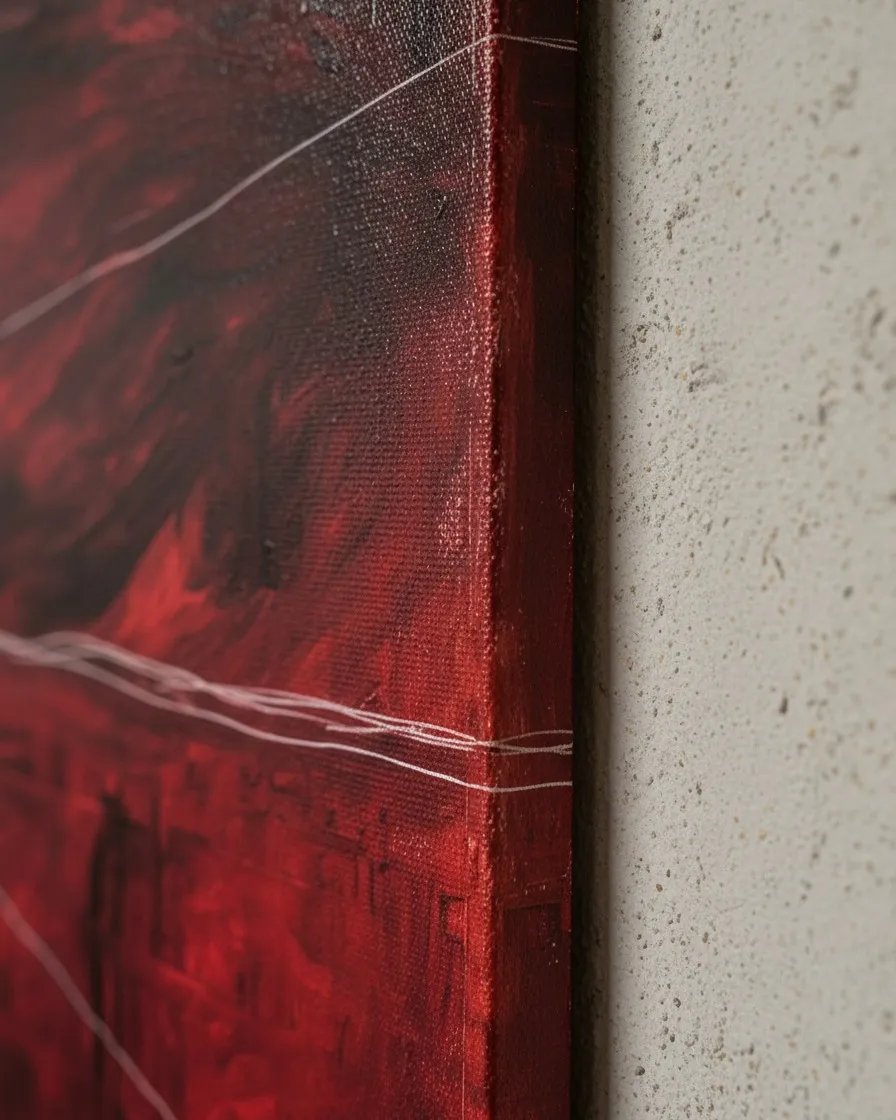
In DISPERSA, the pictorial plane of one hundred and twenty by eighty centimeters becomes a convulsed geography where matter and emptiness fight a silent battle. The surface, built from a dense vibration of oil and acrylic, fluctuates between an open wound, the raw flesh of territory, and the solemn shadow of a primitive sanctuary under deep crimson, vermilion, and black tones. This chromatic field, pulsating with an almost visceral energy, is drastically interrupted by thin horizontal white lines that are not mere strokes but physical incisions on the wet paint—grooves acting as high-tension wires or precarious shelves. On these marks, or floating a millimeter away from them, are small, pale, luminous pink quadrangular blocks. The mathematical rigidity of these incisions enters into direct tension with the solitude of these isolated fragments, evoking the memory of the first human settlements on the European continent, when the foundational gesture of marking the ground with a furrow or a fence constituted the only archetypal means to delimit the external chaos and claim a plot of order from the menacing immensity of nature.
When confronting the canvas, my hand seeks the physical resistance of the material; the act of drawing the white line is not a two-dimensional drawing, but a controlled aggression, a real incision that penetrates the superimposed layers of oil and acrylic to reveal the light of the background or leave a scar in relief. I look for a telluric weight in the density of the red, a gravity that imprisons or expels the forms. In my working process, the grid does not emerge as a cold geometric imposition, but as a desperate attempt to order the wild. These small pink blocks that I place with obsessive precision are born from constant uncertainty: I do not know if they are firmly settled on the ground I have drawn for them or if they float in a weightless drift, suspended over a crimson abyss that threatens at any moment to dissolve their fragile geometry into pure material dispersion.
This spatial arrangement opens a channel of theoretical discussion between the mystic G. I. Gurdjieff—whose sharp critique of daily mechanicalness reminds us that the human being usually functions as an automaton within prefabricated structures—and the psychiatrist Carl Gustav Jung—whose theory of the collective unconscious and the process of individuation describes the painful path of differentiating oneself from the crowd. Confronting the work under this prism, one wonders if these horizontal incisions and the blocks that cling to them represent the relentless social machinery of the "sleeping man," subjected to levels of repetition and constrained by railroad tracks of predictable behavior. Or if, on the contrary, each of those tiny, luminous pink blocks personifies the heroic effort of the Self to awaken from its lethargy, to erect a singular consciousness and resist the temptation to dissolve into the archetypal, blood-colored tide roaring around it.
With these fragments, I seek to question the concept of Situs, the quality of occupying an exact place in space and memory no matter how small the scale of our presence. Observing them, I know I have not painted houses, tombs, or temples in a figurative way, yet I sense that they harbor the ancestral weight of all those human constructions, reduced to their minimal volumetric expression. I wonder if I have configured a cartographic map of the dispersion of our lives in the territory or if, in a more intimate way, I have drawn an X-ray of the necessary distance we must maintain between us—that indispensable safety strip to preserve individuality against the imminent risk of being devoured by the suffocating murmur of the common background.
Returning the gaze to the overall plane of DISPERSA, the visual tension is reactivated under the perspective of Osho—a philosopher who fiercely defended the existential freedom of the individual against any control system seeking to standardize lived experience. From this stance, the fate of the pink blocks becomes ambiguous: it is impossible to determine with certainty whether they are imprisoned in the lines of this score of tensions or if, on the contrary, they use the very rigor of the line as an indispensable springboard to propel themselves toward authentic liberation. The painting, in its silent but deafening vibration of crimson color, does not offer reassuring answers, but rather confronts us directly with the canvas, leaving us suspended before the unsettling question of what position we ourselves occupy within this vast geography of waiting.
- Original artwork
- DISPERSA
- Actual dimensions
- 31.5 × 47.2 in / 80 × 120 cm
- Presentation
- Digital contextual visualization
Context references
oil painting close up · artistic texture detail · incised marks on canvas · painted canvas edge · textured crimson painting · palette knife artwork
About this visualization
This visualization places the artwork within an architectural context to help collectors and viewers imagine its presence in a real space. It is an interpretive reference, not an exact reproduction: the original work remains the sole authority for scale, color, surface and material presence.