Context study / DISPERSA
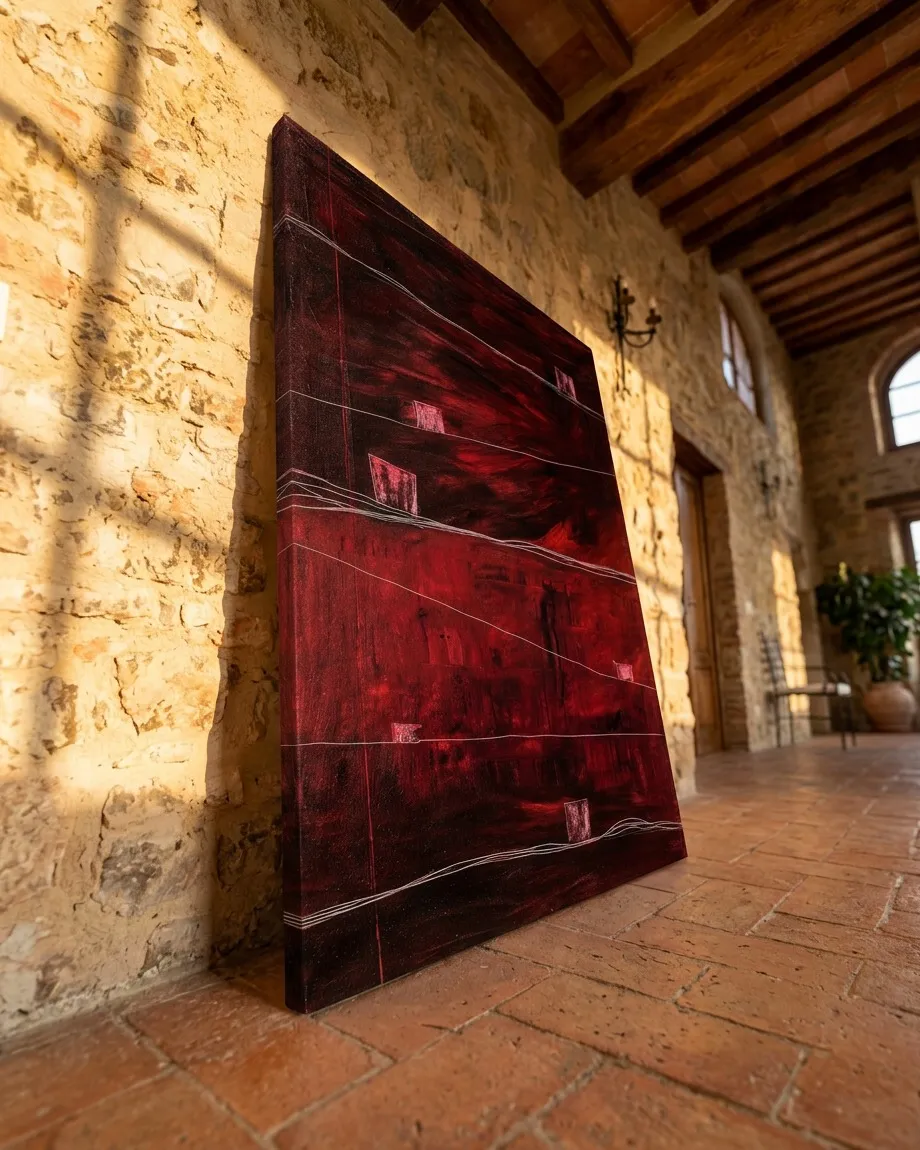
DISPERSA Abstract Painting on a Rustic Brick Floor
DISPERSA imposes itself in its verticality of eighty by one hundred and twenty centimeters as a surface where color is not mere support, but a dense mass of crimson, dark reds, and eroded blacks that vibrate with the opacity of dried blood or a latent fire beneath the ash. The texture, scratched and stratified, is crossed by fine, light-colored horizontal incised lines that furrow the canvas with the fixity of high-voltage lines over an unpopulated horizon or the lines of a disassembled musical staff. These incisions introduce an almost structural tension, evoking the perspective of G. I. Gurdjieff, the Armenian philosopher and mystic who rigorously analyzed the mechanical nature of human existence and the condition of the individual as a sleeping automaton subject to external forces. Valch's horizontal lines operate in a similar way: they present themselves as predetermined rails, fixed and inevitable trajectories that drag matter and time in a linear inertia. Faced with this geometric rigidity, the small quadrangular blocks that appear suspended over the filaments or floating in the chromatic void act as detours or anomalies; they are small strongholds of awareness attempting to halt the continuous flow, seek a provisional anchor, and rebel against the blind traction that seeks to assimilate them into the path.
In the solitude of my studio, the creation of this work began as an exercise in pure material accumulation, a physical dialogue with the resistance of the support. I superimposed successive layers of acrylic and oil, alternating dense black with crimson red to create a geological stratum of color that I later decided to violate. For me, the light line crossing the plane does not arise from a brushstroke or a purely ornamental intention, but from a direct incision, a clean cut with which I tear the accumulated pigment to reveal the white wound beating underneath. It is at this point that the series acquires its true physical dimension; I am not looking to trace a cartography of the Mediterranean or appeal to a floating historical memory here, but to respond to the urgent need to establish a minimal territory, to delimit a physical place where the body can position itself and resist dispersion. By placing those small light blocks on the cleft of the canvas, I experience a sense of precarious balance, as if I were depositing a heavy object on a tightrope, desperately seeking for matter to find its own gravity before space dissolves it.
When contemplating these geometric blocks that inhabit the surface, it is inevitable to link their presence with the notion of refuge developed by Gaston Bachelard, the French philosopher dedicated to the poetics of space and the exploration of intimacy in the most minimal corners of the home. These small light cubes operate as the elemental scale of the house, three-dimensional nests of conceptual resistance that attempt to shelter subjectivity in the midst of a red abyss that devours everything. However, this search for asylum dialogues conflictually with the concept of separation or differentiation postulated by Carl Gustav Jung, the Swiss psychiatrist who delved into psychic fragmentation and the process of individuation. From this analytical perspective, the red and black background of the painting functions as a representation of the collective unconscious, a boiling mass of shadows and unintegrated archetypal memory; the quadrangular blocks, by separating themselves from this chromatic magma through the incised line, perform a necessary act of separation. Dispersion, far from being solely a symptom of isolation or uprooting, is then revealed as the indispensable distance, painful yet structuring, that allows individuality to begin to exist and define itself against the surrounding chaos.
As I observe the arrangement of these elements on the canvas, I understand that the true core of my work does not lie in the blocks or in the lines that support them, but in the silence and the distance that separates them. My own biography, marked by constant transit, displacement, and resettlement in different territories, is projected into this pictorial space where proximity or distance between forms determines their survival. Therefore, I deeply distrust closed interpretations or readings that seek a comforting mysticism in my compositions; for me, painting does not consist in illustrating a journey back to a lost spiritual unity, but in rehearsing an elemental physics of permanence. What is at stake here is the pure tension between the almost brutalist rigor of the incised line, which imposes a cold and alien direction, and the inherent fragility of each of the blocks, which seem to float under the constant threat of losing their balance and sinking permanently into the density of the red background.
The general composition of this work resonates with a latent historical memory, subtly referring to the first attempts of human beings to cartograph and order their environment. There is a formal continuity between the abstract marks our ancestors carved on the walls of Paleolithic caves and the birth of the first musical notations and maps of the medieval era, those primitive systems designed to trap the ephemeral flow of sound or delimit the immensity of physical territory. In this painting, that silent staff does not serve to intone a melody or guide the traveler, but to delimit a space of waiting and temporary suspension where time seems to have frozen. By shunning any comforting conclusion or moralizing lesson on the human condition, the work holds itself in its own material fixity. It is precisely through this economy of resources, where a few precise incisions and a handful of small light blocks are distributed across a plane one hundred and twenty centimeters high, that the observer is placed on the exact threshold where the density of pigment transforms into theoretical speculation and geometric distance inevitably becomes destiny.
- Original artwork
- DISPERSA
- Actual dimensions
- 31.5 × 47.2 in / 80 × 120 cm
- Presentation
- Digital contextual visualization
Context references
large format abstract art leaning · decorating with rustic minimalist paintings · rustic interior with contemporary painting · red painting on brick floor
About this visualization
This visualization places the artwork within an architectural context to help collectors and viewers imagine its presence in a real space. It is an interpretive reference, not an exact reproduction: the original work remains the sole authority for scale, color, surface and material presence.