Context study / DISPERSA
Abstract Painting DISPERSA in Modern Living Room | Maurizio Valch
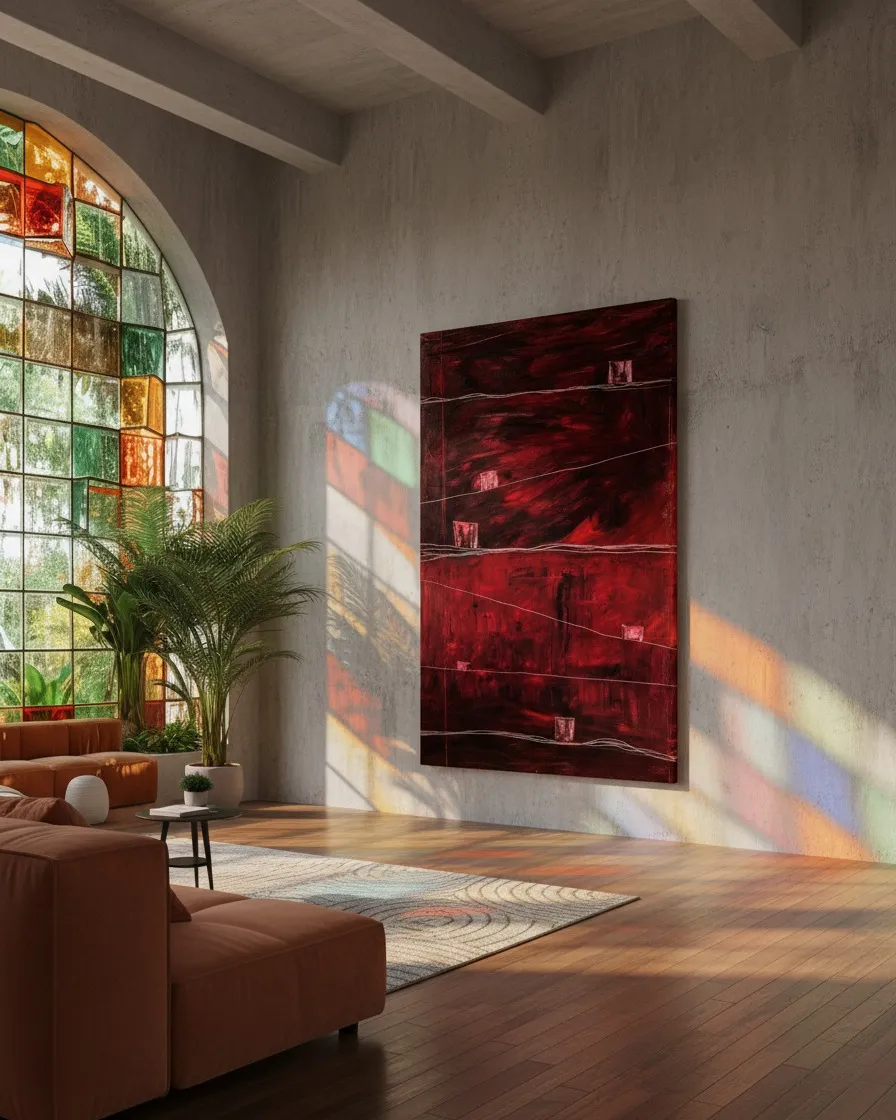
The colored light filtered through the stained-glass window projects onto the bare concrete wall, grazing the dense crimson surface of DISPERSA. In this scene, the large-format painting does not act as a decorative object, but as a tactile presence that claims its own space. This visual confluence between the changing architectural atmosphere and the stillness of the canvas illustrates how painting can become a record of life without needing to narrate it. There are no travel scenes here, no specific faces, nor chronicles of uprooting; yet, all of Maurizio Valch’s biography—his constant nomadism, the fatigue of his long walks, and the sedimentation of his experiences—is inscribed within the dense layers of pigment, suggesting that a life can be evoked not through a linear narrative, but as a territory that has accumulated time, pressure, and wear.
When I walk for hours in the open air or when I am forced to begin anew in an unknown territory, I do not gather anecdotes to tell later. What remains in me is a physical trace, a specific fatigue in the body, the thermal sensation of a boundary, or the memory of a transient room where I am no longer who I was but have not yet become the next.
In the incisions that cross the crimson surface of this work, there are no geographical maps that can be followed with a finger; they are rather the direct trace of that disorientation, the silent testimony of having navigated spaces where the only certainty was movement itself.
This approach to the work as a non-narrative autobiography places Valch in affinity with the materiality of Antoni Tàpies, for whom the canvas also functioned as a wall or a skin marked by the passage of things. However, while Tàpies sometimes surrenders to the informalist chance of the accident, Valch maintains a geometric restraint where the small suspended blocks act as handholds or convictions trying to resist the gravity of the decline. The artist's life is revealed in the painting not as an intimate diary of recognizable events, but as a structural tension: a private geology where thought has hardened into blocks and memory has ceased to be a sequence of recollections to transform into a dense ground, eroded by the creative process itself.
Sometimes I have tried to construct a grand theory about myself, to turn my existence or my art into a kind of heroic quest of self-improvement. Yet, when facing the canvas with the palette knife and scraping the fresh oil paint to discover the white base, that character of the hero simply crumbles; the incision does not add a heroic drawing, but subtracts matter, clearing away the excess. It is in this physical subtraction where I find my true biography: an exercise in shedding where I renounce explaining myself to others to simply sustain my gaze before what remains, before this impenetrable ground that needs no justification to exist.
Contemplated from the distance offered by the space of high ceilings and rough textures, DISPERSA finally reveals itself as a tactile shore where boundaries touch and time passes in a different way. The falling lines and the blocks hanging from them do not ask to be translated using a dictionary of closed symbols; instead, they invite us to inhabit a silence that has understood its own noise. By renouncing the explicit narrative, the painting offers a refuge for the invisible, a navigation map discovered by subtracting, allowing the viewer to encounter not the painter's foreign story, but the gravity of their own presence in the present.
- Original artwork
- DISPERSA
- Actual dimensions
- 31.5 × 47.2 in / 80 × 120 cm
- Presentation
- Digital contextual visualization
Context references
large format living room painting decor · crimson abstract paintings · original artwork in minimalist living room · Maurizio Valch original painting · contemporary wall art
About this visualization
This visualization places the artwork within an architectural context to help collectors and viewers imagine its presence in a real space. It is an interpretive reference, not an exact reproduction: the original work remains the sole authority for scale, color, surface and material presence.