Context study / DECLIVIS
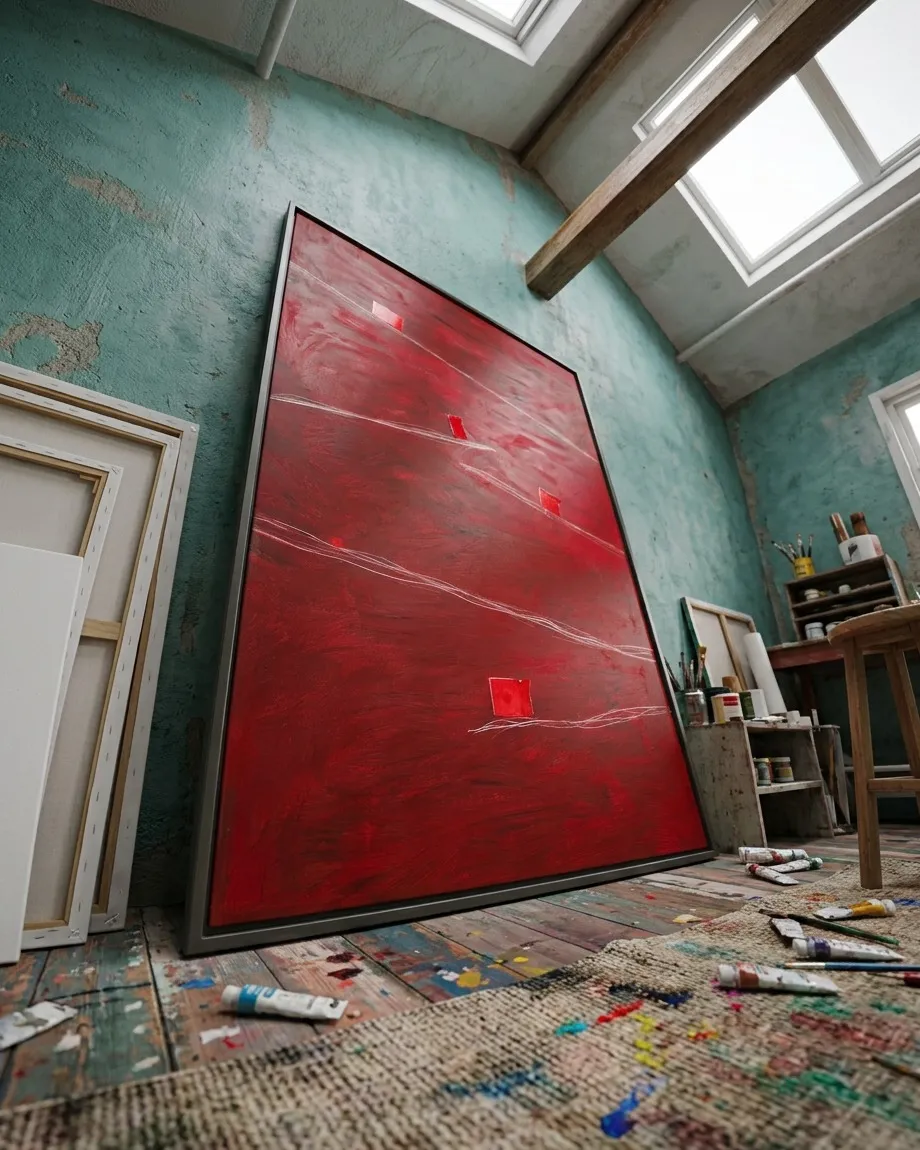
DECLIVIS Abstract Canvas by Maurizio Valch in Bright Studio
Paragraph 1: The temperature of the plane and the imminence of the slide (Third-person voice)
Maurizio Valch’s DECLIVIS stands before the viewer as an imposing chromatic field of force where matter does not merely occupy space, but physically alters it. The dense crimson dominating the canvas, worked with a vigorous palette knife and a palpable tactile accumulation, radiates a latent warmth that transcends simple optical perception to settle in the observer’s body as a somatic vibration. Furrowing this great, inflamed plain, thin white lines, obtained through direct incision on the still-wet paint, trace oblique and slightly sinuous paths that destabilize any attempt at a rigid geometric order. Upon these incised lines sit, with striking precariousness, small quadrangular blocks of a more vibrant and saturated cadmium red, which seem to surrender to a slow process of sliding. There is no desire for containment or orthopedic symmetry here; the entire composition is governed by the physics of the clinamen, inviting an experience of surrender where the elements do not fight against the gravity of the plane, but choose to slide with a sensual passivity down the oblique slope of the canvas, revealing the beauty of a path defined solely in the act of letting oneself fall.
Paragraph 2: Matter under the fingernail (First-person voice - Maurizio Valch)
For me, the gestation of DECLIVIS began with the physical resistance of the accumulated oil, a thick mass of crimson pigment that demanded to be mastered not through contemplation, but through tactile confrontation with the palette knife. When I decide to trace the white lines that furrow the canvas, I am not making a superficial drawing, but performing a deep excavation, a painful and sensual scraping that penetrates the wet layers to reveal the purity of the support hidden beneath the paint. This violent yet delicate gesture plunges me into a state of absolute listening, where my body must attune to the tension of the canvas, the dull sound of the blade carving its path, and the consistency of the color opposing its own strength. The warmth emanating from the binders and the physical friction in the studio becomes an active agent that alters drying times, forcing me to constantly negotiate with chance. At that point in the process, I understand that painting is a radical exercise in the surrender of my own pretensions of control; I must renounce the neatness of the straight line and allow the hand to respond to the untamed relief of the matter, letting the incisions find their own organic declivity on the wounded surface.
Paragraph 3: The syncopation of marks and the silence of space (Third-person voice)
The rhythm of DECLIVIS is not organized through a traditional harmonic structure, but through a visual syncopation that constantly interrupts the flow of color. The small red blocks suspended along the incisions act as scattered notes on a silent score, fostering an exercise in visual listening where the viewer must attend not only to the obvious marks, but to the weight of the emptiness separating them. There is a subtle anomaly in the distribution of these squares: while some seem to temporarily stabilize on the white lines, others slide imminently toward the margins, suspended in the vast crimson desert. This formal tension activates the surrounding space, preventing the gaze from resting on a fixed vanishing point. The enveloping warmth of the red background acts as an atmospheric binder unifying these tensions, transforming the painting into a "tactile shore" where the viewer is drawn to hold their breath, caught in the precise instant before gravity precipitates the definitive fall of the elements, making the surrounding silence an almost physical presence.
Paragraph 4: Returning to the cleared floor (First-person voice - Maurizio Valch)
The moment I decide that DECLIVIS is finished always coincides with a detachment bordering on strangeness, a definitive act of surrender in which the object ceases to belong to the intimacy of my creative process to become an autonomous monolith. Placing it on the studio floor, stripped of the tyranny of the easel, I watch how the painting begins to breathe on its own, interacting rawly with the imperfections of the architecture and the shifting light entering through the window. My role as creator then shifts toward a receptive, passive listening, contemplating how the painting assimilates the environment, the suspended dust, and the shadows cast by the wooden beams onto its textured surface. The dense crimson skin I built with so much physical effort now reveals itself as a vulnerable surface, exposed to the judgment of the outside space and the friction of time. Delivering this work, with all its concentrated warmth and exposed scars, is to accept the fragility inherent in matter, agreeing that its true meaning will only be completed when I am no longer there to justify it or defend it from its own destiny.
Paragraph 5: Integration into the tactile shore (Third-person voice)
Ultimately, the contemplation of DECLIVIS dismantles the intellectual distance that usually separates the viewer from the artwork, forcing a purely somatic immersion. The confluence of the dense warmth emanating from the crimson matter, the attentive listening to the rhythmic pulse beating in the white incisions, and the conscious surrender of conceptual certainties invite the viewer to inhabit the canvas as a navigable physical territory. Valch’s painting does not function as a representation or a window into an outside reality, but as a rough and uneven surface where the gaze slips, stumbles, and is forced to descend along the slope of the oblique lines. By renouncing the rigidity of the perfect horizon, the work proposes a profound lesson in material honesty: that the true vitality of a form lies not in its capacity to remain immutable and erect, but in the beauty of imbalance, in the acceptance of imperfection, and in the silent eloquence of a consented descent into the unpredictable.
- Original artwork
- DECLIVIS
- Actual dimensions
- 31.5 × 47.2 in / 80 × 120 cm
- Presentation
- Digital contextual visualization
Context references
large painting for studio · painter studio decor · crimson abstract work · Maurizio Valch DECLIVIS · canvas leaning on the floor
About this visualization
This visualization places the artwork within an architectural context to help collectors and viewers imagine its presence in a real space. It is an interpretive reference, not an exact reproduction: the original work remains the sole authority for scale, color, surface and material presence.