Context study / DECLIVIS
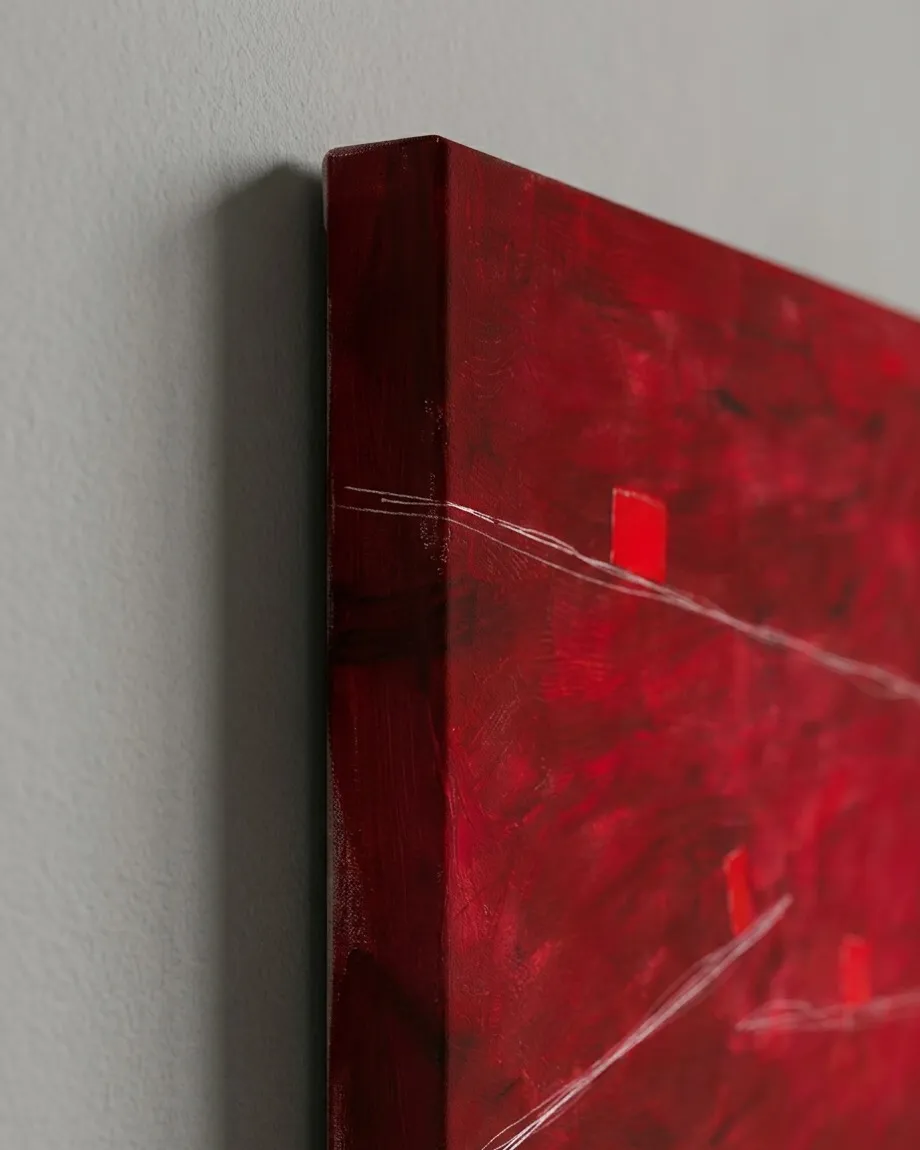
Edge and Texture Detail of DECLIVIS Painting
The first gaze should not enter through the center. It is best to begin at the top, where the red already seems to have accumulated pressure before being seen: a deep red, thick without being stable, with areas that darken as if the air had brushed the surface and left a shadow there. It is not a background. Nor is it a fixed climate. At times it warms the gaze; at times it compresses it. One must let the eye find one of the light lines and accept its tilt.
The line descends. Not cleanly: it curves, hesitates, thins, recovers a bit of light, and continues. At first, it may seem like a path, the record of something that passed through too quickly or too slowly. The eye follows it and discovers that descending is not the same as arriving. The line does not lead to a floor; it leads to another distance within the red. Near it, a small, lighter red shape interrupts the field. It seems halted mid-decision.
Look at it for a few seconds. Only that shape. Ask, with the serious logic of a child: why does something so small not finish falling in such a tilted place?
It is best not to answer just yet. The question begins by being almost amusing: a minuscule rectangle resisting, like a stubborn object refusing to obey the slope. But immediately the red surrounds it again, and the tilt becomes less obvious. Perhaps the shape is not suspended on a slope; perhaps it is the slope that has tilted around it.
Louise Bourgeois. She was an artist who turned memory, bodily vulnerability, and unsettling forms into spaces where an emotion could find architecture.
With that presence nearby, the lines cease to be simple paths. One of them seems too tense to be called a composition: it separates two areas of red, but also holds them together; it protects something, or keeps it at a distance. The white fragility does not reassure. It is a fragility that can cut. Between one line and another, a narrow interval opens where the eye feels it could become trapped, as if the painting had arranged a minimal railing at the edge of a fall that never quite declares itself.
The first gaze descends along these threads and discovers that the red does not merely receive the lines: it presses against them. Each one seems on the verge of yielding, sinking, dissolving into the temperature of the field. Yet, they remain. Not as victorious marks, but as a delicate defense. Bourgeois introduces an uncomfortable suspicion: perhaps nothing is falling. Perhaps the entire surface is containing something that wants to escape beneath its own lines.
I do not find the red still when I look at the work again. I recognize it as a space shifting before my eyes, modifying the distance between the lines, even when apparently nothing changes. I doubt the stability attributed to the red field: sometimes it seems to support the small shapes, and other times it seems to expel them toward an area I cannot see. I resist the idea that the surface has finished deciding its tilt.
The second gaze begins lower down, where a light line crosses the red with less certainty, almost as if it had lost confidence in its own path. It no longer seems like a trajectory. Now it could be a scar: not the sign of an explained injury, but a separation that the surface cannot fully close. Its whiteness does not have the purity of a signal; it has the weakness of something exposed.
The lighter red rectangles, seen again, are not the same either. One seems to approach the line; another seems to remain behind it; another can barely be distinguished, as if the deep red wanted to reabsorb it. None touches a ground. None finds a definitive edge. The childish question becomes stranger: if they do not fall, what keeps them in that position? There is no visible support. No platform. Only the tilted field, the fragile lines, and a kind of minuscule resistance.
Then appears György Ligeti. He was a composer who imagined masses of sound, overlapping rhythms, and music where movement can be felt before it can be counted.
The painting does not become music; it becomes harder to measure. The light lines no longer descend at the same speed. One slides down; another lingers; another seems to move laterally while pretending to tilt. The eye tries to gather them into a single movement and fails. There is a visual polyrhythm: non-coincident descents, delayed tensions, red interruptions entering out of time.
Each small rectangle then functions as a cut that does not obey the neighboring trace. They are not notes placed on a staff, because the staff itself is tilted, eroded, on the verge of losing its rules. But something of that comparison insists: the lines do not organize the field; they throw it off balance. The rectangles do not mark a beat; they throw it off. One falls slower than another. One could be rising while the rest descend. One seems to have arrived too early at a place that does not exist.
Bourgeois objects to that listening. Not every tremor must become rhythm. A line can vibrate because it holds a too-intimate separation, not because it participates in a structure of speeds. This objection alters the gaze on the line crossing near one of the light shapes: it is no longer just a string taut between two incompatible times. It can also be an edge, a precarious protection, a distance someone has traced to avoid touching what threatens to overflow.
But Ligeti, in turn, deforms that protection. If the line protects, it protects in several times at once. If it separates, it does not separate all at once. The nearby red shape does not wait at the edge of the line, nor does it move away from it: it pulses at a different speed. Its immobility becomes active. It does not rest; it insists.
I do not know if that small shape interrupts the lines or if it is the lines that fail to reach it. The area where it stays close to a light thread has become independent of me: it returns a pressure in the chest, a sort of delay in the gaze. I can understand the tension Bourgeois recognizes and I can hear the displacement Ligeti opens, but the rectangle does not fully accept either reading. It returns the question of its weight without showing me where it deposits it.
The third gaze forces a slower descent. It is no longer about following lines like someone following a path. It is best to lose them a little. Let them disappear into the red and reappear lower down. When searched for too intently, they become strings stretched too tight; when allowed to escape, they become edges of a slope that has no single direction.
The red, meanwhile, ceases to feel like a uniform extension. It becomes closer in some areas, almost breathable; in others, it compacts and takes away air. It does not possess a single emotion. It can draw the eye in and turn it away at the same instant. It can open a space and then narrow it around a line. The discomfort does not come from a hidden story, but from that visual temperature that forces a certain distance and, at the same time, makes it impossible to withdraw completely.
The four smaller, lighter accents reappear as occurrences that never quite coincide. They do not form a reliable sequence. They are not stations of a fall. Even so, the eye counts them, loses count, counts them again. One presents itself as a door too small to pass through. Another, like a game piece someone left on a tilted table. Another has the quiet insolence of an object that knows it should slide, yet waits.
The fourth gaze begins where the previous one lost its balance. A white line moves away toward a lower section of the red and seems to lose itself without concluding. Near it, the proximity of a light rectangle no longer seems accidental. The line could be passing in front. It could be passing behind. It might not pass near it at all: the eye produces that neighborhood because it needs to measure something.
The question has changed. It is no longer only about why the shapes do not fall. The tilt has ceased to be an external law; it has become a tension distributed among lines, red, and pauses. The difficult thing now is something else: what are they holding as they descend? Perhaps they hold the interval between one line and the next. Perhaps they hold the compressed breath of the red. Perhaps they hold, with a ridiculously small force, the impossibility of the painting becoming a single descent.
At the end where a light line thins to almost nothing, the red does not absorb it completely. An uncertain strip remains, barely a proximity between thread and rectangle, as if both had halted their relationship an instant before touching.
- Original artwork
- DECLIVIS
- Actual dimensions
- 31.5 × 47.2 in / 80 × 120 cm
- Presentation
- Digital contextual visualization
Context references
painted canvas edge · oil painting border · red paint texture · abstract work close-up · three centimeter stretcher bar
About this visualization
This visualization places the artwork within an architectural context to help collectors and viewers imagine its presence in a real space. It is an interpretive reference, not an exact reproduction: the original work remains the sole authority for scale, color, surface and material presence.