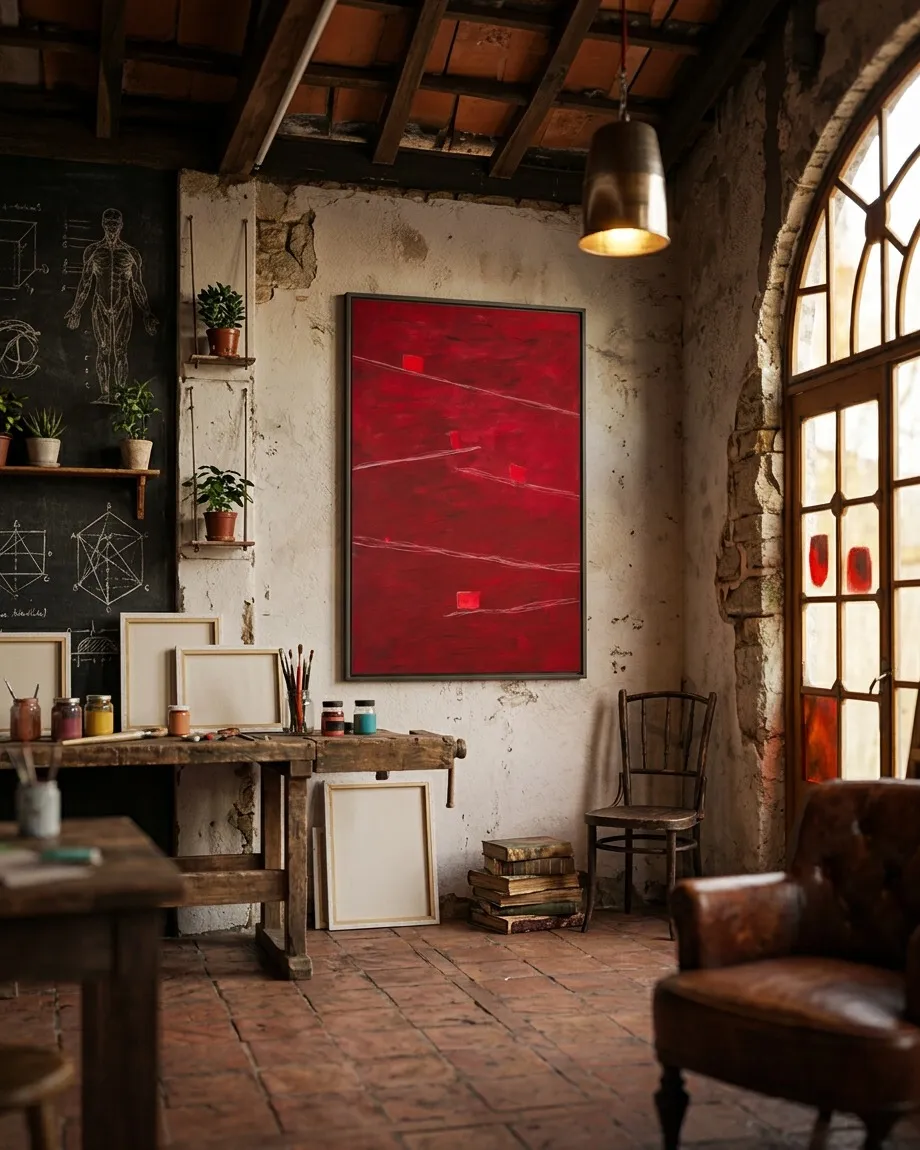
Context study / DECLIVIS
Red Abstract Painting DECLIVIS in Rustic Decor
DECLIVIS
At the beginning, there is no fall. Only a pause before a red that does not quite settle. The gaze enters and believes it has found a field; soon it discovers that the field changes in thickness, harboring denser areas, barely withdrawn veils, and dark spaces that do not allow themselves to be crossed with the same ease. The format is vertical, but the vertical offers no rest: something within it has begun to tilt.
First stop: at the top, a small red shape seems to have halted halfway through a decision. It does not occupy much space, but it alters the scale of everything else. It could be an uninhabited house, reduced to its most obstinate facade. It could be just a rectangle that has learned to retain the air around it. It does not fall. It does not even seem to be fighting the fall. It is simply there, with a calm too compact for the territory surrounding it.
A pale line passes nearby, descending slowly, as if it had lost the certainty that going down consists of arriving somewhere. The gaze follows it and slips slightly. Then it returns upward, searching for the red shape it left behind. The distance between the two is not great, but the eye takes its time to cross it.
At this point, Piet Mondrian appears as a painter who sought to reduce the world to essential relationships of line, plane, rhythm, and balance. He tries to measure: how much red supports the red, what emptiness separates one interruption from the next, what tilt a vertical can tolerate before it ceases to be vertical. But the lines of DECLIVIS do not agree to become a geometric city. They do not organize: they hesitate. They seem like trajectories that began with precision and, slowly, lost confidence in their own path.
When the lines began to descend, I wanted to look at them as distances rather than directions. The red forced me to approach and withdraw without finding a definitive position; the tilt seemed to change depending on how long I remained in front of the surface. I thought I was searching for a balance between minimal presences, but upon finishing the work, I felt that something had shifted beyond my calculations: I did not know if the small shapes were halting the slope or if it was the slope that was watching them.
Second stop: further down, another red shape interrupts a line like an error that refuses to correct itself. It has something of a displaced sign, a piece placed a few millimeters out of place and, precisely for that reason, impossible to ignore. The surface does not expel it. Nor does it fully receive it. It remains embedded in an area where the red thickens and opens up at the same time.
Then a child's question arises, formulated without care for theories: why do lines get tired of going down before the little squares do?
There is no adult answer that improves upon that question. The pale lines, so thin, so fragile, might seem lighter and therefore freer; yet they are the ones that give way, deviate, and extend as if searching for a ground that does not exist. The small shapes, on the other hand, hold their position without showing effort. What kind of gravity keeps them from falling, even when everything around them seems to tilt?
The next descent is not long. It is a grazing. A kind of tightrope that crosses the red and leaves the gaze without a safe handrail. The breath becomes short: follow the line, lose it; return to the field, notice that the field is also moving.
Tom Waits is a musician and composer who turns harsh voice, noise, improvised percussion, and lost characters into ways of listening. Here, he hears the lines before seeing them: untensioned strings, a glass vibrating on the edge of a table, the friction of something dragged without quite falling, percussion that enters late and breaks off. For that listening, the painting does not go down: it stumbles. Each oblique has a short breath, a small creak of direction.
But that music disarms itself before the red interruptions. They make no noise. They do not respond to the rhythm of the lines. Their immobility is radical: they offer no impact, echo, or vibration. Where listening expects a minimal oscillation, it finds a stillness it cannot register. Mondrian’s measurement wanted to order that stillness; Waits’s listening wanted to turn it into an event. Neither succeeds in claiming it.
Third stop: a red shape, slightly lower down, looks like a note displaced on a staff that has decided to tilt. It does not sing. It does not complete any melody. Perhaps it is out of place; perhaps the place has moved around it. If stared at too long, it ceases to be a note and becomes a small thing that forces the entire field to recalculate its weight.
The friction between both methods leaves a third gaze, less elegant and more uncomfortable. It is not about measuring the slopes or listening to them, but about noticing how the body instinctively searches for a support that the painting does not grant. The physical vertical of the canvas remains; the internal slopes do not. The eye wants to straighten them. The red resists this correction. The lines slide. The shapes stop. Between both gestures, a minimal physics appears, still unnamed.
The possibility that these shapes are not on the painting but are that which sustains it discomforts and attracts me. If I consider them supports, all the red around them begins to look more vulnerable; if I consider them intruders, the surface recovers a tension I do not want to resolve. I cannot decide whether they contain the descent or make it possible, and that indecision modifies my way of remaining before the work.
Then, another line goes down with a different slowness. It no longer seems like a trajectory but the remains of one: a trace of movement retained in the instant before disappearing. It crosses a more veiled area of red, barely asserts itself again, and leaves an open distance toward the final interruption.
Fourth stop: the small lower shape does not seem to have arrived; it seems to have survived the slope. It does not triumph over it. It does not contradict it. It remains with the reserve of something that has been exposed to continuous displacement and has decided not to explain how it sustained itself.
From there, the first shape reappears in the eye’s memory. It can no longer be seen as a house, though it may retain that possibility for a moment; nor as a simple suspended rectangle. It has become the first link in a chain of stops that neither ascends nor descends entirely. Each changes the weight of the others. Each forces the nearest line to appear less certain.
What remains, in the end, is a concrete zone: the oblique distance between the last red shape and the pale line passing above, without touching it. In that minimal interval, there is no ground. There is no fall either. There is a gravity as yet unknown, sufficient to tilt everything and yet incapable of moving that which remains.
- Original artwork
- DECLIVIS
- Actual dimensions
- 31.5 × 47.2 in / 80 × 120 cm
- Presentation
- Digital contextual visualization
Context references
abstract painting for rustic living room · decorating with contemporary art · framed red painting · large wood wall painting · Maurizio Valch collectors
About this visualization
This visualization places the artwork within an architectural context to help collectors and viewers imagine its presence in a real space. It is an interpretive reference, not an exact reproduction: the original work remains the sole authority for scale, color, surface and material presence.